

By MARCUS MOORE
If you thought Alaska’s destiny was in the hands of Alaskans, think again. The 2024 IRS filings paint a picture that is both stark and troubling: the state’s political and economic landscape is increasingly being steered, not by our local industries, communities, or elected leaders, but by an intricate web of out-of-state progressive donor networks. Networks that aren’t content with writing checks, they are buying influence, shaping narratives, and redirecting our state’s future from resource-driven growth to grant-dependent activism.
We’ve been warning about this for years, but now the numbers are out in black and white.
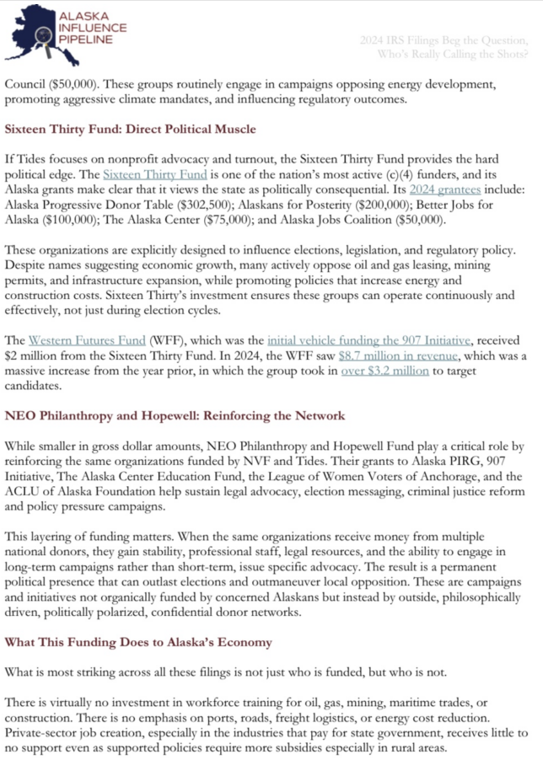
The “Alaska Influence Pipeline” report, along with IRS Form 990 filings from 2024, reveals that millions of dollars from national progressive funds, primarily connected to Arabella Advisors (which rebranded as Sunflower Services in late 2025) flow through nonprofit intermediaries to finance a highly coordinated anti-development campaign in Alaska.
And make no mistake, this is not just about “climate awareness” or “social equity.” This is about reshaping Alaska’s economic priorities in ways that serve donors in D.C., New York, and Silicon Valley, not the people who actually live here in our state!
The Mechanics of Influence: How Out-of-State Money Moves In
The system is vertically integrated, sophisticated, and, frankly, scary in its efficiency.
Here’s how it works:
- National Funders — Arabella Advisors (Sunflower Services), New Venture Fund (NVF), Tides Foundation, Sixteen Thirty Fund, NEO Philanthropy, Hopewell Fund, and Western Futures Fund, collect and pool donations from major philanthropic players like George Soros, Hansjörg Wyss, and foundations such as Ford and Hewlett. InfluenceWatch reports Arabella alone raised $6.5 billion from 2005–2021.
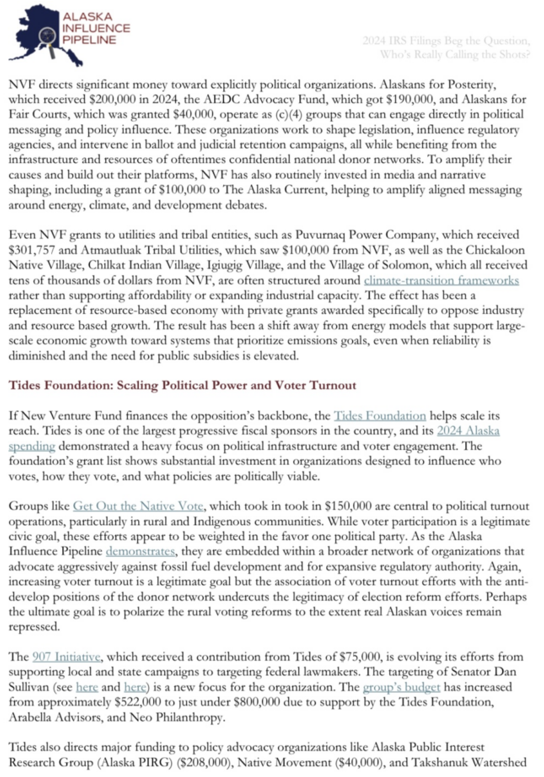
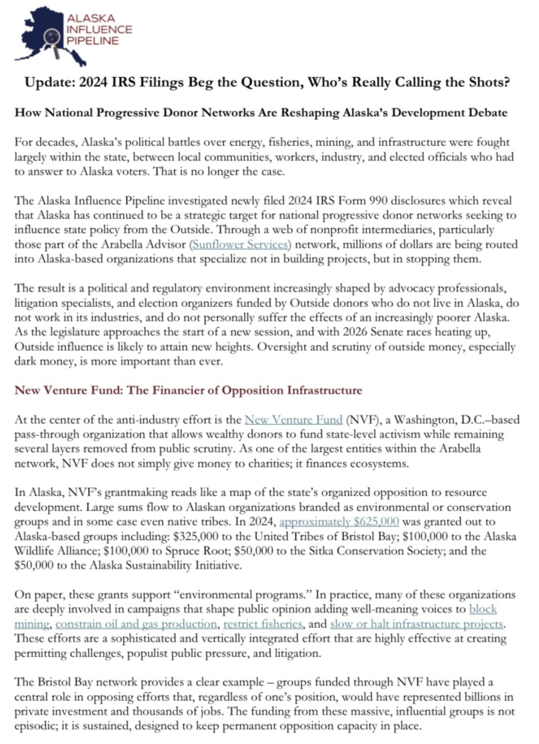
- Pass-through Grants —These national funders then funnel millions into Alaska-based advocacy groups via annual grants, explicitly earmarked for anti-development campaigns. 2024 numbers alone are staggering: NVF gave over $625,000, Tides $523,000, Sixteen Thirty $728,000. Layer on support from Hopewell and NEO Philanthropy, and you see a funding structure designed to endure.
- Local Recipients — Groups like, United Tribes of Bristol Bay ($325,000 from NVF), Alaska PIRG ($208,000 from Tides), The Alaska Current ($100,000 from NVF), and 907 Initiative (funded by multiple sources) receive these grants and direct them toward litigation, voter mobilization, and media campaigns. Workforce training for Alaskan oil, mining, or construction? Not a dime.
- Indirect Control —Through these grants, national donors influence elections, policy debates, and public opinion. Voter mobilization efforts like Get Out the Native Vote ($150,000 from Tides) target Indigenous communities with messaging that aligns with anti-fossil fuel agendas, leaving real Alaskan voices marginalized.
It’s an elaborate puppet show, with Alaska caught in the middle. And the strings are long, reaching far beyond Juneau.
Who’s Really Pulling the Levers?
The leadership and boards of these organizations read like a who’s who of progressive philanthropy.
- Arabella Advisors / Sunflower Services: Founded by Eric Kessler. Current CEO Himesh Bhise oversees operations post-2025. Former CEO Sampriti Ganguli. Board Chair Gail Steans. Senior leaders include Bruce Boyd and Allan Williams.
- New Venture Fund: President Lee Bodner (formerly Arabella MD). Board includes Thomas Gibian (Chair/Secretary), Akilah Massey, Katherine Miller (Treasurer/Vice-Chair), Chuck Redmond, and Adam Eichberg.
- Tides Foundation: CEO Janiece Evans-Page. Officers include Diane Peters (Chief Legal), Karen Caldwell (CFO), Sajit Joseph (Chief Digital). Board Chair Brickson Diamond.
- Sixteen Thirty Fund: President Amy Kurtz. Board includes Dara Freed (Treasurer), Douglas Hattaway (Secretary), Eric Kessler (Director), Jeff Cherry, and Latoia Jones.
- Hopewell Fund: President Anna Brower. Board Chair Lee Bodner. Directors include Andrew Schulz and Marissa Padilla.
- NEO Philanthropy: President Michele Lord (retiring Dec 2026). COO Erin Ballard. CFO Su Hyun Lim. Board Co-Chairs Kerrien Suarez and Kristen Ruff.
- Western Futures Fund: President Michael Hennesy, Secretary Christopher Hirsch, Treasurer Jeremy Krones.
The overlap is telling. Many of these players rotate through boards or maintain advisory roles across multiple organizations. The result? A near-monopoly on progressive funding influence, perfectly orchestrated to maintain a constant anti-development narrative.
Alaska’s Local Recipients: The Frontline
These national networks don’t just fund abstract policies—they fund people and groups directly shaping our state’s economy. Here’s the roster of key 2024 recipients:
- United Tribes of Bristol Bay: $325,000 from NVF for anti-mining campaigns.
- Alaska Wildlife Alliance: $100,000 from NVF, blocking resource extraction.
- Spruce Root / Sitka Conservation Society / Alaska Sustainability Initiative: $50–100K from NVF; anti-development advocacy.
- Alaskans for Posterity: $200,000 from NVF, $200,000 from Sixteen Thirty; political messaging.
- AEDC Advocacy Fund: $190,000 from NVF; legislative influence.
- 907 Initiative: Multiple funders, including WFF; campaigns targeting Sen. Dan Sullivan.
- Alaska PIRG: $208,000 from Tides; regulatory opposition.
- Media Outlets: The Alaska Current ($100,000 from NVF) amplifies anti-development narratives.
- Voter Mobilization: Get Out the Native Vote ($150,000 from Tides) and Alaska Progressive Donor Table ($302,500 from Sixteen Thirty).
- Other Policy Groups: Better Jobs for Alaska, The Alaska Center, Alaska Jobs Coalition, ACLU of Alaska Foundation, all receiving layered funding to maintain continuous campaigns.
And don’t overlook tribal utilities like Puvurnaq Power Company ($301,757 from NVF) and Atmautluak Tribal Utilities ($100,000 from NVF), framed under “climate-transition” projects, subsidized by grants rather than market-driven development.
The Timeline That Matters
It’s not just who is funding whom, it’s when. 2024 marks a ramp-up in preparation for the 2026 Senate races:
- Early 2024: NVF disperses $625,000, including $325K to United Tribes of Bristol Bay.
- Mid-2024: Tides grants $523,000. Includes $150K to Get Out the Native Vote and $208K to Alaska PIRG.
- Late 2024: Sixteen Thirty Fund disperses $728,000. WFF revenue surges to $8.7M, funding 907 Initiative’s attacks on Sen. Dan Sullivan.
- Ongoing 2024: NEO and Hopewell layer grants to groups like 907 Initiative and ACLU of Alaska to sustain campaigns.
Alaska has been under the Arabella network’s radar since at least 2020, including ranked-choice voting campaigns funded via Sixteen Thirty. 2024 demonstrates escalation: this is no longer occasional influence; it’s a full-on takeover of the local political narrative.
Who Feels the Impact?
The report and public filings suggest influence on three fronts. Politicians, Communities, and the Economy.
- Politicians: Sen. Dan Sullivan is the primary target. 907 Initiative, funded by Tides/Arabella/WFF, launched campaigns like “Doormat Dan” and “Yes Man Dan” highlighting his pro-fossil fuel stance and votes on health care, attempting to paint him as out of touch with Alaska. Progressive ads have hit him on ACA subsidies and Medicaid cuts. Other lawmakers face pressure from Alaska Center and Progress Alaska on renewable energy and tax policies.
- Communities: Indigenous leaders in Bristol Bay are courted via grants, which the report argues suppress local voices in favor of donor-driven agendas. Groups like SalmonState are allegedly used to weaponize issues like salmon protection against development.
- Economy: Funding is carefully structured to prioritize litigation, delays, and narrative shaping over job creation or infrastructure development. The “chilling effect” is real: permitting challenges, populist pressure, and lawsuits deter companies, shift economic priorities away from local industries, and leave Alaska increasingly reliant on grant money instead of investment.
The Ironic Twist
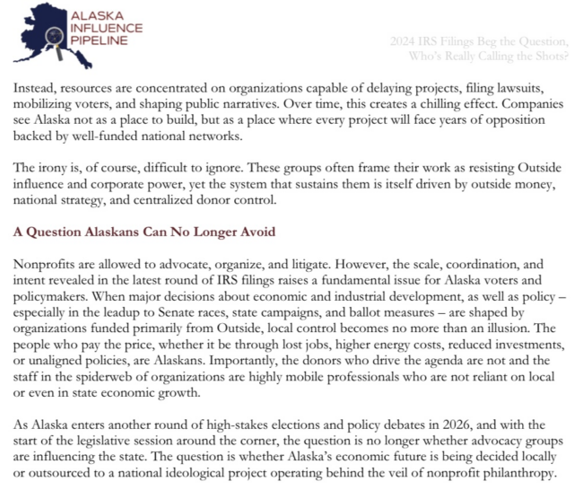
These networks loudly decry “outside corporate influence” in Alaska politics, yet every dollar sustaining their anti-development campaigns comes from national, often anonymous donors. Millions of dollars from billionaires and foundations in New York, California, and abroad dictate which projects live or die in Alaska. This is ideological outsourcing at its finest, and the 2024 filings prove it in cold, hard numbers.
I’ll finish my Rants with “Its Alaska’s Choices,” what’s at Stake
Let’s be honest. Alaska is at a crossroads. Every grant, every lawsuit, every voter mobilization effort has consequences. The 2024 IRS filings reveal a system where local autonomy is steadily ceded to donors with philosophical agendas. Workforce development in oil, gas, mining, and construction? Ignored. Infrastructure projects? Delayed. Our economy? Shifted from local initiative to grant dependence.
If you care about Alaska’s future, its jobs, its communities, its self-determination, you need to understand who is really calling the shots. National progressive donor networks have been quietly reshaping our debate for years, and 2024 marks a decisive escalation.
The question now isn’t whether Alaska can resist this influence, it’s whether we WILL sit back and let it happen in silence. It’s time to wake up. We’ve been telling you this was coming. Now, the numbers prove it.
Marcus Moore aKa Rants @AlaskanRants


