
It’s showtime for getting two federal judgeships filled for Alaska. Currently, two positions on the three-member Alaska US District Court bench are vacant, and Judge Sharon Gleason has reached the age of retirement and may open up a vacancy if she moves to the “senior judge” status. That would mean three new federal judges for Alaska.
In the process used by Sen. Lisa Murkowski, the list of applicants to the Alaska Bar Association for the two US District Court judgeships that are open included the following 12 names:
- Jessica Moats Alloway
- Joseph F. Busa
- Robert W. Corbisier
- Michael J. Heyman
- Ronald W. Opsahl
- Scott A. Oravec
- Danée Lynn Pontious
- Kyle Reardon
- Ian Wheeles
- Joan M. Wilson
- Justin R. Works
- Adolf V. Zeman
The Alaska Bar Association polled its members in February to see which of the judge applicants have the most support from Alaska attorneys to get a lifetime appointment to the federal bench.
Most of the names on the list received little support. Most of their qualifications were not known by the bar association attorney colleagues who took the poll.
Just one stood out: Activist Superior Court Judge Adolf Zeman was at the top of the attorneys’ internal poll.
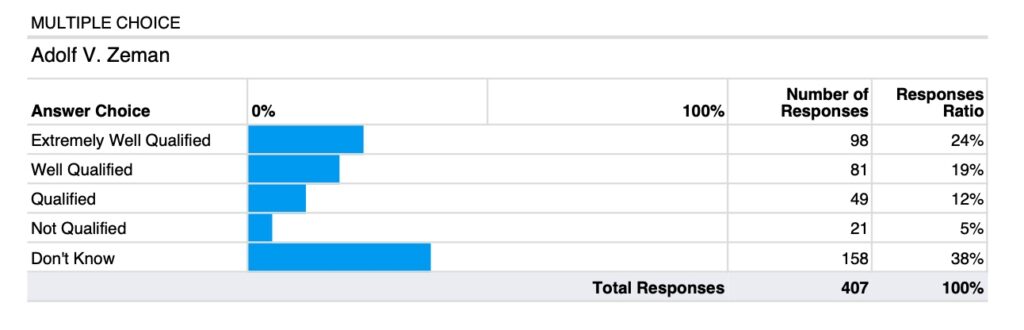
Judge Zeman as the Bar Association’s favorite for promoting to the federal bench is an interesting pick and reveals much about the association process that Murkowski uses. The Alaska Bar Association is a liberal group and 24% of those who answered the poll said Zeman is extremely well qualified, while another 19% said he is well qualified and 12% said he is qualified. No other applicant even came close.
But Zeman may be Alaskans’ second-least favorite Adolf.
Last year, he decided that Alaska’s correspondence study students were second-class citizens and could not get state support for their education unless it came from a public institution — a government school. Typically people homeschool their students because they don’t want them in government schools.
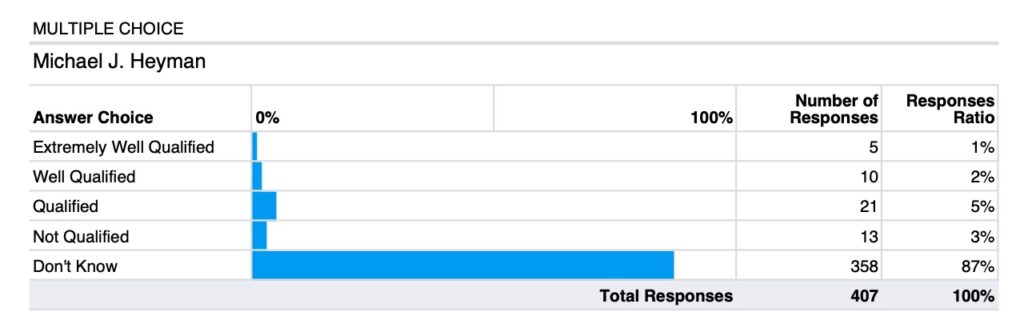
Revealing about the judgment of the Alaska Bar Association members is that applicant Michael Heyman only received 1% support as “Extremely Well Qualified.” Heyman was appointed last month to run the Alaska office of the Department of Justice by US Attorney General Pam Bondi, who is a Trump appointment. Heyman is the current US District Attorney for Alaska. One 1% of the bar association members said Heyman is extremely well qualified.
The Alaska Bar Association poll is now in the hands of Sen. Lisa Murkowski, who relies on the association for recommendations that she will make to the president. Because of her poor standing with and dogged opposition to President Donald Trump, it’s unlikely that the names she forwards will be considered. She has already forwarded one name.
Sen. Dan Sullivan has developed a different process for recommending these judgeships, something Murkowski wants no part of because it cuts out the liberal bar association.
Sullivan set up the Alaska Federal Judiciary Council in 2023 to assist the senators in recommending candidates for federal judicial vacancies in Alaska. He sees it as an alternative to the bar association process, but Murkowski said it would only slow the process down.
Sullivan aimed to use this council to identify candidates with “character, experience, and an unflinching commitment to the rule of law,” reflecting his priorities for federal judgeships.
The council is chaired by attorney Sean Parnell, a former Alaska governor and current chancellor of the University of Alaska Anchorage.
The council consists of nine members including a mix of attorneys and non-attorneys with diverse professional experiences. Notable members include Jonathan Katchen, a former federal judicial nominee; Loren Leman, former lieutenant governor; Stephen Cox, a general counsel and former US Attorney in Texas; and Kim Reitmeier, president of the ANCSA Regional Association.
The council’s process involves soliciting applications, reviewing candidates, and providing Sullivan with advice on potential nominees. Applicants submitted a questionnaire available on Sullivan’s Senate website, and the council evaluated them before making recommendations.
Sullivan will forward his preferred candidates to the White House through the “blue slip” process by which senators have influence over the judge nomination process. Sullivan’s approach follows the pattern used in 25 other states.
While 12 attorneys are on the Alaska Bar Association poll, about double the number of attorneys applied to the Alaska Federal Judicial Council, which has yet to announce its recommendations to Sullivan. Here is the link to Sen. Sullivan’s web page for the AFJC.
The process continues with the senators’ recommendations to the president, who will pick his choices; those nominees are forwarded to the Senate Judiciary Committee, which then forwards its recommendations to the full Senate for the advice and consent process. Both senators are usually consulted in the “blue slip” process that goes along with advice and consent, which means they both must agree on the nominees before the Judiciary Committee chairman (Sen. Chuck Grassley) will take up the matter.
That could be tricky, with Murkowski increasingly moving to the left.


