
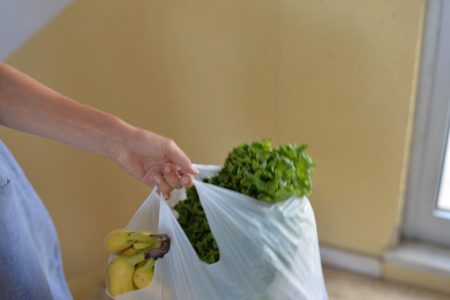
The Wasilla City Council on Monday voted to ban single-use plastic bags. That is, the council banned them from being issued by stores inside the city limits. Stores outside the city, and there are many, may continue to use them.
The lone dissenting vote on the council was from Tim Burney, who said on Facebook that he recently chose to not use plastic bags himself, “But does that give me the right as a council member to dictate to you that you can’t? This has not as much to do with the bag itself, but more of another nibble at our liberty. Frustrated is an understatement.”
Proponents of the ban said that a large number of valley residents support the ban on plastic bags because of the risk they pose to wildlife and their non biodegradable nature is a blight on the landscape.
Homer, Bethel, Cordova, and Hooper Bay have all banned single-use plastic bags. (Homer overturned its bag ban, however.)

In November, 2016, California became the first state to enact a statewide ban on single-use plastic bags at large retail stores, but the state law had to battle it out first with a voter referendum, Prop. 67. The legislation also required a 10 cent minimum charge for recycled paper bags, reusable plastic bags, and compostable bags at some establishments.
Hawaii’s most populous counties all prohibit non-biodegradable plastic bags at checkout, as well as paper bags containing less than 40 percent recycled material. Each county has some variation on it and legislation is pending to make the laws all uniform.
In 2009, the District of Columbia enacted a law to ban plastic bags. Massachusetts’ ban will go into effect in August.
Some of the major cities around the country that have plastic bag bans include Austin, Tex; Cambridge, Mass.; Chicago; Los Angeles; Seattle; San Francisco; Boulder, Colo.; and New York City.
ANDY JOSEPHSON WOULD TAX THE REST
Meanwhile, at the legislative level, Rep. Andy Josephson, an Anchorage Democrat, has introduced HB 264 to tax disposable shopping bags. Calling it a fee, the legislation would cost shoppers 20 cents for every single-use bag — plastic or paper — used to take their purchases from stores. According to the legislation, the State would take 15 cents and leave 5 cents for the store owner for his or her trouble.
The bill has no companion bill on the Senate side but will likely earn co-sponsors from House Democrats.


