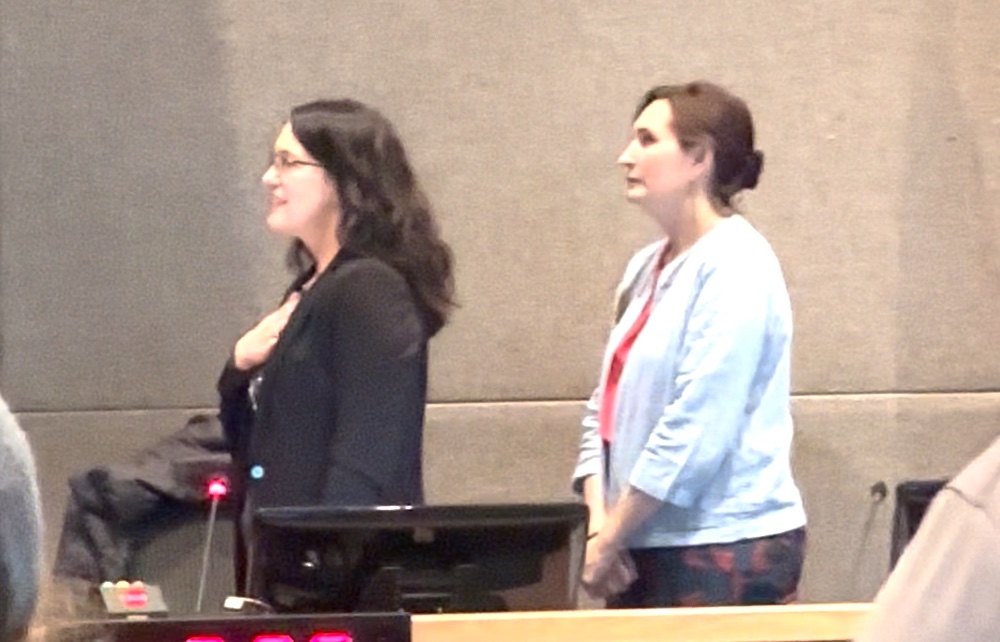
At first it seemed like a one-off at an Anchorage Assembly meeting. Now, it’s clear that Anchorage Assemblywoman Meg Zaletel, who represents Midtown and works as the czar of the Anchorage Coalition to End Homelessness, doesn’t have laryngitis. She is just not feeling the love for the Pledge of Allegiance.
Zaletel, part of the leftist leadership on the Assembly, is the only member who does not put hand over heart and at least mouth the words to the flag salute.
She does not face reelection the year, but if Zaletel becomes the Assembly chairwoman after March-April election, upon the retirement of Assembly Chair Suzanne LaFrance, she may find herself in an awkward position being the lone refusenik, unless others follow her lead.
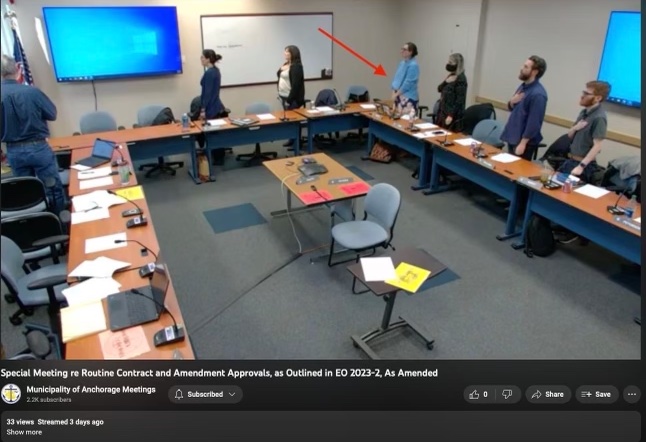
It’s Zaletel’s right as an American to refuse to recite the Pledge. Freedom of speech includes the right to not speak. But she may be the first elected official in Alaska history to stand in protest of the Pledge.
However, Zaletel would not be the first public figure in America to refuse to honor the flag. Last year, the Fargo, N.D. school board voted 7-2 to stop reciting the Pledge of Allegiance because it does not align with the district’s “diversity code” due to the fact that the Pledge includes the phrase “under God.” In New York’s Legislature in 2009, several leftist members refused to stand for the Pledge of Allegiance.
Zaletel at least stands during the Pledge, and faces the flag, keeping her hands together in front of her, standing in silent protest.
The pledge was originally written about 118 years after America’s founding. It was written in 1892 by a socialist minister named Francis Bellamy. It was published in The Youth’s Companion, a children’s magazine. Bellamy hoped the pledge would be used in other countries, as well. The original version read, “I pledge allegiance to my Flag and the Republic for which it stands, one nation, indivisible, with liberty and justice for all.”
In the 1920, “the Flag of the United States of America” were added. At this time it read: “I pledge allegiance to the Flag of the United States of America and to the Republic for which it stands, one nation, indivisible, with liberty and justice for all.”
In 1954, the country was in the middle of the Cold War and was worried about the spread of communism. President Dwight Eisenhower encouraged Congress to add the words “under God,” which Congress did over the objections of Bellamy’s daughter. Today, the Pledge remains as it has been unchanged for nearly 70 years:
“I pledge allegiance to the flag of the United States of America, and to the republic for which it stands, one nation under God, indivisible, with liberty and justice for all.” Some people object to the words “under God.”
Watch as Zaletel refuses to say the Pledge on March 7, 2023 at the beginning of a regular Assembly meeting: