
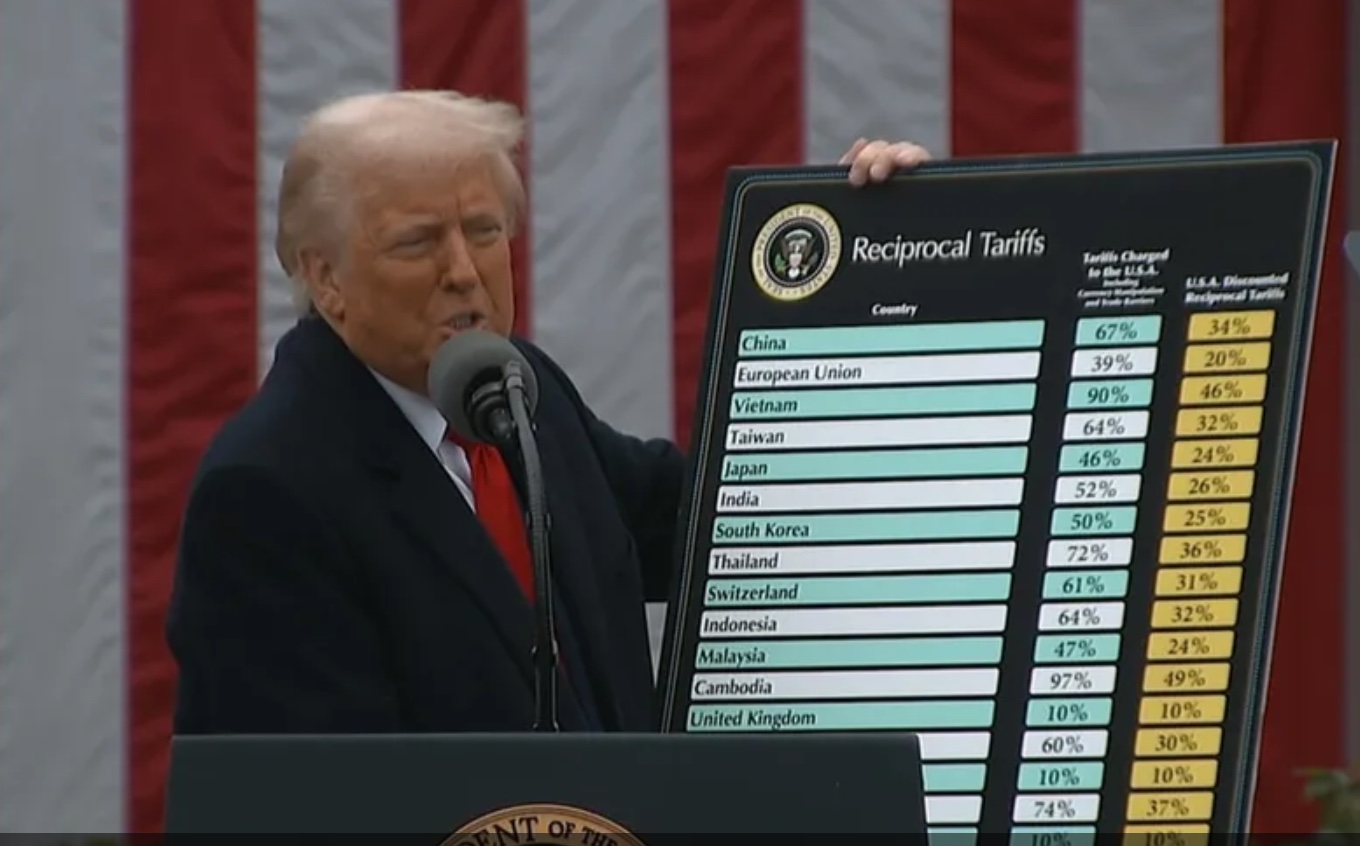
President Donald Trump imposed a tariff of 10% on all imports as a baseline, and additional, reciprocal levies on nations like China. His effort is intended to restructure the imbalance of trade that now exists in the world that have put American companies and workers at a disadvantage.
Declaring foreign trade and economic practices a national emergency, Trump ordered that on April 5, the 10% tariff will be imposed. Then on April 9, a higher tariff will be applied to imports from countries with which the United States has the largest trade deficits. The tariffs will remain in place until Trump determines that nonreciprocal trade arrangements and other unfair practices have been addressed.
The trade deficit was $1.2 trillion in 2024. The tariffs are in response to the economic and trade policies of other nations, which include devaluing their currencies and imposing high taxes on American goods.
Trump held up a chart during the outdoor announcement at the White House that shows how the United States has one of the lowest average tariff rates globally, while major trading partners impose massive tariffs on American goods. India imposes 52%, China imposes 67%, and the European Union imposes 39% on American goods. In addition, counterfeit goods, pirated software and stolen trade secrets by communist regimes like China cost the US economy between $225 billion and $699 billion a year.
Trump’s tariffs on China will amount to 54%, as part the additional “reciprocal” levies on “nations that treat us badly.”
Additional tariffs, such as a 25% tariff on all foreign-made and imported auto that takes place at midnight, be rolled out over the coming days.
“Jobs and factories will come roaring back into our country,” Trump said. “This will indeed be the golden age of America.”
Spared from the tariffs are some metals. Steel, copper, gold, and aluminum imports already have a 25% duty on them and won’t be subject to higher reciprocal tariffs. Also exempt from the additional reciprocal tariffs are pharmaceuticals, semiconductors, and lumber articles.
The White House fact sheet can be read here.


