
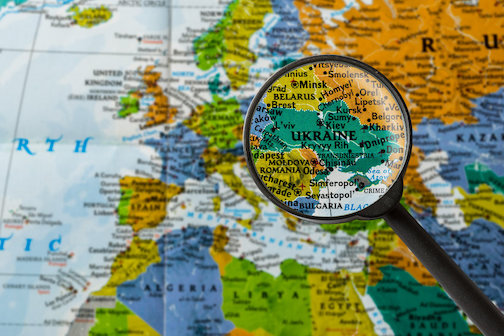
A brief timeline of recent events leading up to the invasion of Ukraine:
Jan. 20, 2022: “I think what you’re going to see is that Russia will be held accountable if it invades. And it depends on what it does. It’s one thing if it’s a minor incursion and then we end up having a fight about what to do and not do.” – President Joe Biden.
Then, Biden told the world exactly what was about to happen in the Donetsk and Luhansk regions of Ukraine, which broke away from the Ukrainian government in 2014 and declared themselves “people’s republics.” Russia has been supporting these independent regions, known as the Donbas, with troops, Covid-19 support, and has even issued Russian passports to some 800,000 of the residents.
Jan. 25, 2022: “If he were to move in with all those forces, it would be the largest invasion since World War II. It would change the world.” – Joe Biden.
Jan. 25, 2022: “We have no intention of putting American forces, or NATO forces, in Ukraine. But we — as I said — they’re gonna be serious economic consequences if he [Vladimir Putin] moves.” – Joe Biden.
Feb. 10: Four B-52s from Minot Air Force Base, N.D., deployed to RAF Fairford, Gloucestershire, England.
Last week: 5,000 troops from the U.S. Army’s 82nd Airborne Division arrived in Poland to assist with processing centers for the tens of thousands of Americans and their families who are preparing to leave Ukraine if Russia launches a full-scale invasion. A dozen F-35A Lightning II fighter jets and 350 airmen from Hill Air Force Base, Utah were deployed to Spangdahlem Air Base, Germany.
Feb. 19, 2022: 1,000 American troops from the Stryker squadron of the Army’s Second Calvary Regiment (Mechanized Infantry, Vilseck, Germany), moved from Germany to Romania. The U.S. Air Force sent a group of fighter jets to Eastern Europe.
Feb. 20, 2022: Russian President Vladimir Putin and President Joe Biden agreed, in principle, to make an effort one last time for a diplomatic solution; it would come in an in-person meeting later this week.
Feb. 21, 2022: Putin formerly recognized breakaway regions of Ukraine as independent.
Feb. 21, 2022: Putin sent troops into the Moscow-aligned regions of Ukraine.
Feb. 21, 2022: The White House refused to call it an invasion, when asked by the White House press corps. Late Monday, the White House would not commit to the full-fledged sanctions that President Biden had earlier said Russia would face if it invaded Ukraine.
Feb. 22, 2022: The United States has doubled the number of ground troops to 9,000 in Poland and 2,000 in Romania. Russia has assigned 190,000 troops to the border and breakaway regions.
Feb. 22, 2022: German Chancellor Olaf Scholz announced he is halting the certification of the Nord Stream 2 natural gas pipeline from Russia, one of the first major sanctions.
This story is evolving rapidly and more announcements of sanctions and NATO reactions are expected today.


