
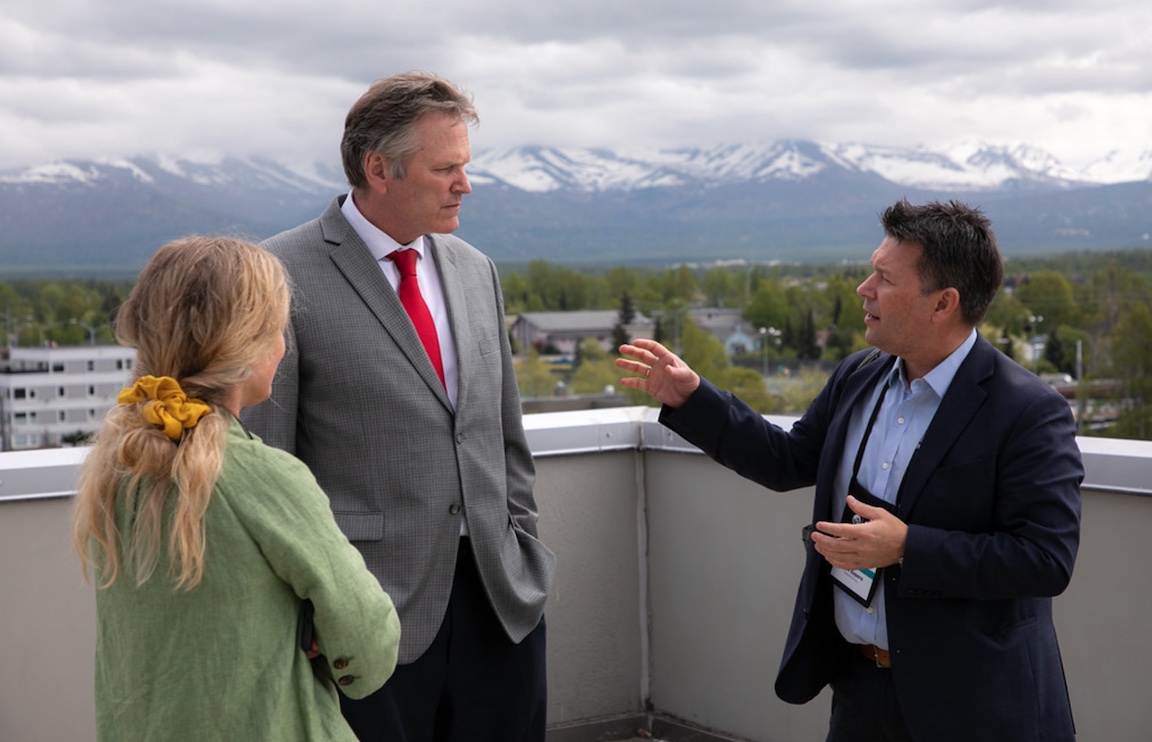
Anchorage’s downtown looked again like the civic hub of the state this week, with the Den’aina Center hosting a large-scale energy conference, the first in many, many years. Only rather than focusing on oil and gas, this conferenced looked ahead toward some of the next opportunities for the state.
Hosted by Gov. Mike Dunleavy, the inaugural Alaska Sustainable Energy Conference drew national heavyweights to the state to discuss nothing less than the future of the civilized world.
Dunleavy kicked off the proceedings on Tuesday in the main ballroom filled with over 500 attendees. The governor’s opening remarks harkened back to Alaska’s past and present, and projected a picture of the immense potential of Alaska’s future.
“Alaska is an oil giant, but it has every resource to be an energy giant,” said Dunleavy. Flanked by Bill Ritter, the former Democratic governor of Colorado, Alaska’s governor was in his element, with a vision of Alaska pioneering energy independence from the global instability that is now on full display in Ukraine, Russia, and China.
Notable individuals in the audience included executives of the state’s largest companies and industries. It also included Bill Walker, Dunleavy’s predecessor as governor who is running for the fourth time in a row. Sitting dead center in the ballroom, Walker was treated to a full experience of Dunleavy’s Rolodex as one A-list speaker succeeded another.
Former U.S. Secretary of Energy and Texas Gov. Rick Perry provided a path for Alaska to be an “all of the above” energy state (Dunleavy earlier pointed out that Texas, the epitome of oil gusher states, has three times the renewable energy generation as crunchy liberal California).
Former U.S. Secretary of State and Congressman Mike Pompeo touched on the national security of sustainable energy sources. Democratic Governor of Louisiana John Bel Edwards participated via video in a panel with Dunleavy and Ritter on how governors can use the laboratories of democracy to pioneer energy solutions for their people ahead of federal bureaucracy.
Outside the main hall, vendors ranging from Alaska utilities to nuclear power firms displayed information and wares. On the ground level, electric-powered sports cars from Mercedes, BMW, Tesla, and other brands caught the eyes of passersby checking out innovations hitting streets today across the world.
What was notably absent from the conference, apart from passing remarks, was overt partisan politics or pushing a green agenda. It was clear to many observers that Alaska, and the world, is at an inflection point, and the state stands to benefit from harnessing its many sources of potential.
This was punctuated in the afternoon of the first day. Flanked by Ritter and Soldotna Rep. Ron Gilham, Dunleavy signed into law a bill he introduced to streamline the permitting system for microreactors in Alaska. It was the first nuclear energy bill in a generation signed in state, and the first time a governor of another state was present for a bill signing. Former Gov. Walker was not seen after the first day.
The succeeding days broke into various panel discussions on investment opportunities in Alaska. It is clear America is at a disadvantage, with three-quarters of critical minerals needed for everything from solar panels to electric cars to iphones being located in China. Alaska has immense critical mineral deposits, but it will need a lot of help from Washington to, literally, clear a path from the red tape to get out from under the Beijing government’s thumb.
What was also made apparent was Alaska’s strategic location to manufacture essential goods. That is only possible with affordable, stable energy. This was on the minds of many attendees when Dunleavy, flanked by the heads of every utility on the railbelt, announced the largest investment in power transmission in a generation. Upgrading the power lines from the Bradley Lake dam, currently the cheapest power in southcentral, allows for other sources of power to come online, protect Alaskans’ utility bills, and keep power from falling off when it is needed most.
The day concluded with a panel by the oil and gas industry on its role in energy transition. Representatives from Hilcorp were at the stage, as was Janet Weiss, the Grande Dame of oil in Alaska. Weiss, the former head of BP Alaska and current member of the Alaska Gasline Development Corporation, brought perspective into the value of harnessing the state’s massive natural gas reserves and exporting it to coal-producing countries.
From members of an industry that displaced the whaling oil industry and the horse-drawn means of transport, it was a piercing moment of introspection as the next ten to twenty years show great acceleration. There is a desire not to let America lose out to China and other unfree governments in the next stage of energy.
The third and final day continued that outward look at the future, including some mind-bending contributors. Tony Seba, a venture capitalist, had a vibrant give-and-take with Dunleavy about everything from when natural gas will be displaced (Seba says mostly within 10 years) to the future of industrial agriculture (Seba says within 15 years maximum, steaks will be history, while Dunleavy, a known fan of ribeyes, disagreed).
As Thursday ended and the hundreds of attendees walked out into the still-sunny Anchorage weather, the city seemed like it was waking up from the two years of Covid-induced paralysis. Few masks were seen in the crowd of what were, almost certainly, a more left-of-center demographic. Reactions to the conference included surprise that a Republican governor cares about alternative energy (ignoring the role President Donald Trump played in accelerating the movement without much media notice) to urgency on getting Alaska’s house in order before another global movement creates additional supply shocks.
What was evident as the conference closed is that Alaska remains a deep reservoir of potential for generational energy production, if only it can create the right business-friendly climate that invites the necessary investment for these large-scale projects.
In a state notorious for its almost third-world hostility to business, that will be a tough sell. But if Gov. Dunleavy’s conference showed anything, it is that one opportunity did not have to come at the expense of another.



