
A new survey by Intelligent.com shows how the artificial intelligence application called ChatCPT is pervasive in school curriculum as teachers increasingly use it to develop lesson plans, and students embrace it to do their homework.
The downtown Seattle-based company, which is privately funded by unknown entities, assists students through their study challenges, college application process, as well as navigating financial aid.
The company said it surveyed 1,000 teachers and found that 8 in 10 teaches approve of students using ChatGPT, and nearly all teachers are using it to help them manage their work.
Key findings from the survey include:
- 95% of teachers are aware of ChatGPT
- 98% of teachers use ChatGPT
- 79% approve of student use
- 84% of teachers that approve of its use have spent time teaching their students how to use it
- 35% believe most or all of their students turn in assignments they used ChatGPT to complete
- 71% say their school doesn’t have a policy surrounding ChatGPT use
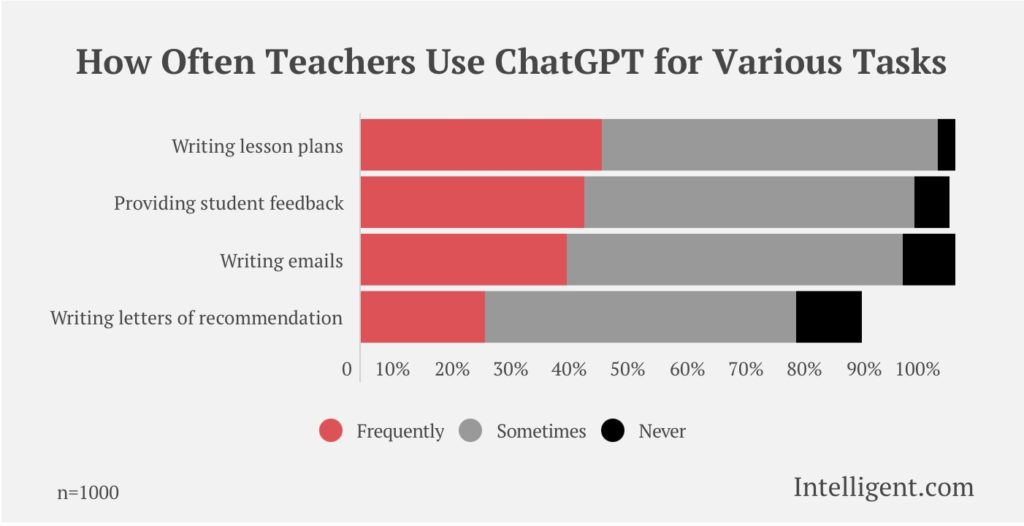
The survey also revealed that 97% of teachers were frequently or sometimes using ChatGPT to write lesson plans, while 93% were using it to help them grade and provide feedback to students. Some 91% of teachers were using it to write emails and 89% to write letters of recommendation.

ChatGPT and other artificial intelligence programs are newly available to the public. ChatGPT was launched in November and has come under criticism for having a strong left-leaning bias.
Earlier this year, Must Read Alaska asked ChatGPT to write about why drag queen story hour was a bad idea for children, and the chat bot would not do it, but did provide a glowing story on the benefits of drag queen story hour for children.
Others have conducted similar experiments and found strong biases. Some express concern about whether students are really learning when they are relying so heavily on a chat bot to do their homework.
An example of how chat bots can do assignments is beyond just answering a series of questions: A computer programming teacher can assign students to write some code that performs certain functions. The students can ask ChatGPT to write the code for them and complete the assignment in a few seconds.
ChatGPT can also write creative stories, academic reports, poems, and compositions of various types. As artificial intelligence, it learns quickly and improves its quality by the second, as it picks up new information from the internet constantly.
Other forms of AI can produce completely realistic-looking photographs and artwork that looks like it was painted by a master.
The top reason the surveyed teachers give for using ChatGPT was time-saving, with 42% of teachers citing it as a factor. Many teachers also found that it provided good suggestions (41%) and helped them understand ChatGPT’s capabilities (17%).
The survey indicated that teachers who used the tool generally approved of their students using it as well. Two-thirds of teachers surveyed believed that many students were turning in assignments generated by artificial intelligence. The results showed that 6% of teachers believed all of their students turned in work generated by ChatGPT, with 30% believing most students did so, and 30% thinking many students used it. Conversely, 25% of teachers thought only some students used it, and only 1% believed none of their students used it.
The survey also found that a third of teachers believed that all (6%) or most (28%) of their students used ChatGPT during class. Another 25% thought that many students used it, while 27% thought that only some did. Only 5% believed none of their students used it in class.
Nearly three-quarters of teachers survey (71%) said that their school did not have a policy surrounding ChatGPT use.
Learn more details about this survey at Intelligent.com.
eLearningIndustry.com says there are many good reasons to incorporate AI into the classroom.
“One of the key benefits of incorporating AI into the classroom is the ability to provide students with a more personalized learning experience. AI algorithms can analyze student data and adapt to their learning styles, providing feedback and recommendations that are tailored to their individual needs and abilities. This can help to keep students engaged and motivated and can lead to improved academic performance. Another benefit of incorporating AI into the classroom is the opportunity to deepen students’ understanding of this rapidly-evolving technology. By incorporating AI into the curriculum, teachers can help students develop a critical perspective on this technology, and prepare them for the challenges and opportunities of the digital age. Finally, incorporating AI into the classroom can also help students develop important 21st-century skills, such as problem-solving, critical thinking, and collaboration. These skills are essential for success in the digital age, and they can be developed through hands-on experience with AI tools and applications,” the trade group writes.
The group also cautions that there are drawbacks, including training and integration of the technology among teachers, and ethical challenges. But in general, the education industry group speaks favorably of the new technology.



