Sen. Dan Sullivan visited Harvard University last week, and came away stunned at what he saw. While he was there for the Army-Navy football game, he decided to walk the campus to see what had changed at Harvard, where he earned his undergraduate degree in 1987.
A lot had changed, evidently. Sullivan wrote up a debriefing of his visit in the Wall Street Journal on Saturday, focusing on his trip to the university’s library, where he was accosted and badgered by radicalized students.
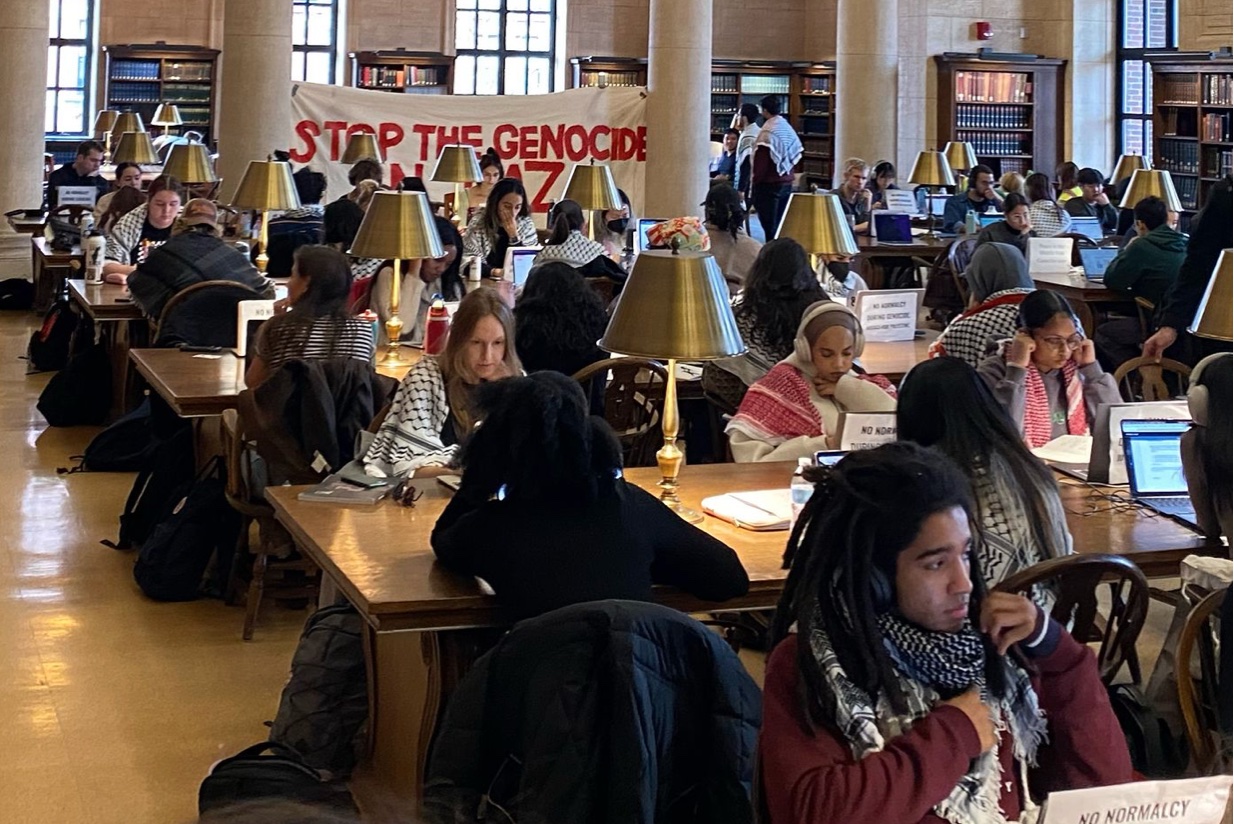
“When I walked upstairs to the famous Widener Reading Room, I couldn’t believe my eyes. Nearly every student in the packed room was wearing a kaffiyeh [Palestinian scarf]. Fliers attached to their individual laptops, as well as affixed to some of the lamps in the reading room, read: ‘No Normalcy During Genocide—Justice for Palestine.'”
He observed a woman handed the fliers to all who entered, and massive banner hung across one end of the room, which had, in red letters, “Stop the Genocide in Gaza.”

Curious about what was going on, he engaged in a discussion with two of the organizers of this anti-Israel protest inside of one the world’s great libraries—not outside in Harvard Yard, where such protests belong.
“They told me they were from Saudi Arabia and the West Bank. I told them I was a U.S. senator who had recently returned from a bipartisan Senate trip to Israel, Egypt and Saudi Arabia. I mentioned the meetings I had. I expressed my condolences when they told me their relatives had been killed by Israeli military action in Gaza,” he said.
“One then asked whether I supported a cease-fire in Gaza. I said I didn’t, because I strongly believe Israel had the right both to defend itself and to destroy Hamas given the horrendous attacks it perpetrated against Israeli civilians on Oct. 7,” Sullivan wrote.
That’s when things got ugly for him.
“You’re a murderer,” one said to him.
“You support genocide,” the other told him.
“Excuse me, what did you say?” Sen. Sullivan asked in disbelief.
The organizers repeated their charges.
“I tried to debate them, noting the Israel Defense Forces don’t target civilians, and that the only group attempting to carry out genocide is Hamas. But civil debate with these women was pointless. As I was leaving Widener Library, they pulled out their iPhones and continued taunting: ‘Do you support genocide? Do you support genocide?'”
The Harvard Palestine Solidarity Committee posted some of this exchange on Instagram, Sullivan wrote.
“As a U.S. senator who has been through two election campaigns, I’ve had plenty of iPhones aggressively shoved in my face by members of radical groups,” he wrote.
Indeed, during his 2020 campaign, a radical Native activist in Anchorage tried to shove a raw caribou heart at him during a campaign event. For Sullivan, a cell phone being shoved in his face is par for the course in Washington, D.C.
“Nevertheless, I was shocked and, again, ashamed of my alma mater. All of this—the anti-Israel protests, the big banner, the fliers, the iPhones, the taunting questions—took place inside the Widener Library, a revered place of quiet study for tens of thousands of Harvard students and alumni,” he wrote.
Would you feel welcome in Harvard’s most famous library, he asked, if you were an Israeli or a Jew facing the same situation? Or would you feel rattled, intimidated, and harassed by the anti-Israel banner screaming “Stop the Genocide in Gaza”?
“As Jason Riley has written, ‘If accusing Israel of genocide isn’t defamation of Jewish people, I don’t know what is,'” Sullivan wrote.
“If you were that 18-year-old student, would you believe the vacuous statement recently put out by the Harvard Corp., after it decided not to fire Ms. Gay, that “disruptions of the classroom experience will not be tolerated”?
“Is this what [Harvard President] Gay when she testified that ‘it depends on the context?”
Sullivan concluded his op-ed condemning the Ivy League institution: “Not all university leadership is so craven, morally bankrupt and afraid of the most vocal, radical sects of their own student bodies. I serve on the board of visitors for the U.S. Naval Academy, which is the No. 1 public university in America. The contrast couldn’t be starker between the service academies and the Ivy League on issues like civil discourse, so-called safe spaces, trigger warnings, American history and our unique and, yes, exceptional place in the world.
“America’s so-called elite universities used to be a positive source of our nation’s power, strength and influence. No longer. I believe over the past several weeks a bipartisan consensus has emerged: It is time for Congress to save these important and once-respected institutions from themselves and their weak leaders who have lost their moral compasses. I intend to work with my colleagues in the Senate to do so.”
I was in Boston last weekend for the Army-Navy game. The day after the game, five days after Harvard President Claudine Gay’s disastrous testimony before Congress, I decided to walk the campus to reminisce about my time at Harvard, where I earned my undergraduate degree in 1987, and reflect about what had gone wrong at this once-great university.