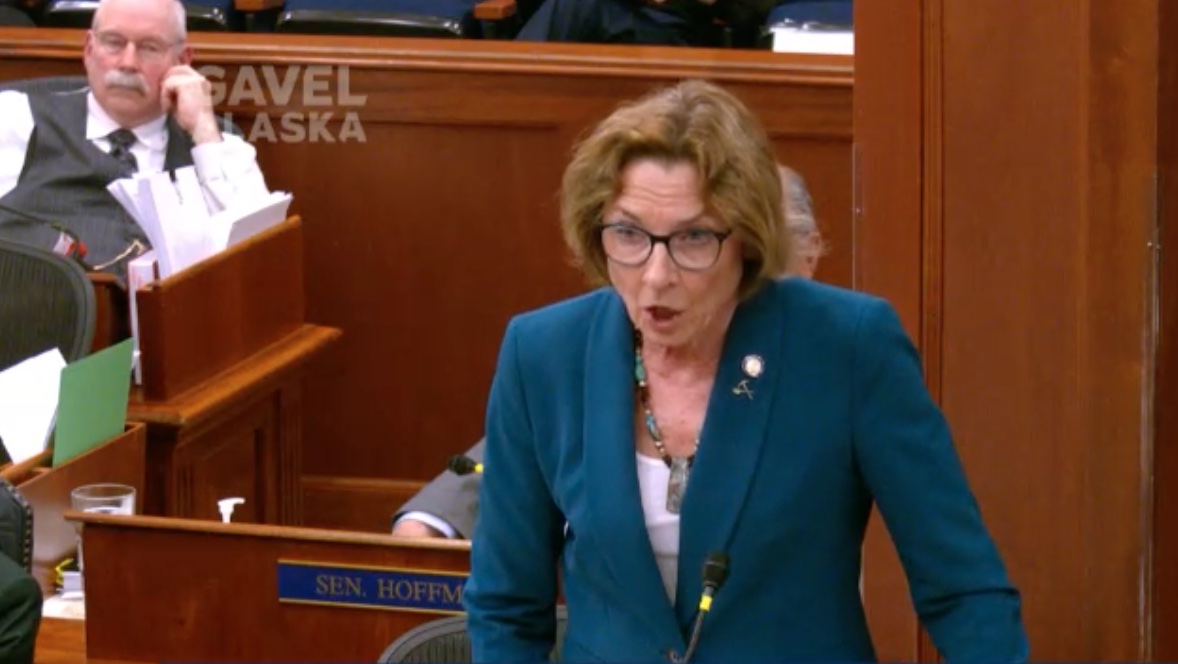
A bill that is meant to help meet the teacher’s shortage was hijacked by Sen. Cathy Giessel on Tuesday and made into an entirely different bill, which passed the Senate before she ended up withdrawing the amendment. Word in the Capitol is that her move to force her own bill into another had made her very unpopular with the Democrat-majority caucus that she has joined.
Giessel, working at the behest of the AFL-CIO and Alaska Public Employee Association, inserted the entire contents of the failing Senate Bill 88 — a return to a defined pension plan for public employees in Alaska — into House Bill 230.
Sen. Bert Stedman, who was a key lawmaker in dismantling the old pension plan, which became unaffordable for the state budget, spent 40 minutes on the Senate floor speaking against Giessel’s amendment. Next was Sen. Shelley Hughes, who agreed with Stedman, and then came Sen. David Wilson, who also agreed.

Sen. Mike Shower voiced his objection:
“This is a 52-page bill being shoved into a one-page bill. This has become one of those tur-duck-ens” said Shower. (Tur-duck-en is a turkey stuffed with a duck, stuffed with a chicken).
“When the State cuts a check for a defined contribution plan, it’s gone. That liability for future generations is gone, not on the books. However, on a defined benefit plan, then you have something where we [the State] are assuming the risk. That is something that is not insignificant in this debate,” he said.
Shower said Alaska’s children, grandchildren and their grandchildren are going to assume the liability and that today’s workers want to move around, and do not want to stay in jobs for dozens of years.
In addition, “we have billions of dollars that we are trying to make up for the previous plan,” Shower said.
HB 230 addresses the current situation in which teachers are allowed to count eight years of out-of-state teaching experience, if they have a masters’ degree, and six years of out-of-state teaching experience, if they have bachelors’ degree, for the purpose of determining the correct placement on a district’s salary scale, even if they taught out of state for much longer. Repealing these onerous conditions is a recommendation from the “2021 Teacher Retention and Recruitment Action Plan,” a product of the governor’s working group on teacher retention and recruitment that was established in 2020.
Districts across Alaska are having an extremely difficult time filling teaching positions, the governor’s working group said. First day teacher vacancies in Alaska have increased from about 155 in 2019 to about 394 in 2022 according to the Department of Education and Early Development and this shortage impacts both urban and rural districts. With the passage of this bill, state statute will no longer inhibit districts from hiring the most experienced out-of-state candidates, and in turn teachers will be fairly compensated for their experience.
During her closing remarks, Giessel mentioned to President Gary Stevens that he has a house in Kodiak, and his house might get broken into because there are not enough police. It was not a threat, but it was on the boundary of what is considered appropriate.
Voting in favor of the amendment were Senators Click Bishop, Jesse Bjorkman, Matt Claman, Forrest Dunbar, Cathy Giessel, Elvi Gray-Jackson, Scott Kawasaki, Jesse Kiehl, Kelly Merrick, Loki Tobin, and Bill Wielechowski.
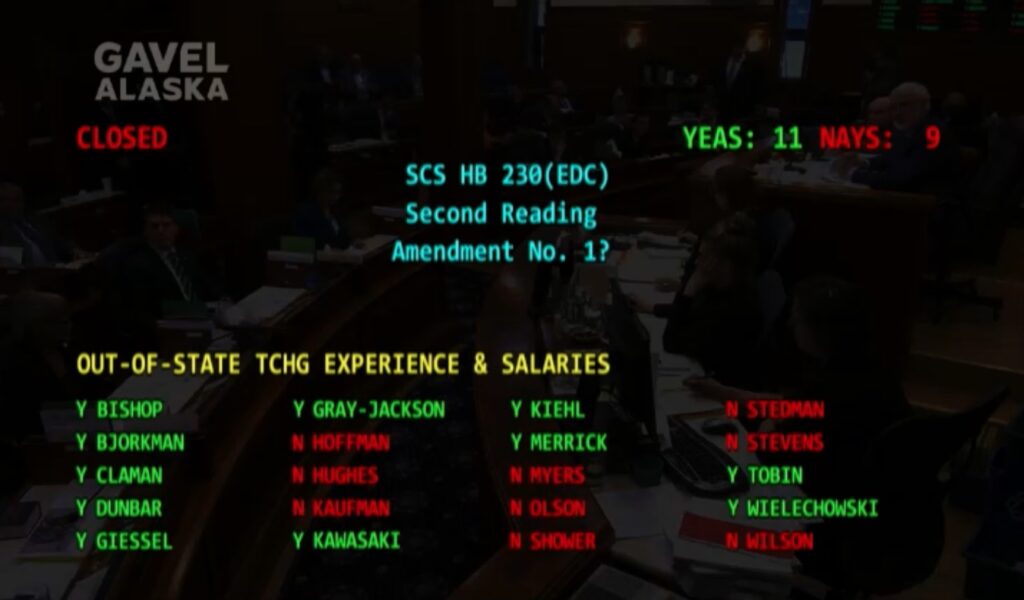
Voting against the bill were the two co-chairs of Senate Finance Committee, Stedman and Donny Olson, as well as Lyman Hoffman, Shelley Hughes, James Kaufman, Robb Myers, Mike Shower, Gary Stevens, and David Wilson.
The 52-page hostile amendment by Giessel transformed the governor’s bill into her own bill.
The amendment was later withdrawn after Stedman removed his name as a cross-sponsor of the bill. The original bill then passed the Senate.