

On November 20, this year, Procurement Officer Robert Roys issued a Request for Proposals (RFP) on behalf of the Department of Commerce, Community, and Economic Development (DCCED), Division of Administrative Services on behalf of the Division of Insurance (INSU). DCCED-INSU requests the help of qualified contractors to provide “a report identifying the cost drivers of primary care delivery and recommendations to improve access to primary care within Alaska.” Opportunity for qualified contractors to submit proposals closes this Wednesday, December 31.
With healthcare costs rising in Alaska, the State wishes to investigate “how health care providers and health care payers are impacted by state and federal laws and regulations, as well as how primary care operations are impacted by the payer mix and various payment models.”
Healthcare providers to be included in the comprehensive report are all levels of primary care practitioners, including mid-level practitioners and support professionals such as Advanced Practice Registered Nurse (APRN), Certified Medical Assistant (CMA), Community Health Aides/Practitioners (CHA/Ps), and Medical Assistant (MA). Primary care also includes behavioral health, pediatric, prenatal/obstetrical, and dental care.
DCCED-INSU estimates a budget between $1million and $1.5million. The contractor(s) will be paid subject to funds already appropriated and identified.
The report will include the following:
- An analysis of Alaska primary care providers overall business operations.
- A comparative assessment of primary care provider operational costs for Alaska, the national average, Washington state, Montana, and North and Dakota. Alternatively, the offeror can propose a different comparison state.
- An analysis of how the payer mix and various payment methodologies impact the operational viability of primary care providers and patient access to primary care.
- An analysis of how state and federal laws and regulations are impacting primary care providers and payers.
- An analysis of how pressures on one payer impact other payers.
- Identification of barriers to primary care in Alaska
- The financial impact of patients being sent out of state to receive primary care available in Alaska, include access to follow-up care.
- The impact on access and the scope of costs passed down to consumers in the form of monthly premiums and cost-sharing (deductibles, copays, and coinsurance), and to the State.
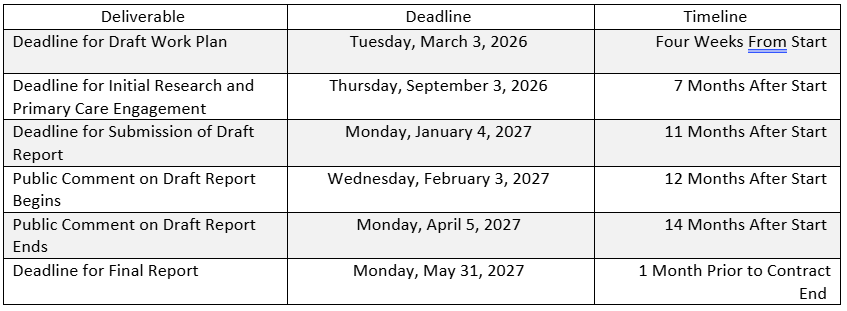
The report is expected to take approximately a year and a half to complete. The project’s provided deliverables timeline determines the final report will be completed May 31, 2027.
While future Alaskans may benefit from this extensive report on what drives healthcare costs in Alaska, many remain skeptical that the report will lead to any real action to reduce healthcare costs. While taxpayer monies go to a year and a half of data gathering and analysis, it remains to be seen whether the report will stimulate action or simply be filed away and forgotten.


