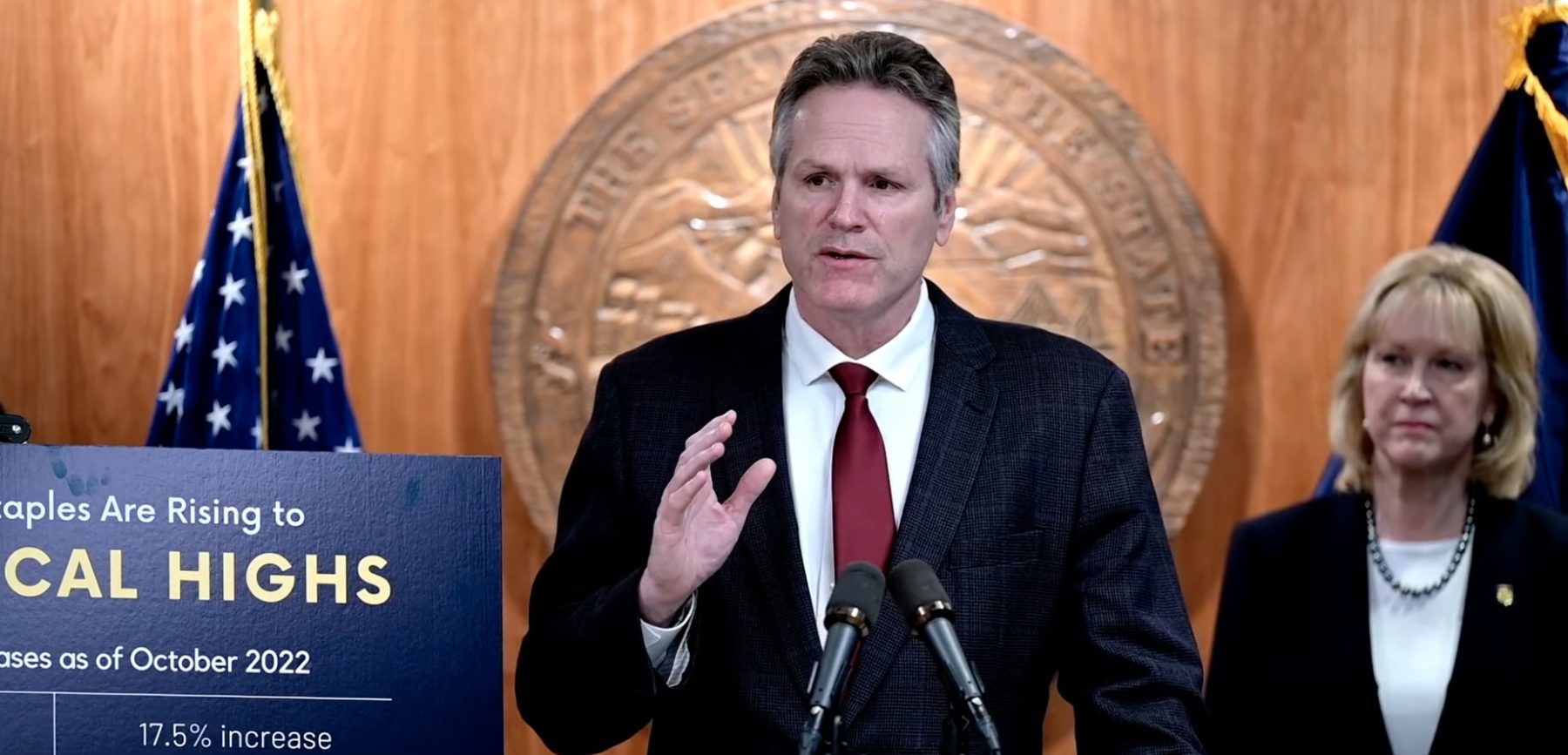
Gov. Mike Dunleavy rolled out his state budget for fiscal year 2024 today, a budget year that starts July 1. The proposed budget reflects a flat spending strategy, with fully funded essential state services during a time when oil revenues are down by $1.8 billion year over year.
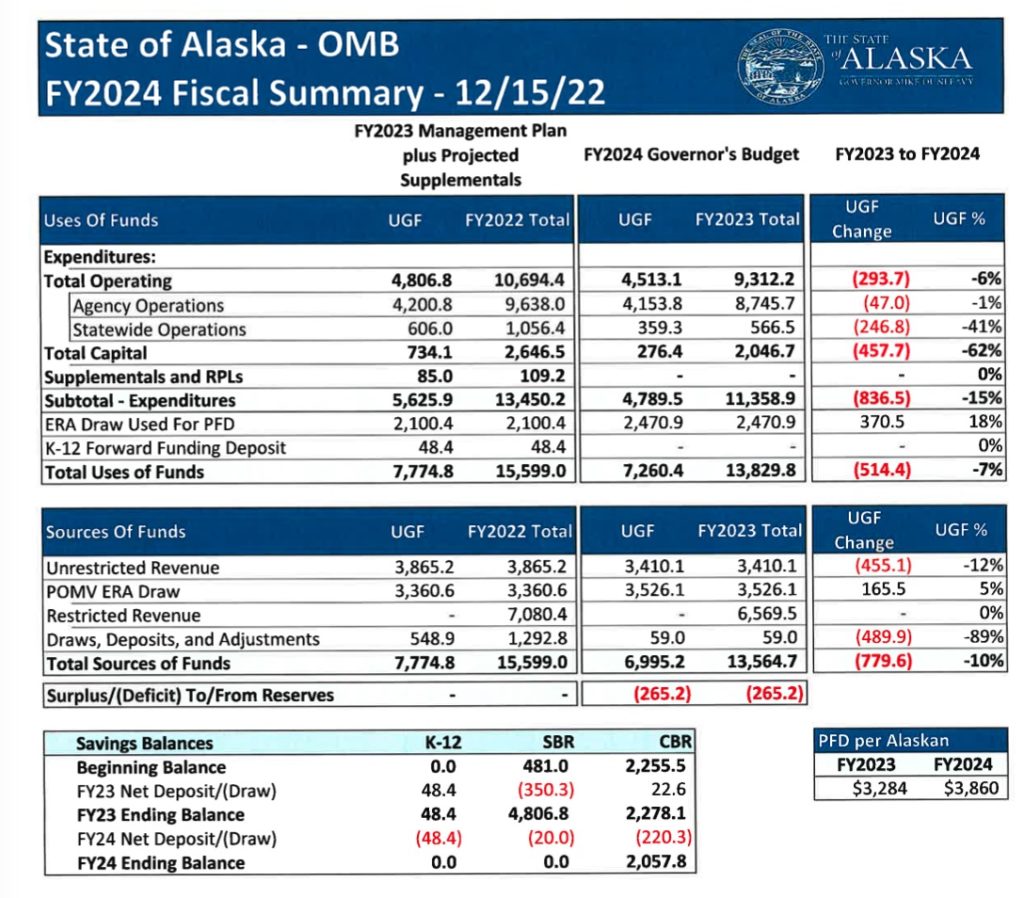
Dunleavy is again funding a “statutory Permanent Fund dividend” of about $4,000 per eligible Alaskan, and the overall budget has a deficit of about $265 million, which, after tapping the Constitutional Budget Reserve, will leave about $2 billion in that reserve fund.
The numbers underscore a commitment to fiscal discipline, which is what the governor ran on. This in the face of inflation running at over 7%, the overall budget reduction year over year is 15%.
The Capital Budget is pegged at $200 million to leverage $1 billion in federal dollars. Capital spending is seeing a $457 million in reduction, and the operating budget will have about $378 million in reductions, for an overall spending reduction of $836 million year over year.
Over the course of his administration, Dunleavy has retired millions of dollars in debt, which frees up some financial flexibility for the state. By using the bigger revenues in past years to pay off debt and liabilities, the state is no longer making the same kind of debt payments. It’s like the state doesn’t have credit card debt, so has more liquidity.
He’s asking state agencies to use their existing unfilled positions, or PCNs, to help keep operational costs flat.
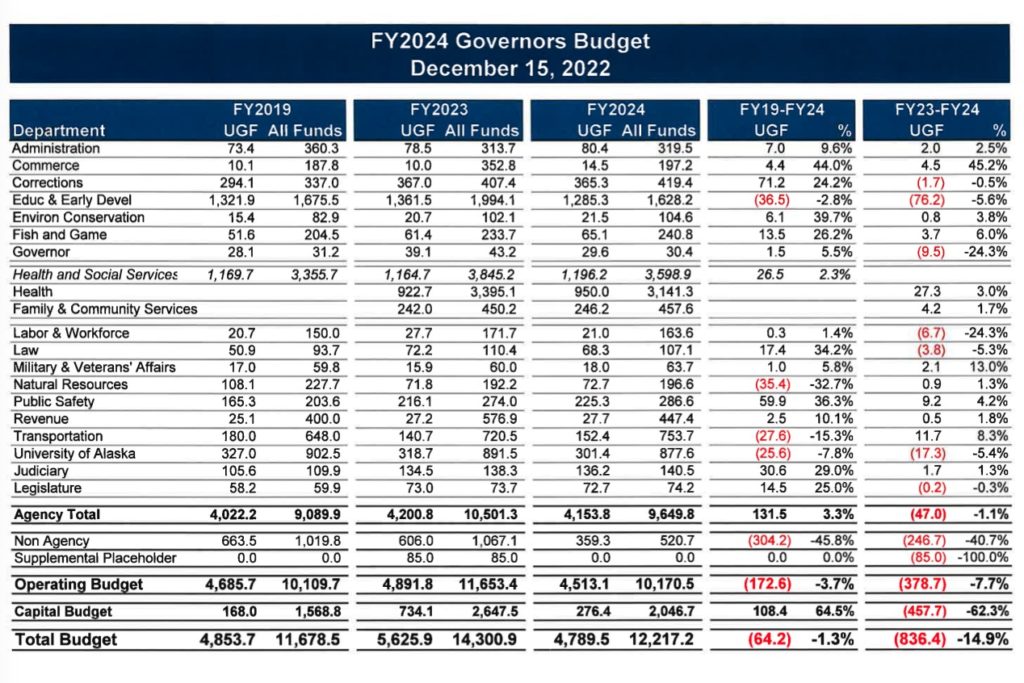
Other highlights include: Fully funded Power Cost Equalization programs for rural areas, fully funded education, but no increases and no forward-funding, due to revenue shortfalls.
Budget highlights:
- FY23 revenue estimate is down $1.8 billion from when the govenor signed the current budget in June.
- The statutory PFD should be almost $4,000 per eligible Alaskan
- FY 2024 projected deficit is $265 million
- The Constitutional Budget Reserve will have a $2 billion balance
- $25 million – Energy projects for Alaska Energy Authority, including rural power system upgrades, bulk fuel upgrades, hydro development and renewable energy/efficiency projects, and grid resiliency
- $5 million for marketing of Alaska through Department of Commerce Community and Economic Development
- $14.2 million for Public Safety capital investments, including post remodel and expansion, patrol vessel replacement, investigative and forensic electronic equipment
- $3.3 million – 30 DPS Trooper support and administrative positions, to help get troopers out doing their jobs
- $5 million – Rural professional housing (expanded scope and funding)
- $10 million – University of Alaska drone program, with the idea that Alaska can become drone technology research capital
- $2 million – Expand the WWAMI program to add 10 more physician training slots
- $11 million – Statehood defense investment, including funding for research, science, and legal, to be prepared to fight the federal government if it tries to cut off the ability of the state to access resources
- $4 million – New cabins and park sanitation stations, to make them more accessible to those with disabilities
- $9.5 million – Healthy Families Initiatives to address things like congenital syphilis and tuberculosis, recruitment and retention of health professionals to Alaska, and expand postpartum Medicaid coverage
- $6.4 million – Year 2 of the Department of Education reading program approved last year
- $4.6 million – DGF capital projects for food security programs, including animal bank, Alaska marine salmon program, Arctic fisheries, and Central Region fisheries management sonar replacement
- $3 million – Three-phase power extensions and upgrades to Delta Farm Region and Co-op
- $4.1 million – Department of Corrections capital projects, including Point Mac Correctional Farm produce processing plant and statewide security doors and windows
- $2.5 million – DMVA State Defense Force
- $2 million – Labor Business Enterprise program, including a political program for a new day care in Mat-Su
- $1.5 million – Department of Health community-based senior grants cost of living
- $1 million – Alaska Native Science Engineering partnership
The budget was due today to the Legislature, whose main job is to debate and vote on the budget and return some version of it back to the governor before the fiscal year begins. From the way it’s shaping up in the Legislature, it appears that both the House and Senate will be controlled by Democrats, who are planning to increase spending and offer an income tax to pay for the increases. The Legislature convenes Jan. 17 for a 90-day session that usually stretches past 120 days. The makeup of the Legislature is primarily Republican but it appears many of the Republicans are going to give control to the Democrats, as they have already done so in the Senate.
Sen. Gary Stevens posted an immediate response to the governor’s budget proposal. Stevens, long an advocate for an income tax, said in 2018 that the state could not rely on oil taxes to fund the state budget, and would need additional revenue. Today he expressed concern that the budget is not big enough, and that he wants to see more spending on education. As the incoming Senate president, he is telegraphing to the public that it will be a difficult negotiation season with the governor to get to an agreed-upon spending plan.