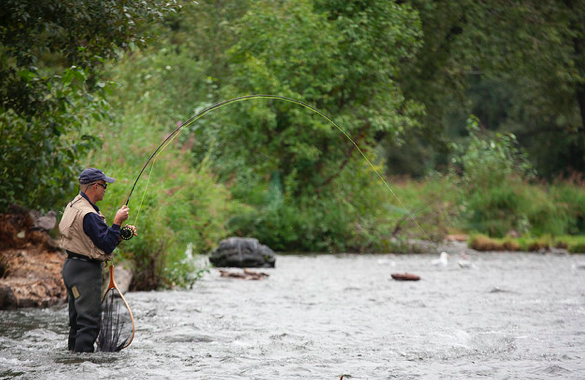
Sen. Jesse Bjorkman, a Republican member of the Senate’s Democrat-dominated majority, is offering a bill that reels in residency requirements for resident fishing, hunting, and trapping licenses.
It’s a companion bill to House Bill 201, filed last year by Rep. Rebecca Himschoot (no party, member of Democrat caucus) of Sitka and Rep. Sarah Hannan, a Democrat, of Juneau.
According to HB 201 and Senate Bill 171, a person would have to be not only physically present, but continuously present, in the state of Alaska for the 12 months prior to applying for an in-state fishing, hunting, or trapping license, in order to qualify for the resident rate.
There are exceptions, and they are found in Alaska Statute AS 43.23.008, the law that defines what a resident is for the purpose of receiving a Permanent Fund dividend.
Those exceptions are things such as going Outside the state for medical treatment, to serve in the military, to care for a gravely ill relative, or settle the estate of a deceased parent. The exceptions include staffers for Alaska’s congressional and Senate leaders in Washington, D.C., or a State of Alaska field office staffer in another state. There’s a 90-day continuous-absence limit and a 180-day total absence limit, with all kinds of proof needed for the Permanent Fund Division, which examines each application thoroughly and has an investigation division with people assigned to bird-dog fraud.

What the two fishing-hunting-trapping bills would do is create a new and likely costly bureaucratic hurdle for the Department of Fish and Game, which would have to vet applicants at the same level the Permanent Fund Division currently does.
HB 201 has been referred to House Resources and Judiciary committees; Resources will first meet on Friday.
The Himschoot-Bjorkman bills originated because some out-of-staters come to Southeast Alaska, specifically Prince of Wales Island, in the summer to work and they get in-state fishing licenses, even though they maintain residences out of state. Alaska resident sport fishing licenses cost $60. Nonresidents pay $100 for an annual license. Resident hunting licenses are $85, and residents don’t pay for tags. Nonresidents pay $260 for an annual hunting and sport fishing license.
Alaska residency is a sticky and litigious subject with Alaskans. When the Alaska Permanent Fund was established, it originally had an elastic benefit that gave more dividend money to those who had maintained residency since statehood.
But then, an Anchorage couple, Ron and Patricia Zobel, sued and won because the residency requirements were a violation of their constitutional right to equal protection. The residency requirement was dialed back as a result. Now, a person must be a resident of the state for a full year before being eligible to apply for a dividend. And they can be gone from the state for a certain amount of time each year.
The Himschoot-Bjorkman bills are written in such a way that they can be interpreted as disallowing a vacation to Hawaii, since the proposed statute says “has been physically present in the state at all times during the 12 consecutive months under (2) of this subsection or, if absent, was absent only 03 as allowed in AS 43.23.008.”
In U.S. Supreme Court case Dunn v. Blumstein, 405 U.S. 330, 92 S. Ct. 995, 31 Ed.2d 274 (1972),[6] the court held, “All durational residency requirements inherently infringe upon the fundamental constitutional right of interstate travel. Hence, all such requirements are prima facie invalid and will be countenanced only when they serve a compelling state interest.”
Residency issues are found in another Senate bill that was offered by Sen. Forrest Dunbar of Anchorage. That bill is trying to address the problem some people have because bed-and-breakfast owners don’t want to rent to Alaska residents. That story is linked below: