
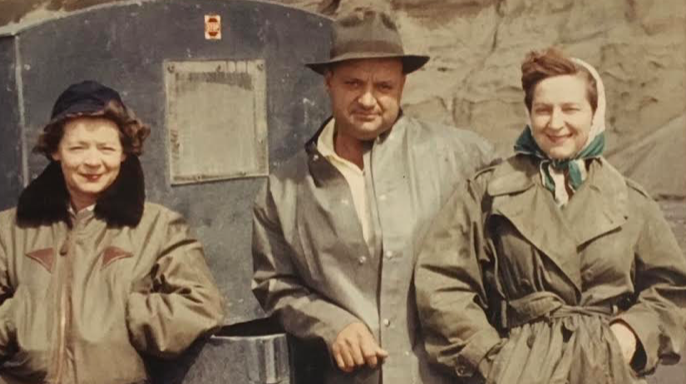
(Editor’s Note: This is a guest column penned by the granddaughter and great niece of three murder victims in one of Anchorage’s most notorious violent crimes, which occurred in 1985. At the end, the author has a call to action for readers to send letters to the Alaska Parole Board asking that they keep the killer locked up.)
BY TAMERA LIENHART
GUEST WRITER
It was a lifetime ago, when a vicious crime happened that changed my life forever. In 1985, my grandparents, Ann and Tom Faccio, age 70 and 69, and my great aunt, Emilia Elliott, age 76, had their lives cut short, executed by Cordell Boyd and an underage accomplice, Winona Fletcher.
In April, the Alaska Parole Board will decide whether Boyd, who has served just one-third of his sentence, will be freed. Discretionary parole, it’s called.
The two murderers had long criminal histories in Anchorage; and had no association with my family, until they terrorized and shot three members of my family while attempting to rob them.
My grandparents and great aunt were like many of us in Anchorage: They were responsible citizens, small business owners, parents, grandparents, making ends meet, and paying taxes.
This fateful day started out like so many others. Tom and Ann Faccio and Emilia Elliot were at their home in east Anchorage, enjoying dinner and watching the news, when they answered the doorbell.
Someone was having car trouble and needed to borrow their phone. Who wouldn’t help someone in need? Life for all of us was forever changed because my beloved family opened that door and offered to help.

FROM THE LEGAL FILES
Below are the facts of the case as outlined in one of the many legal briefs written after the murders:
On April 22, 1985, W.M.F., age fourteen, and Cordell Boyd, age nineteen, forced their way at gunpoint into the house of Tom and Ann Faccio and Emilia Elliott. W.M.F. initially struggled with Mr. Faccio, age sixty-nine, during which her .22 caliber handgun discharged. Ms. Faccio, age seventy, entered the kitchen, where the disturbance was taking place. Boyd demanded money from Mr. Faccio and was given approximately $300 at that time. Boyd directed W.M.F. to find Ms. Elliott, age seventy-five, who was found in the garden and brought back into the house. Boyd and W.M.F. ordered the three victims to sit down on the living room couches. While there, Ms. Elliott pointed out to W.M.F. that she did not have a mask on, and W.M.F. became concerned that she could be identified. Boyd checked the living room for valuables and then went upstairs to obtain neckties from an upstairs bedroom in order to tie up the victims.
Boyd returned downstairs and directed W.M.F. to take Ms. Faccio upstairs because she appeared to be having a heart attack. While W.M.F. took Ms. Faccio upstairs, Boyd began tying up Ms. Elliott and Mr. Faccio. W.M.F. returned downstairs to retrieve her gun and then went back upstairs. While Boyd was tying up Mr. Faccio, a shot was heard from upstairs. Boyd ran upstairs to find Ms. Faccio kneeling at the foot of the bed praying. W.M.F. was laughing. W.M.F. had attempted to shoot Ms. Faccio in the head, but Ms. Faccio had ducked and the bullet had missed her. At that moment, Boyd looked downstairs and noticed that Mr. Faccio was getting loose from his bindings, so he immediately ran downstairs to finish tying up Mr. Faccio. While tying up Mr. Faccio, Boyd heard a second shot from upstairs. Boyd went back upstairs and found W.M.F. holding the gun over the body of Ms. Faccio, who had been shot in the head at a distance of three inches. W.M.F. later indicated that Ms. Faccio had been pleading for her life and W.M.F. had become angry and said, “Shut up, bitch” as she pulled the trigger. When asked why she had shot Ms. Faccio, W.M.F. indicated that it was because Ms. Faccio could identify her.
Mr. Faccio called out from downstairs, asking what was wrong. Boyd told him that his wife had just been shot, and Mr. Faccio started crying. Subsequently, both Boyd and W.M.F. went downstairs. W.M.F. walked directly to Ms. Elliott and shot her in the head, killing her. Boyd then obtained more money from Mr. Faccio, (approximately $400) and, according to W.M.F., Boyd proceeded to shoot Mr. Faccio twice, first in the chest, and a second time in the head to end Mr. Faccio’s misery. Boyd asserts that W.M.F. shot Mr. Faccio in the chest, and Boyd subsequently shot Mr. Faccio in the head to end his misery.
After the murders, Boyd and W.M.F. immediately left the house without taking any other property. They went to the nearby home of Boyd’s sister, dropping the murder weapon in the woods along the way.
MY GRANDPARENTS, TAKEN FROM ME
My grandparents were responsible people. They went to church and donated to charities. They did a good job raising their children, and an even better job spoiling their grandchildren.
They were very involved in our lives, coming to our events, we had family dinners together and I thought every grandpa smelled like garlic as it was in everything he cooked. Even in our family with five children we all had special times with grandma and grandpa.
In the period of time since the murders, well-intentioned people have told me “Don’t worry, you will get over it in time.”
This is not reality. While we have learned to live with what happened, we do not ever “get over it.”
While other residents of Anchorage were understandably horrified that a crime like this could happen in our city, we alone were left cleaning up a house filled with bloodstains, bullet holes. We were left giving statements to police officers, and watching our backs, since no one knew who could possibly have done something so horrible.
A reward was offered to catch the murderers, and Winona Fletcher and Cordell Boyd were brought in after another criminal decided the reward worth it.
With no remorse, the two bragged to many about what they had done. We were thankful they were taken off the streets and convicted of murder. Originally, Fletcher was sentenced to 297 years in prison, but the courts later reduced it to 135 years. Cordell Boyd was sentenced to 99 years.
CORDELL BOYD COMES UP FOR PAROLE
On Feb. 22, I received a call from the prison saying Cordell Boyd will be up for a parole hearing on April 2, and I was asked if I wanted to be involved.
His sentence is now my family’s sentence.
The very fact that this hearing is happening takes me back to that awful day in 1985, as if it were yesterday and I was attending East High in German class, when my brother walked in with sunglasses on saying, “Come, you need to go with me. Something bad has happened.”
We raced across town as he struggled to find the words or the place to tell me about the horrific news that no one should ever have to tell another person.
Yes, it has been a long time, and the anger has subsided, but no one gets over something like this, and every time it comes up again, we have to relearn how to live with it all over again.
Random violence can impact anyone; rich, poor, educated or not. What does a sentence actually mean if convicted murderers only have to serve a one-third of their sentences?
Our community has a growing list of random, unassociated heinous murders in our recent memory — Robert Hansen, Israel Keyes, and Jerry Active, to name a few. Cordell Boyd is one of those killers.
OUR CALL TO ACTION
My late mother, Janice Lienhart, pioneered the victim’s rights movement in Alaska after my grandparents and great aunt were executed in cold blood.
She and my aunt, Sharon Nahorney, discovered the harsh reality that victims had no standing in the criminal justice process. They championed the creation of Victims for Justice, an organization that focuses on helping the victims negotiate the very confusing criminal justice system.
Because of their efforts, victims rights are now enshrined in the Alaska Constitution.
Today, I’m asking the community to step forward and, for the sake of all victims, speak out against the early release of a killer.
The Parole Board takes comments from the public. If you agree with me that Mr. Boyd should remain in prison for executing my grandparents and my great aunt, please write to the Parole Board.
The email address is [email protected] , and — importantly — make sure to copy your letter to the Office of Victim’s Rights at [email protected]
Sample wording for your letter to the Parole Board:
RE: Faccio Murders
Dear Alaska Parole Board;
I urge you to not release a murderer coming up for parole who has only served a small portion of his sentence. Please do not release Cordell Boyd.
It only takes a minute, but your voice matters to the safety of our entire community.
Thank you.


