
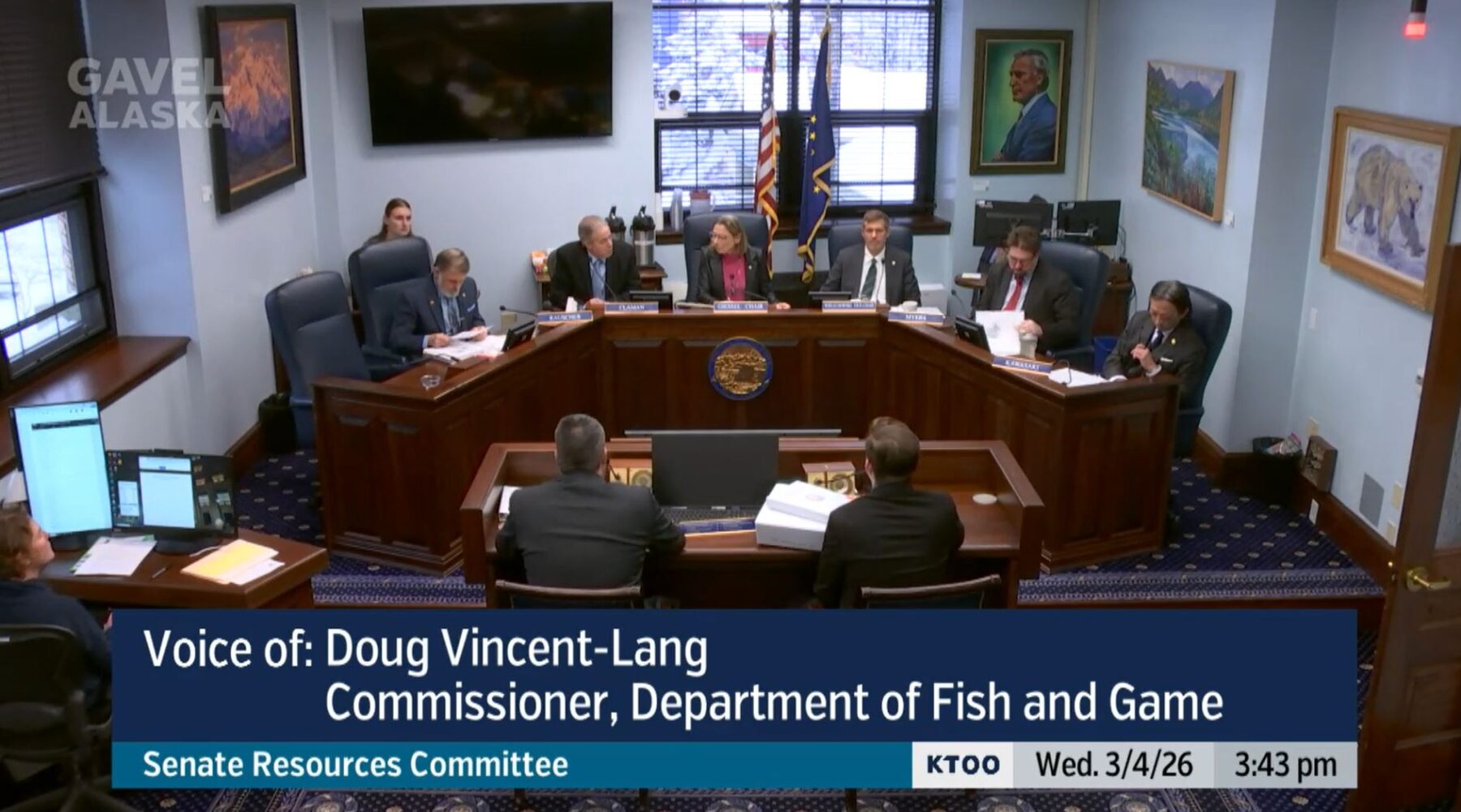
The Alaska Senate Resources Committee held hearings on SB 161, a proposal to prohibit bottom trawling in state waters starting in 2028. Sponsored by Sen. Mike Cronk (R-Tok), the bill also mandates a comprehensive study by the Alaska Department of Fish and Game (ADF&G) on trawling’s impacts on seafloor habitats, marine wildlife, and bycatch, with recommendations for sustainable management. The hearings revealed deep divisions between supporters emphasizing ecological and cultural preservation and opponents highlighting economic impacts on coastal communities and the need for science-based management through existing regulatory bodies.
Sen. Cronk presented SB 161, framing it as essential for addressing declining fisheries. He cited statistics like a two-thirds reduction in halibut weights over 35 years and consistent declines in Chinook salmon sizes over five decades. Highlighting a 2024 incident where trawlers caught 2,000 Chinook salmon in one set—enough to decimate spawning populations in smaller tributaries—Cronk argued that current management by the Board of Fish and North Pacific Fishery Management Council (NPFMC) fails to prioritize subsistence and common use, violating Alaska’s Constitution (Article VIII, Sections 3 and 15). He referenced polls showing 70% support in 2024 rising to 74% in 2025 for banning trawling in state waters, asserting trawling as the largest controllable threat to salmon, halibut, crab, and other species.
Committee questions focused on jurisdictional boundaries. Vice Chair Sen. Wielechowski (D-Anchorage) inquired about the trawl fleet’s scale in state versus federal waters. Staffer Paul Menke estimated around 100 boats operate in both, with a majority of catch likely in federal waters beyond the three-mile state limit. Sen. Kawasaki (D-Fairbanks) sought specifics on locations, with Cronk identifying Kodiak and the Gulf of Alaska as key areas, noting curtailments due to king crab declines and distinguishing scallop dredging from pollock trawling. Sen. Claman (D-Anchorage) requested a map of the three-mile limit, which Manke agreed to provide as a for follow-up.
ADF&G Commissioner Doug Vincent-Lang clarified that over 90% of trawling occurs in federal waters, with state activities mainly for Pacific cod in the Aleutians and various species in Prince William Sound. He noted the bill would eliminate scallop dredging, the only practical method for that fishery, and close limited “parallel fisheries” access for federal boats in state waters. On monitoring, he confirmed federal requirements for electronic observers or monitoring, contrasting with state’s human-only programs, and mentioned a failed prior bill to expand state coverage.
Sen. Myers (R-North Pole) asked about the bill’s message to federal regulators. Cronk responded it would signal prioritizing Alaskans and resources, emphasizing food security for families amid declining catches in areas like Valdez and Seward.
No decisions were made, and the bill was set aside for public testimony.
Summary of Invited Testimony:
Chief Chairman Brian Ridley of the Tanana Chiefs Conference (TCC) supported SB 161, detailing Yukon River salmon collapses since 2020, leading to subsistence closures and food insecurity. He noted TCC’s $2 million annual aid distributing 120,000 pounds of salmon and a 70% prediabetes increase among Alaska Natives, arguing rural communities bear unfair conservation burdens.
President Richard Peterson of the Central Council of the Tlingit and Haida Indian Tribes echoed support, stressing ecosystem interconnectedness across state and federal waters, urging equitable conservation to protect subsistence.
Policy Director Rod Arno of the Alaska Outdoor Council backed the bill, citing habitat damage and Board of Fisheries’ inaction, aligning with constitutional sustainability.
Board President Patrick O’Donnell of the Alaska Whitefish Trollers Association, from Kodiak, opposed the bill and clarified that bottom trawling is already prohibited in most state waters except for shrimp, scallops, and a small Sanak Island area. He defended family-owned Kodiak fleets providing 63% of local groundfish, warning of economic harm.
Fisheries analyst Charlotte Levy of the Aleutians East Borough opposed, noting devastating impacts on small-vessel fleets in communities like Seward and King Cove, where 10% of harvest from state waters is crucial for safety.
CEO Luke Fanning of the Aleutian Pribilof Island Community Development Association (APICDA) criticized replacing established management with presumptive harm, urging study-first approach and reliance on ADF&G data.
President Julie Decker of the Pacific Seafood Processors Association (PSPA) opposed, citing negligible Gulf of Alaska bycatch of Western Alaska salmon (0-100 annually) and harmful precedent bypassing Board of Fisheries.
Summary of the Public Testimony:
A resident from Juneau, Glenn Merrill with 35 years in management, endorsed Board processes over legislation.
A resident from Anchorage, sport fisherman Ryan Astalos, supported but suggested exempting shrimp/scallops, citing unintended bottom contact in pelagic trawls.
A representative of the Kenai River Sport Fishing Association, Shannon Martin, supported, highlighting lost opportunities for Alaskans amid unequal conservation burdens.
A resident from Wrangell, third-generation fisherman Scott Phillips, sought protections for small-scale Southeast shrimp beam trawling.
A resident from Unalaska, former mayor Frank Kelty, opposed, advocating for ADF&G and Board initiation.
Mayor Sven Paukan from St. Mary’s urged passage, describing six-year subsistence bans leaving families without salmon, with his granddaughter never tasting it.
Brandon Ahmasuk of Quark Incorporated from Nome supported, emphasizing benthic habitat risks to walrus and subsistence.
Dianni Chapman of Alaska Environment from Anchorage backed the bill for seafloor integrity against desertification and acidification.
A resident from Anchor Point, Kerry Harris, supported a full ban, noting 75% Alaskan approval and river closures, urging gear transitions.
Lauren Hines with Oceana from Wasilla, marine scientist, provided data on long-lived corals/sponges damaged for centuries by trawls.
Mel Erickson from Soldotna, fishing guide, supported, frustrated by restrictions on sport/commercial sectors while trawlers evade conservation.
Patricia Phillips from Pelican, commercial longliner, praised the study, advocating 100% video monitoring for accurate bycatch data.
Janet Woods from Rampart, pleaded for action amid Yukon Chinook shortfalls, arguing subsistence users unfairly shoulder burdens while trawlers operate year-round.
Kelsey Ivanoff from Unalakleet, with Native Peoples Action, emphasized Indigenous stewardship, seafloor ecosystems, and kelp forests’ role in climate adaptation.
Commissioner Vincent-Lang responded, acknowledging concerns and outlining actions: industry research on pelagic gear impacts (report due June 2026), 100% scallop observer coverage, bycatch limits in Prince William Sound, and NPFMC reductions in halibut/crab/salmon bycatch. He stressed all fisheries have bycatch, committing to regulatory processes.
Chair Giessel closed testimony, setting SB 161 aside for further consideration with the next meeting on March 9.
The hearings underscored Alaska’s fisheries crisis, balancing cultural survival, ecological health, and economic vitality. SB 161’s fate hinges on reconciling these, potentially influencing federal policies amid widespread public engagement.


