
The Alaska Senate Finance Committee convened Monday for a high-stakes session centered on the Department of Revenue’s long-awaited spring revenue forecast and detailed life-cycle modeling of a hypothetical new oil field. The committee received updated projections showing meaningful revenue gains driven by higher Alaska North Slope oil prices. Yet presenters repeatedly stressed unprecedented market uncertainty, with volatility indices at near-record levels and wide probability bands that could swing unrestricted general fund revenue by billions.
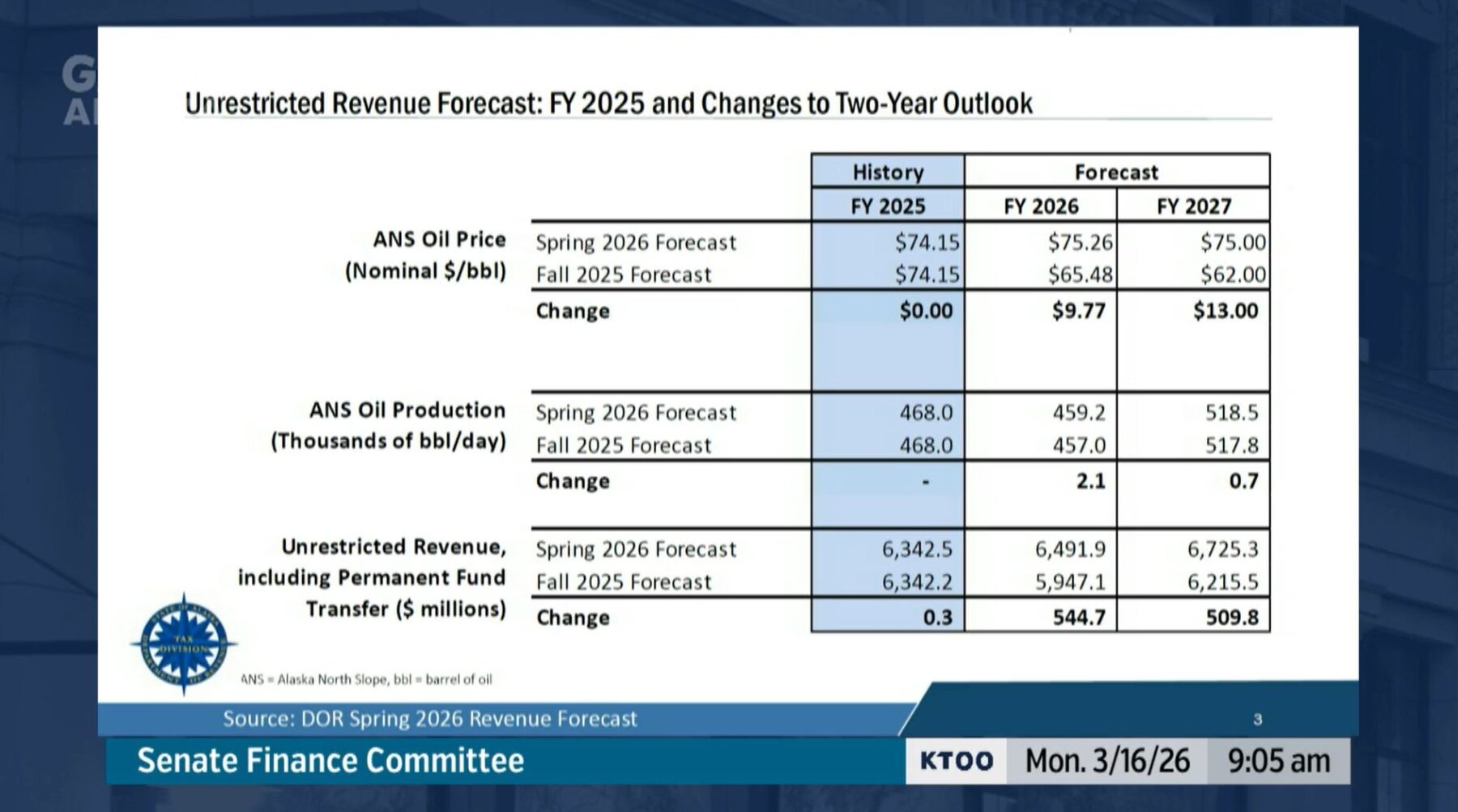
Acting Revenue Commissioner Janelle Earls introduced Chief Economist Dan Stickel, who described the spring forecast as “one of the more interesting” in recent memory. Slide Three captured the headline revisions: Alaska North Slope oil prices up $9.77 per barrel for FY26 and $13 per barrel for FY27, with FY27 now averaging $75 per barrel. Production forecasts rose modestly—2,100 barrels per day in FY26 and 700 in FY27—partly from the anticipated startup of new fields. Those inputs translated into an additional $545 million in unrestricted revenue for the current fiscal year and $510 million for FY27.
Stickel broke down the FY26 gain: $105 million from stronger non-petroleum corporate taxes (largely already booked by December), roughly $370 million from higher production tax and royalty revenue as prices lift more companies above the minimum tax floor, $20 million in additional oil-and-gas corporate taxes, $30 million from property tax increases (including the first detailed Trans-Alaska Pipeline System reassessment in years), and $18 million from mining and investment earnings. Through February, unrestricted revenue already ran $115 million ahead of the fall forecast, driven mainly by corporate income taxes outside petroleum.
Unrestricted revenue composition for FY25–FY27, shown on Slide Five, highlighted the POMV transfer as the dominant and most stable pillar: $3.8 billion in FY25, $3.9 billion in FY26, and $4.1 billion in FY27. Petroleum revenue contributed $1.9 billion in FY25, dipped slightly to $1.8 billion in FY26 before returning to $1.9 billion, while non-petroleum sources grew steadily from $639 million to $760 million. Total unrestricted revenue is now projected at $6.5 billion for FY26 (up from $6.3 billion) and $6.7 billion for FY27.
Oil price methodology and timing dominated subsequent slides amid March’s geopolitical turbulence. The department delayed finalization until March 11 to incorporate the latest futures data, using the median of the five trading days ending that Wednesday. Stickel noted the forecast assumes stable annual prices rather than monthly volatility—an important distinction when comparing regimes such as the former ACES tax, which captured temporary spikes. Sen. James Kaufman (R-Anchorage) asked for historical accuracy analysis; Stickel confirmed such reviews exist and that futures markets have proven the most reliable benchmark despite inherent forecasting challenges.
Volatility metrics underscored the risk environment. Illustrated by ANS prices averaging $74 per barrel since 2020 but with dramatic swings: negative pricing during peak COVID, spikes above $125 after Russia’s 2022 invasion of Ukraine, and a recent surge above $100 tied to Middle East developments. The Oil Volatility Index (OVIX) sits at its second-highest level since 2007, exceeded only by the initial COVID shock. Options-implied probabilities showed a 10% chance of prices exceeding $200 per barrel or falling to $30 later in FY26, and a 10th-to-90th percentile band for FY27 spanning roughly $45 to $130 per barrel around the $75 midpoint.
“There is a ten percent chance that oil prices will go well over $200 per barrel later this fiscal year. There is a ten percent chance that oil prices will fall to $30 per barrel later this fiscal year”
Late-year price variances translated into revenue sensitivity for the final four months of FY26. At the forecast $91.09 per barrel average for March–June, each $1 change moves unrestricted revenue by about $15 million. The 10th-to-90th percentile range implies a potential $1.5 billion swing—from below $6 billion to above $7.5 billion—highlighting the practical difficulty of budgeting amid such uncertainty.
Co-Chair Sen. Bert Stedman (R-Sitka) pressed for operational clarity on current supplemental requests. “What do we need for a break-even price when we look at the entire year of FY26?” he asked, noting modest pending supplementals would not strain finances but hundreds of millions could necessitate CBR draws. Stickel referenced the accompanying sensitivity matrix and committed to calculating an exact “from today forward” break-even inclusive of supplementals. Sen. Lyman Hoffman (D-Bethel) later framed the Senate’s proposed $373 million CBR authorization not as spending but as prudent contingency: “If they are materially lower… that is why the Senate proposed a draw on the CBR… just in case.” He emphasized the funds would remain untouched unless required, avoiding a special session in August.
Stedman requested expanded distribution data beyond the 10th–90th percentiles, including one- and two-standard-deviation ranges. Stickel agreed to provide those metrics alongside the break-even figure. The discussion reinforced caution: plan for materially lower outcomes while recognizing the POMV transfer’s stabilizing role—known with certainty for FY26 and FY27 and comprising more than two-thirds of unrestricted revenue.
Mining provided a diversification bright spot. Record gold prices above $5,000 per ounce and silver above $100 per ounce, plus gains in zinc and lead, are expected to generate over $200 million in FY27 revenue, including $189 million unrestricted. Mining license tax alone exceeds $100 million, with corporate income tax nearing $80 million and royalties contributing more than $30 million.
The afternoon transitioned to life-cycle economic modeling of a hypothetical 500-million-barrel field under current law (SB 21), current law without the Gross Value Reduction, and the former ACES regime. Stickel described the model’s purpose: evaluating full-field economics from pre-FID investment through decline, calculating net present values and internal rates of return for producers and governments. Assumptions included $25-per-barrel total costs, 12.5% royalty, and a 20% GVR for new fields. Pre-FID exploration costs were rolled into the first-year capital outlay for modeling consistency.
Under current law for a new entrant, the producer internal rate of return reached 13.1%—positive but marginal compared with the 15%-plus benchmark many firms target. State revenue totaled $6.7 billion over field life ($1.9 billion NPV at 10% discount), with production tax deferred several years due to GVR and credits. Municipalities (primarily North Slope Borough property tax) captured about 5% of profits. Stickel noted ACES would yield more state revenue from a new project but lower overall under the forecast price deck due to the softer minimum tax floor and different timing of credits. For incumbents, ACES paradoxically delivered both higher incremental state revenue and higher producer returns in some scenarios because of low-take during high-spend development phases.
Stedman raised sovereign exposure concerns: stacked multi-year developments without a cost-recovery limit could delay state revenue for extended periods. “You can’t just move one item and expect everything else to stay the same,” he cautioned, advocating holistic package design when considering policy levers. Kaufman emphasized cause-and-effect: policy changes drive investment reactions, and a 13.1% IRR is “not stellar.” Stickel confirmed the numbers align with current economics—projects remain marginally attractive, with limited excess profit available for capture.
The committee accepted the spring forecast framework and endorsed the CBR contingency authorization as risk management, not spending. Action items include delivery of the exact FY26 break-even price from today forward, expanded distribution analysis with standard deviations, updated sensitivities using the spring deck and historical prices, and further modeling outputs for multiple scenarios.
“There is a ten percent chance that oil prices will go well over $200 per barrel later this fiscal year. There is a ten percent chance that oil prices will fall to $30 per barrel later this fiscal year,” Chief Economist Dan Stickel stated, quantifying the extreme uncertainty framing near-term fiscal decisions.
Lawmakers prioritized protecting the CBR for genuine downside protection, leveraging the POMV’s predictability, and pursuing diversification through mining while scrutinizing tax structures that could deter marginal investment. With supplementals pending and a $373 million CBR backstop proposed, the committee signaled intent to plan conservatively—funding known needs without premature reliance on reserves. Updated break-even and sensitivity materials will inform final appropriations posture before session deadlines.


