
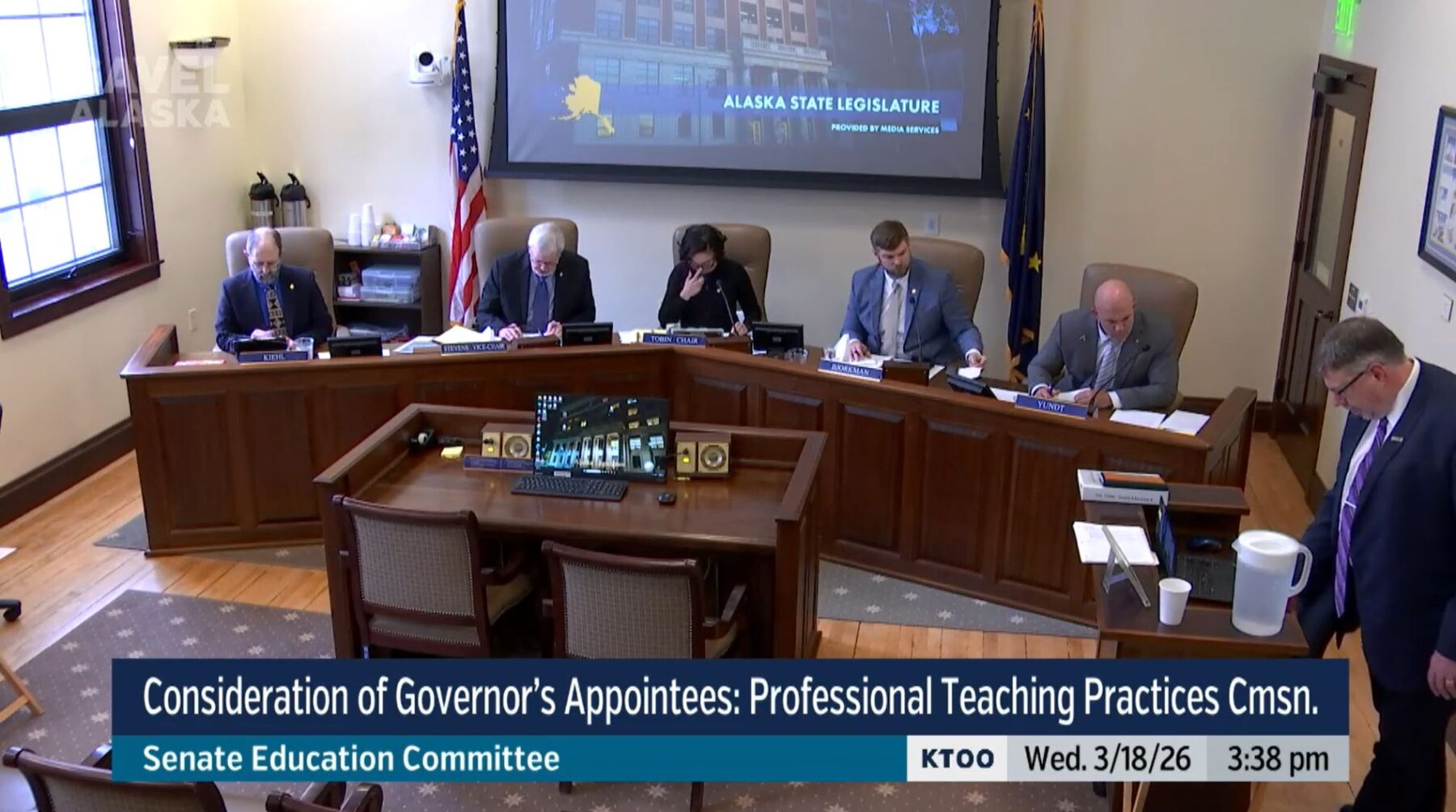
The Alaska Senate Education Committee, convened on interviewing qualified leadership while launching its first hearing on SB 277, a comprehensive package of education reforms.
The committee first recommended forwarding three appointees to a joint session for confirmation: Pamela Dupras, an educator with 23 years of statewide experience; Sally Stockhausen, Special Education Director in Ketchikan with 28 years in the field and emphasis on teacher apprenticeships; and Michael Robbins, Superintendent of the Bristol Bay Borough School District, who highlighted student-centered decision-making in rural communities. No public testimony was offered, and the nominations proceeded without objection, reflecting broad support for experienced professionals committed to quality education across Alaska’s diverse regions.
Sen. Loki Tobin (D-Anchorage), joined by staff Mike Mason, introduced SB 277 as a collaborative response to input from committee work, task forces, and the Children’s Caucus. The bill targets “prudent education reforms” to improve service delivery without overreach. Section 1 adjusts charter school indirect cost recovery from 4% to up to 8% (or actual costs, whichever is lower), allowing districts to recover legitimate overhead for services like facility support, therapies, transportation, and HR functions. Sen. Gary Stevens (R-Kodiak) sought clarification on making districts “whole” without harming other students, and Sen. Rob Yundt (R-Wasilla) stressed local control in contract negotiations.
Section 2 removes barriers for correspondence students switching programs or returning to traditional schools by allowing retention of materials, addressing fiscal penalties that could reach thousands of dollars over multiple years. Yundt called the prior practice “very unfair,” while Sen. Jesse Kiehl (D-Juneau) urged narrowing language to distinguish consumables from high-value durable goods.
Section 3 indexes pupil transportation grants to motor fuels CPI (approximately 6.5%), projecting a $6.5 million statewide increase.
Sections 4 and 7 drew the most scrutiny, establishing inter-district cooperative agreements with an 8% indirect cost cap for local services provided to out-of-district correspondence students. Sen. Tobin provided examples of hybrid arrangements and dual enrollment, where funding follows the student but protects home-district taxpayers. Sen. Yundt praised the hybrid model’s future potential and confirmed the cap’s flexibility (down to 0% if no services are used). Sen. Kiehl questioned fee scope to safeguard dual-enrollment course funding and standard activity fees. The chair raised scenarios involving specialized therapies, prompting discussion of telehealth alternatives and guardrails. The intent—local control with accountability through Department approval—was framed as balancing choice with fiscal prudence.
“Our charter schools actually cost more to operate than our brick-and-mortar schools… because of the administrative costs incurred by the district, but not necessarily recouped through the indirect rate,” Sen. Loki Tobin stated, explaining the rationale for balanced cost recovery.
Section 5 eliminates the 0.9 ADM multiplier for correspondence students, counting them at 1.0 for base funding while excluding full foundation formula multipliers. Section 6 applies a 1.9% Anchorage CPI adjustment to the Base Student Allocation, raising it from $6,660 to $6,786.54 and injecting approximately $31.8 million statewide. Sections 8 and 10 modernize accreditation language from “regional” to “institutional” for federal alignment. Sections 11–16 grant the Southeast Regional Resource Center (SERC) parity with districts to rehire retired educators without retirement penalties, a “common sense update” per Executive Director Chris Reitan, who noted SERC’s partnerships with 88 percent of districts in special education and other supports.
Section 17 removes “subject to appropriation” language from the Alaska Reads Act, triggering roughly $26 million for $450 per-student reading proficiency grants to enrolling districts. Sen. Yundt highlighted the “Read by Nine” focus but expressed concern that funds reach families rather than remaining at the district level, citing past BSA increases that did not increase allotments. Section 18 authorizes the Legislative Budget and Audit Committee to commission a foundation formula review with the University of Alaska Anchorage’s Institute of Social and Economic Research, targeting data-driven recommendations for 2027 policymaking.
Lori Weed and Deborah Riddle presented fiscal notes projecting $77.7 million over FY2027–2032 for the Public Education Fund (including $4.7 million for transportation and $73 million for formula changes), plus a $78.7 million FY2026 supplemental. The Student and School Achievement component added $22.3 million in FY2027, including $21.8 million for reading grants and one new specialist position. The committee directed staff to compile totals for transparency.
Public testimony, with approximately 38 participants and a two-minute limit, revealed strong public engagement. A resident from Wasilla expressed skepticism that increased funding reaches classrooms, opposing the charter indirect cap increase as an “arbitrary success tax” on high-performing alternatives. A resident from North Pole warned that Sections 4 and 7 shift control back to districts families left due to unmet special needs. A resident from Anchorage highlighted risks of administrative redundancies and double fees for dual-enrolled students. A resident from Fairbanks, a certified teacher and former homeschool parent, argued the provisions could falsely inflate home-district budgets without improving outcomes. Rural voices, including a resident from Yukon-Koyukuk and a resident from Nenana, cautioned against undermining successful correspondence systems that serve remote communities. A resident from Kenai Peninsula described enforcement gaps in existing memoranda of agreement. Supporters included a resident from Anchorage representing the Coalition for Education Equity, who praised inflation adjustments and the foundation formula study while noting Alaska’s lagging investment since 2013. A resident from Anchorage School District board offered technical clarifications on indirect rates and transportation shortfalls.
The committee made directional decisions: forwarding appointees, indexing transportation and BSA to inflation, removing the correspondence multiplier, authorizing SERC rehire flexibility, fully funding the Alaska Reads Act, and commissioning a formula review. No final votes occurred, with plans for a committee substitute incorporating clarifications on cooperative triggers, fee scope, ADM placement, and grant timing. Public testimony remains open for the next hearing.
As Senator Tobin noted, the goal is “better quality of education services for young folks” without damaging successful choice models.


