
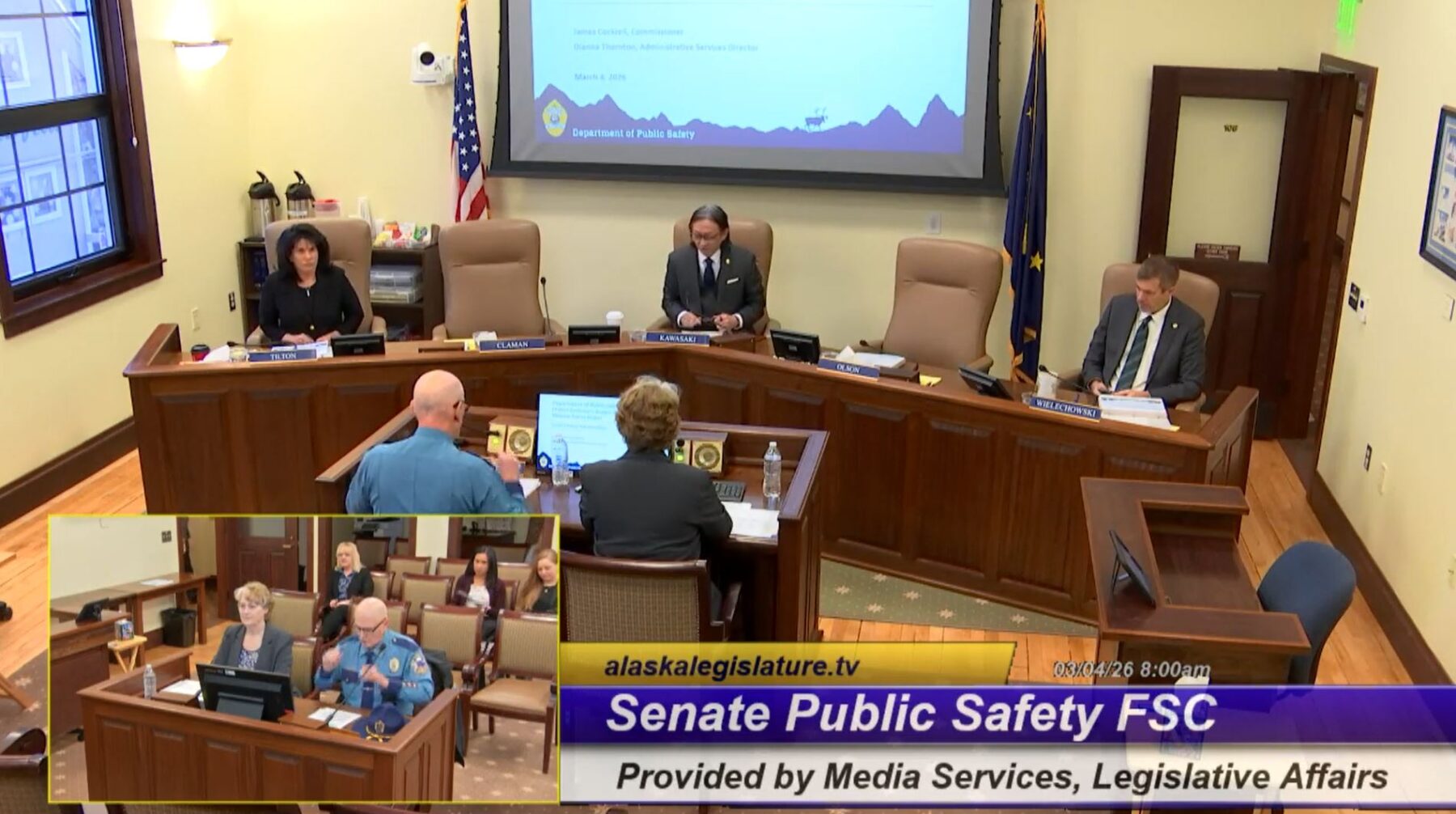
The Senate Department of Public Safety Finance Subcommittee opened its FY27 budget review with a clear message of progress amid persistent challenges. Commissioner James Cockrell and Administrative Services Director Dianna Thornton delivered a concise yet comprehensive overview covering midyear FY26 status, supplemental needs, legislative intent follow-up, and the Governor’s proposed FY27 operating budget.
Commissioner Cockrell opened with statewide trends: “Statewide, we’ve seen crime decrease… approximately about 41%.” He noted violent crime remains a focus but credited targeted enforcement for measurable gains. Drug interdiction yielded “634 pounds of illicit drugs,” primarily seized near Anchorage’s airport entry points via USPS, airlines, FedEx, and UPS. Modest trooper staffing growth and improved retention have sustained momentum.
The Village Public Safety Officer (VPSO) program stood out as a “shining star.” Cockrell reported 87 of 90 funded positions filled, with 20 new VPSOs placed in previously uncovered villages. “Our ultimate goal is to provide a VPSO in any village that wants one,” he stated, acknowledging the program’s expansion despite cost pressures. The Missing and Murdered Indigenous Persons (MMIP) Unit, with four investigators across regions, has delivered results: two long-missing individuals located, three sets of remains identified, and additional cases advancing. “We’re the only agency in Alaska that’s focused directly on missing and murdered indigenous persons, including unidentified remains,” Cockrell emphasized.
Forensic improvements were equally notable. The crime lab has cleared backlogs on sexual assault kits, with turnaround times continuing to drop. Cockrell voiced strong support for HB 69, the sexual assault tracking kit legislation, noting it would empower victims with real-time status updates. Three Crimes Against Children investigator positions in Western Alaska are now filled, preventing patrol troopers from being pulled from other duties.
Administrative Services Director Dianna Thornton outlined budget mechanics. The FY27 request totals approximately $336 million, a 2% increase over FY26, with 58% allocated to personal services. Key increments include $1.3 million in general funds to sustain statewide body-worn and in-car camera operations—now fully deployed with over 600 body cameras and nearly 400 in-car systems feeding a unified digital evidence platform. Thornton explained the shift from capital deployment to recurring operations: “The increment covers ongoing operational cost for the system including licensing, storage, evidence management.”
A $1.25 million FY26 supplemental request for VPSO operations addresses an operating shortfall driven by improved retention (from 50% in 2017 to 80% last year), rural travel, and equipment costs. Without it, grant-funded positions would face reduction. An FY27 structural alignment of $1.65 million aims to prevent recurring gaps. Thornton noted internal efficiencies already implemented, including merged academies and eliminated recruitment advertising.
The Restorative Justice Fund dynamics drew scrutiny. Thornton detailed a $592,000 reduction in Violent Crimes Compensation Board authority to align with projected revenues and a $169,000 CDVSA reduction offset by equivalent general funds to stabilize shelter grants. “The reduction aligns the spending authority with the projected revenue of the fund,” she stated, ensuring no change in eligibility or services.
Senator Claman (D – Anchorage) requested a detailed breakdown of the 61% appropriation share between Alaska State Troopers and Wildlife Troopers, including position counts. Thornton committed to providing component-level data. Discussion also touched on the unfunded Talkeetna Post, with coverage now stretched from Palmer, Wasilla, and Cantwell. Cockrell described high visitor traffic and enforcement gaps along the Parks Highway, a known drug corridor.
Senator Wielechowski (D – Anchorage) inquired about tribal policing relationships. Cockrell described collaboration at two levels—village-based officers with limited training and more formalized forces like Chickaloon’s that meet state standards. A budget request would enable VPSO Division training in Bethel for both Village Police Officers and tribal officers.
On Anchorage public safety, Wielechowski asked about the governor’s State of the State remarks. Cockrell clarified DPS provides support rather than primary policing, citing surges like “Summer Heat” with APD, Marshals, and Probation. He advocated sustained presence over periodic operations: “If a quiet community means we’re doing our job, and we don’t have to arrest, that’s success.”
The subcommittee noted ongoing pressures on domestic violence shelters and the Violent Crimes Compensation Board, with House subcommittee amendments proposing additional increases.


