
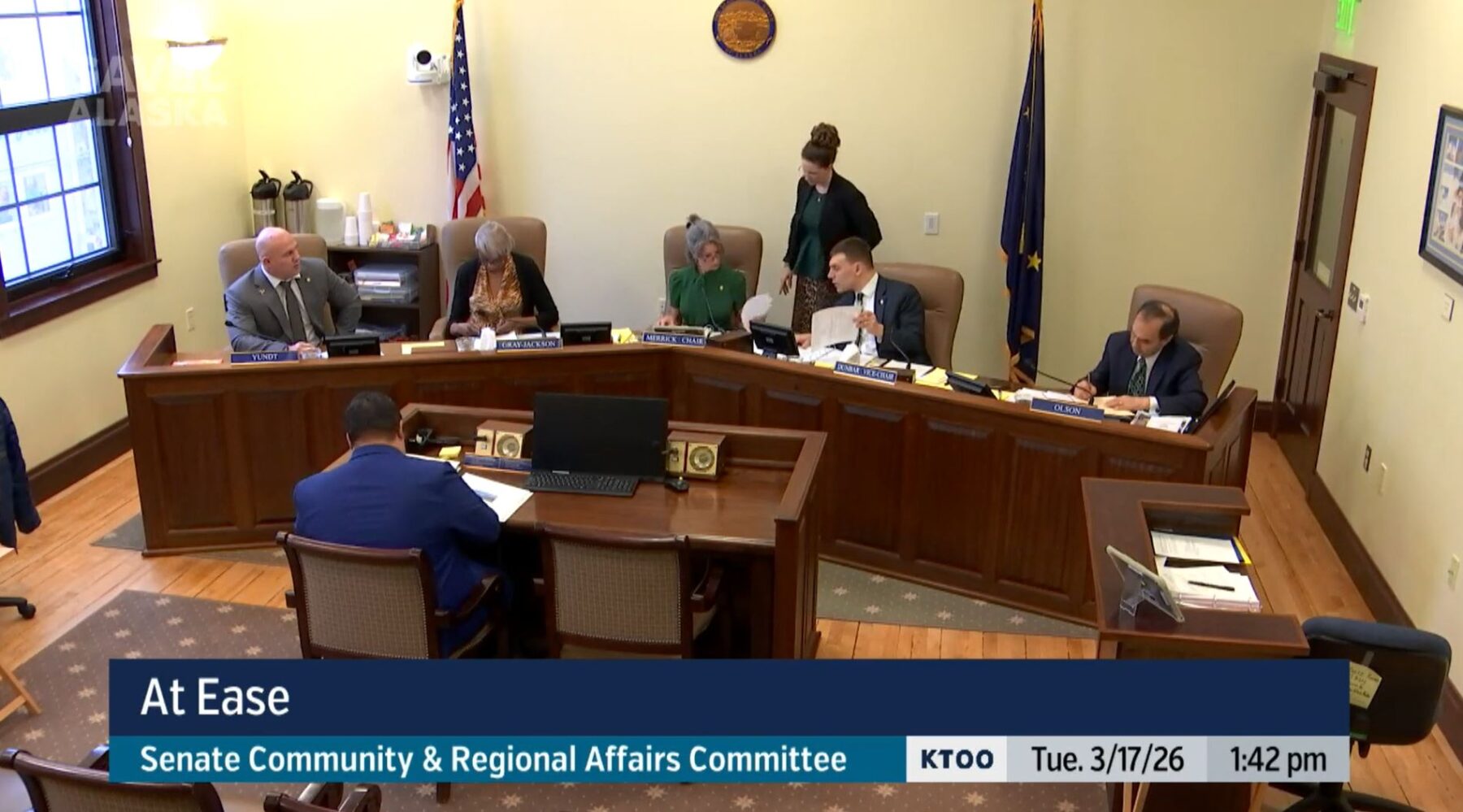
The Senate Community and Regional Affairs Committee held a productive session Tuesday focused on legislation empowering local governments while addressing critical public safety concerns. The committee moved three bills forward and advanced others for further review. Discussions highlighted optional tools for municipalities to manage taxes and operations efficiently, alongside urgent action on child safety in the digital age.
HB 13: Municipal Property Tax Exemptions
The committee first addressed HB 13, sponsored by Rep. Andrew Gray (D-Anchorage), which provides municipalities with five optional property tax exemptions aimed at encouraging affordable housing development. Gray emphasized the bill’s focus on flexibility: “House Bill 13 offers five different ways for municipalities to make optional property tax exemptions that would hopefully help us get more housing that Alaskans can afford.” Staff Sorcha Hazelton outlined the committee substitute, which aligns refund interest on overpayments with market realities. Under current law, municipalities must pay 8% interest regardless of fault or prevailing rates. The substitute reduces this to three percentage points above the Federal Reserve District discount rate when the taxpayer is not at fault, and eliminates interest entirely for taxpayer-caused errors. Hazelton noted the changes stem from an Alaska Municipal League resolution, allowing communities to retain more resources while remaining fair to residents.
The substitute required a title change but passed without objection. Vice Chair Sen. Forrest Dunbar (D-Anchorage) then moved the bill from committee for third reading and passage with individual recommendations, fiscal note, and title change resolution, authorizing Legislative Legal Services for conforming edits. With no opposition, HB 13 advanced.
SB 143: Municipal School Board Terms and City Council Composition
Next, the committee considered SB 143, sponsored by Sen. Rob Yundt (R-Wasilla), granting municipalities and boroughs optional authority to set school board term lengths—already available for assemblies and mayors—and allowing second-class cities under 1,000 population to choose council sizes from three to seven members. Staff Ryan McKee explained the bill preserves voter approval for any changes, citing Mat-Su Borough savings from shifting assembly seats to four-year terms to reduce off-year election costs. Yundt added, “This would have to be at the pleasure of the voters,” reinforcing democratic accountability.
The committee substitute incorporated the council-size flexibility requested by the Alaska Municipal League. Hazelton highlighted representational imbalances in small communities, noting a 40-person town with 20 voters would see each council member represent 35% of the population under the current seven-member requirement. The substitute passed without objection. Sen. Dunbar moved the bill from committee with individual recommendations and fiscal note.
SB 255: Municipal Grant Land – Mat-Su Borough Transfer
The committee smoothly advanced SB 255, sponsored by Sen. Yundt, facilitating the transfer of municipal grant land to the Mat-Su Borough. After prior introduction and invited testimony on March 3, the bill faced no additional comments or questions. Public testimony opened and closed with no participants. Senator Dunbar moved the bill from committee with individual recommendations and fiscal notes, authorizing Legislative Legal Services for conforming changes. With no objections, SB 255 progressed.
SB 259: Optional Cap on Assessed Residential Property Values
SB 259, sponsored by Sen. Jesse Bjorkman (R-Nikiski), generated substantive discussion as the committee adopted a committee substitute and set the bill aside for further consideration. The measure allows municipalities the option to cap annual increases in assessed value at 5% or less for permanent places of abode, treating capped values as full and true value while prohibiting state penalties for adoption. Sen. Bjorkman described it as a “smoothing mechanism” to prevent assessment spikes that burden taxpayers: “The desire is for this cap to really serve as a smoothing mechanism and to disallow spikes in assessments that really offer taxpayers a lot of heartburn.” He noted optional nature prevents mandates, while the 5% threshold curbs compounding increases.
Sen. Dunbar questioned the fixed cap versus broader local discretion and potential burden shifts onto renters under Anchorage’s tax cap, asking whether multifamily properties could qualify. Bjorkman confirmed focus on owner-occupied homes but acknowledged edge cases like fourplexes. State Assessor Dan Nelson clarified the “owned and occupied” and 185-day rule, warning of possible inequities if rental units remain uncapped. Public testifier Lisa Bass supported the bill, citing an $8 million borough deficit and education funding strains: “If this continues, it’s definitely going to push more families out of the state.” The substitute passed without objection, but the bill remains pending further analysis on multifamily treatment, renter impacts, and service-area dynamics.
SB 247: Generated Obscene Child Sexual Abuse Material
The committee held a first hearing on SB 247, sponsored by Sen. Jesse Kiehl (D-Juneau), addressing AI-generated and computer-edited child sexual abuse material (CSAM) with parity to traditional offenses. Kiehl stressed urgency amid technological advances: “The rapid growth of artificial intelligence is leading to the ability to generate images… some people use these technologies to terrible effect.” The bill criminalizes knowing possession and distribution of generated CSAM, applying the Miller obscenity test for cases without identifiable real children, while maintaining existing “knowingly” mens rea.
Trevor Storrs of the Alaska Children’s Trust testified in support, citing alarming trends: NCMEC AI-related CSAM reports surged from 4,700 in 2023 to over 400,000 in the first half of 2025. Alaska data showed sexual abuse comprising 10% of maltreatment cases in 2022, up from 5% in 2015, with 35% of Alaska women reporting childhood victimization in 2020. Storrs highlighted 186,000 national sextortion victims in 2023 and at least 36 teenage boy suicides linked to it. Sen. Dunbar sought clarification on mens rea and scope, ensuring non-obscene materials like children’s doodles remain protected. Kiehl confirmed reliance on the Miller test and existing CSAM definitions. The bill was set aside for further review, with Department of Law invited to the next meeting.
SB 258: Contract Licensing for Software Applications
The committee introduced SB 258, also sponsored by Sen. Kiehl, preventing software licenses from restricting where state and municipal entities run applications. Kiehl framed it as ensuring merit-based procurement: governments should choose based on “performance, security, interoperability, time to value, long-term cost.” The bill bars terms forcing migration to vendor-preferred clouds or prohibiting competitors’ infrastructure, preserving on-premises, cloud, or hybrid flexibility.
Sen. Dunbar supported the anti-lock-in approach, drawing parallels to right-to-repair legislation. Kiehl noted the public-sector focus, consistent with other states. The bill advances for continued consideration, underscoring conservative priorities of competition, taxpayer value, and government efficiency free from vendor capture.
With several bills moving forward and others refined, the panel continues prioritizing Alaska families, local control, and responsible governance.


