KETCHIKAN, Alaska — Charley McAnally, a retired Alaska law-enforcement officer with more than 30 years of public-service experience, is expanding a practical online training program designed to serve individuals, agencies, organizations, and rural communities throughout Alaska.
McAnally is the founder, lead instructor, and curriculum developer for McAnally Training and Consulting, a Ketchikan-based training company offering courses that can be completed using a telephone, tablet, or computer. The online format is intended to make professional development more accessible to people who may not have the time, funding, or ability to travel away from their communities for traditional classroom instruction.
Although McAnally currently lives in Ketchikan, his connection to rural Alaska is deeply personal. He was raised in Selawik and still has a family cabin upriver, near the place where his father’s ashes were spread. Two of McAnally’s children are NANA shareholders, further strengthening his family’s continuing connection to the Northwest Arctic region.

“Being raised in Selawik taught me the importance of community, responsibility, self-reliance, and helping people when help is needed,” McAnally said. “Those lessons have stayed with me throughout my career and are part of the reason I want this training to reach rural Alaska.”
McAnally’s public-service background includes law enforcement, fire service, emergency medical services, search and rescue, military medicine, industrial safety, instruction, and emergency response. He is a former Village Public Safety Officer and has served as a field training officer, methods-of-instruction trainer, and public-safety instructor.
He also served as an advanced combat medic in the Army National Guard and spent approximately three years in Iraq as an international police trainer. While working in Iraq, he helped train the country’s first police dive team.
Closer to home, McAnally served as a public-safety diver and volunteered in body-recovery operations on the Selawik and Kobuk Rivers. Those difficult missions gave him firsthand experience with the emotional, physical, and operational challenges faced by responders working in remote environments.
“Public safety in rural Alaska is different,” McAnally said. “Responders may work with limited equipment, long transportation delays, extreme weather, and very few available personnel. Training needs to recognize those realities and provide information people can actually use.”
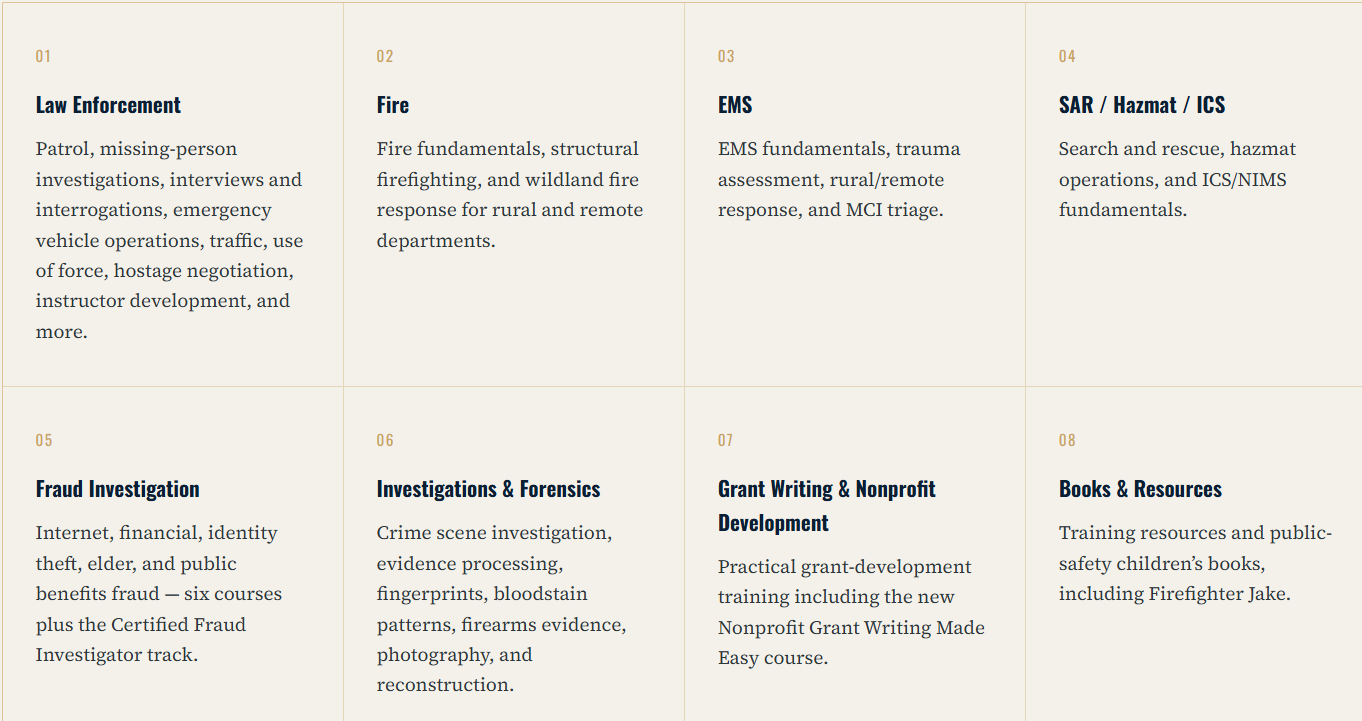
McAnally Training and Consulting offers courses in areas that include:
- Law enforcement and public safety
- Fire and emergency medical services
- Emergency management and disaster preparedness
- Hazardous materials and workplace safety
- Search and rescue
- Leadership and supervision
- Report writing and professional documentation
- Instructor development
- Policy and procedure development
- Grant writing
- Community and organizational preparedness
Basic, intermediate, and advanced courses are being continuously developed and added. The company also offers bulk enrollment and agency licensing options for tribes, municipalities, public-safety departments, nonprofit organizations, businesses, and other employers seeking training for multiple participants.
Among the company’s programs is a Grant Writer Certification Course intended to help participants understand how to identify funding opportunities, develop stronger proposals, organize supporting materials, construct realistic budgets, and improve grant-management practices.
When allowed by the applicable funding program, organizations may be able to include relevant training expenses in a grant proposal. Allowability depends on the specific grant, funding source, approved budget, and applicable rules, so organizations should always confirm eligibility with the funding agency.
McAnally said the goal is to provide practical instruction based on real-world experience rather than theory alone.
“Many people in Alaska already carry enormous responsibilities,” he said. “They may be responding to emergencies, supervising employees, writing reports, developing policies, seeking grant funding, or helping keep their communities prepared. I want to give them useful tools that respect their time and experience.”
The online format allows participants to study from their own communities and proceed through coursework without the expense and disruption of unnecessary travel. This can be especially important for rural agencies that may struggle to send employees away for training while maintaining essential local services.
McAnally personally reviews completed examinations and issues certificates to successful participants. He said maintaining direct involvement in the training process helps ensure accountability and gives students a clear connection to the instructor responsible for developing the material.
The company’s statewide outreach is intended to introduce the training platform to tribal governments, municipalities, public-safety organizations, emergency responders, nonprofit groups, private employers, and individual professionals throughout Alaska.
“This is more than a business to me,” McAnally said. “It is a way to take what I have learned through more than three decades of service and make it available to people who are serving their own communities today.”
Additional information and current course offerings are available at McAnallyTraining.com.
Press release provided by McAnnally Training and Consulting.