
The Alaska Legislature’s Legislative Council, which meets on administrative matters when the body as a whole is not in session, will take up on Dec. 12 what looks like a final draft of a social media policy guide for legislators.
Some legislators have run into legal troubles when constituents sued them for banning them from commenting or removing their comments from the legislators’ official page, where they are presented as government officials. The First Amendment to the U.S. Constitution addresses the government censoring citizens, and social media has become one of the latest battlegrounds.
One nonconstituent, Mark Kelsey, represented by the Northern Justice Project, sued Rep. Kevin McCabe for blocking him, and won in court earlier this year; that case, however, is still under review, due to a recent Supreme Court ruling. Kelsey was harassing other commenters on a page that was operated by McCabe personally, not officially. Another Democrat sued former Sen. Lora Reinbold, who is still battling in court and is representing herself in the long-running case.
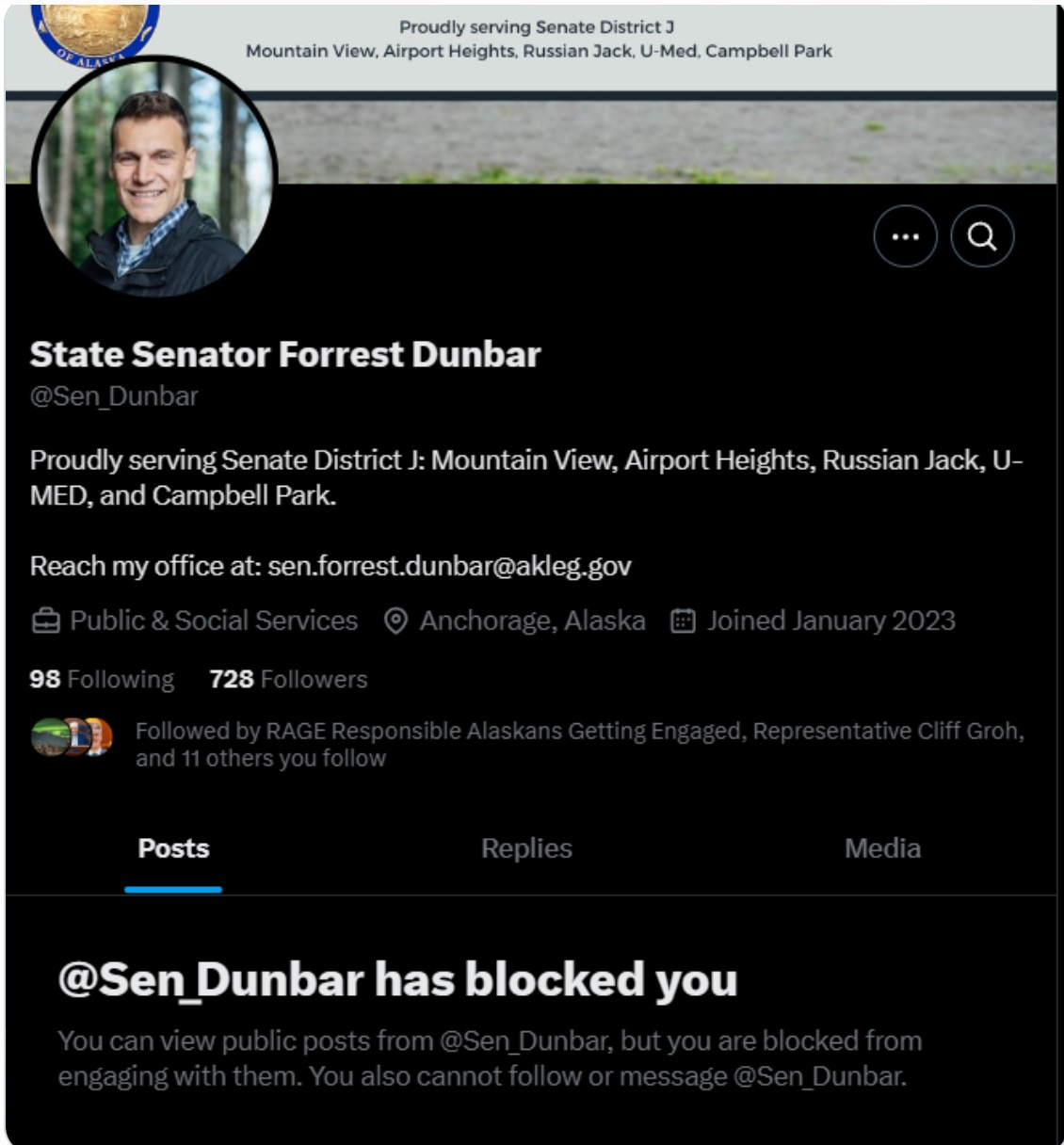
For years, Democrat Sen. Forrest Dunbar has blocked Must Read Alaska from his official government social media page on X. Recently, after this conservative publication pointed it out to legislative staff at the Legislative Affairs Agency, Dunbar, who is a lawyer, suddenly unblocked the publication. Must Read Alaska, unlike the Democrats, has never sued Dunbar over what the court has determined in the McCabe case is an illegal action.
The new policy that will be considered next week says that if legislators allow comments on their official social media accounts (ones that use their elected title and link to their official office), legislators shall not block, ban, or remove comments made by the public, because it is viewpoint discrimination. There are exceptions for obscene comments or posts.
Among the specifics in the draft policy:
“It is the policy of Legislative Council that a legislator assumes all risk and responsibility for legal defense of any action resulting from filtering, deleting, or hiding comments on a social media post related to legislative matters, or from blocking, banning, or otherwise restricting user access to a social media account used for legislative matters.”
The policy advises legislators clarify that their social media page is not an attempt to exercise the authority of the legislature by following these suggestions, which the courts may apply as tests to determine whether you’ve taken a “state action”:
- “Add a disclaimer to your social media account stating, “The views expressed on this page are strictly my own; I do not speak on behalf of the legislature”;
- “Refrain from having a legislative employee manage your account;
- “Do not share official information and, if sharing official information, do not invoke the authority of the legislature when sharing the information; and
- “Share only information that is available elsewhere and, if possible, include a link to where that information is available; do not use the account to make legislative announcements unavailable elsewhere.”
The policy advises legislators that they simply do not allow comments or other interactions with the public on posts, or on the account itself. If no one is allowed to comment on the official page, there can be no conflicts over discrimination against viewpoints, the legislative attorney said in her draft.
“If you disable the public’s ability to post or comment on your social media platform, either by account or by post, there will be no public forum and no risk of violating someone’s rights under the First Amendment,” the policy advises.
“If you choose to open your account to comments or other public interaction, do not filter, delete, or hide comments and do not block or ban any person from access to the account.”
Such activities around the country by lawmakers at every level of government have been an evolving portion of law, but in March, the Supreme Court ruled that officials just can’t block or ban people from official social media accounts that they use as personal pages, but where they discuss official actions of the government.
Read the entire draft policy here:


