
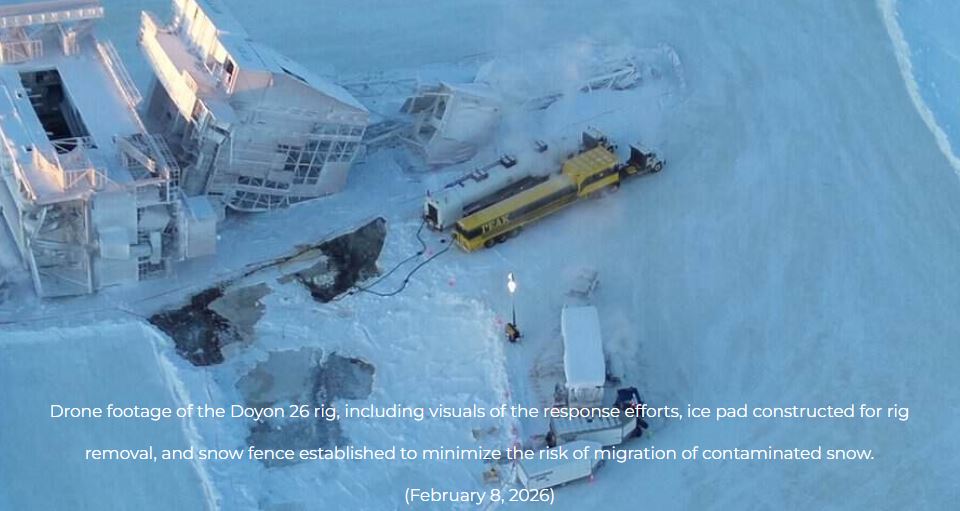
In the wake of the January 23, 2026, overturning of the drilling rig Doyon 26 on Alaska’s North Slope, response teams have made substantial headway in cleanup and deconstruction efforts, as detailed in recent updates and official reports. The incident, which occurred on a gravel road approximately 6.5 miles northwest of Nuiqsut, involved the massive rig—nicknamed “The Beast” for its nearly 10 million-pound weight—tipping over during transport for ConocoPhillips operations. This led to a spill of about 4,000 gallons of diesel and 600 gallons of hydraulic oil onto the tundra, accompanied by a brief fire that was swiftly contained by emergency responders. Fortunately, all personnel were accounted for, with no serious injuries; eight individuals received treatment at nearby clinics and were released. Nearby infrastructure, including pipelines roughly 202 feet away and the community’s natural gas supply, sustained no damage, and the seasonal fuel haul proceeded without interruption.
The Alaska Department of Environmental Conservation’s (DEC) Situation Report 3 (SitRep 3), issued on February 4, 2026, provides a comprehensive snapshot of the early response. Under a Unified Command led by Doyon Drilling, Inc. and including the EPA, DEC, North Slope Borough, and Iñupiat Community of the Arctic Slope, efforts focused on source control, with no ongoing leaks observed. Initial actions included delineating the spill area using visual, infrared, and aerial methods, deploying sandbags to curb migration, and constructing a snow fence to contain contaminated snow. By then, crews had recovered 111 gallons of product through water flushing and vacuum trucks. The site, within critical habitat for polar bears, caribou, Arctic foxes, muskox, and ptarmigan, showed no wildlife impacts, though an Arctic fox and collared muskox were spotted. Air monitoring was established, and weather challenges—like below zero temperatures and blowing snow—delayed some activities. The report outlined a three-phase plan: Phase 1 for containment and mitigation, Phase 2 for rig inspection and removal, and Phase 3 for final remediation. Resources at risk were noted, but no threats to waterways, like the nearby Nechelik Channel tributary, or the community were identified.
By February 19, 2026, Phase 2 had advanced significantly, with over 2,475 gallons—more than half the estimated spill—recovered. Approximately 30% of the rig had been deconstructed, starting with the derrick, and parts were loaded for transport via a newly built ice road and pad to minimize tundra damage. Site evaluations continue in real-time, with deconstructed components slated for cleaning and recycling. No immediate risks to air quality, water sources, wildlife, or infrastructure persist, and a third-party investigation into the cause is ongoing.
ConocoPhillips has adapted swiftly, shifting operations to the Doyon 142 rig, which shares a similar modular design, to limit delays in exploration and development. This pivot highlights ERD’s role in sustainable growth. “This project opens a new era we call ‘growth without gravel’ where we can use extended reach technology to access 60 percent more acreage from a single pad, dramatically reducing our footprint,” said Erec Isaacson, president of ConocoPhillips Alaska.
Stakeholders emphasize collaborative efforts to ensure full recovery, with ongoing monitoring and public updates via the Unified Command. As Alaska’s oil industry navigates environmental and operational hurdles, this incident serves as a reminder of the Arctic’s challenges, yet also of the sector’s resilience and commitment to safety.


