
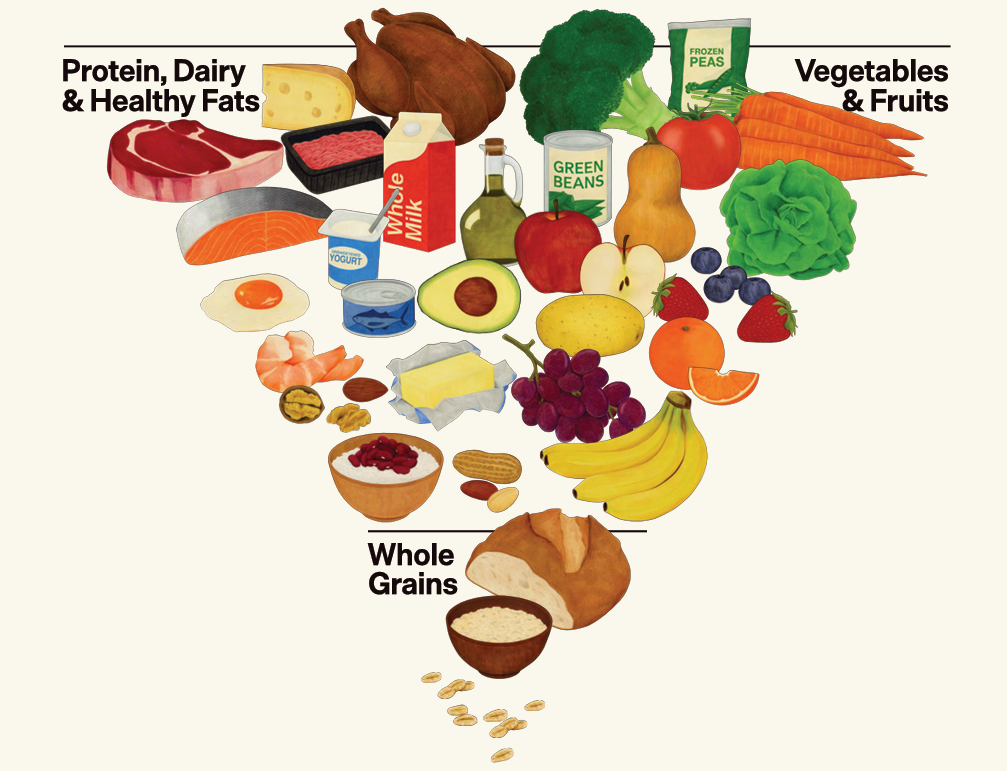
On January 7, Department of Health and Human Services Secretary Robert F. Kennedy Jr. and Department of Agriculture Secretary Brooke Rollins released America’s new dietary guidelines, emphasizing a return to the basics. The guidelines begin, “The message is simple: eat real food.” This mean prioritizing nutrient-dense, no-additives proteins in every meal and regularly consuming sugarless dairy products, whole fruits and vegetables, healthy fats, and whole grains. The guidelines emphasize that “no amount of added sugars or non-nutritive sweeteners is recommended or considered part of a healthy or nutritious diet.”
The new guidelines aim at reducing food-related chronic diseases and obesity rates in America. According to the “Message from the Secretaries” included in the new guidelines: “The United States is amid a health emergency. Nearly 90% of health care spending goes to treating people who have chronic diseases. Many of these illnesses are not genetic destiny; they are the predictable result of the Standard American Diet—a diet which, over time, has become reliant on highly processed foods and coupled with a sedentary lifestyle.”
According to a fact sheet from the Trump Administration: “The United States faces the highest obesity and Type 2 Diabetes rates (OECD) in the developed world.” Additionally, the U.S. spends 2.5 times more per capita than the average of developed countries (OECD) on health care. Despite the high healthcare spending, U.S. life expectancy is 4 years lower than the average among developed countries. The Trump Administration identifies unhealthy eating habits as a primary driver of these statistics.
Secretary Kennedy calls on Americans to “prioritize whole, nutrient-dense foods—protein, dairy, vegetables, fruits, healthy fats, and whole grains—and dramatically reduce highly processed foods. This is how we Make America Healthy Again.”
Alaskans wrestle with unhealthy eating behaviors similar to the rest of the country. According to the “Alaska Physical Activity, Nutrition and Obesity Facts Report” published by the Alaska Department of Health in August 2025: over 70% of Alaskan adults are overweight or obese, 85% of Alaskan adults do not consume the recommended amount of vegetables, over 90% of Alaskan high schoolers do not consume the recommended amount of fruits and veggies, and 43% of Alaskan high schoolers report engaging in unhealthy eating behaviors such as trying to lose weight via unsafe methods and/or binge eating.
With economic strain and high costs of fresh foods contributing to unhealthy choices, America’s new dietary guidelines cannot solve the whole problem. However, the guidelines inform Americans about healthy eating and the dangers of unhealthy eating, encourage healthier personal choices, and drive food system policies based on “common-sense, science-driven” nutrition.


