
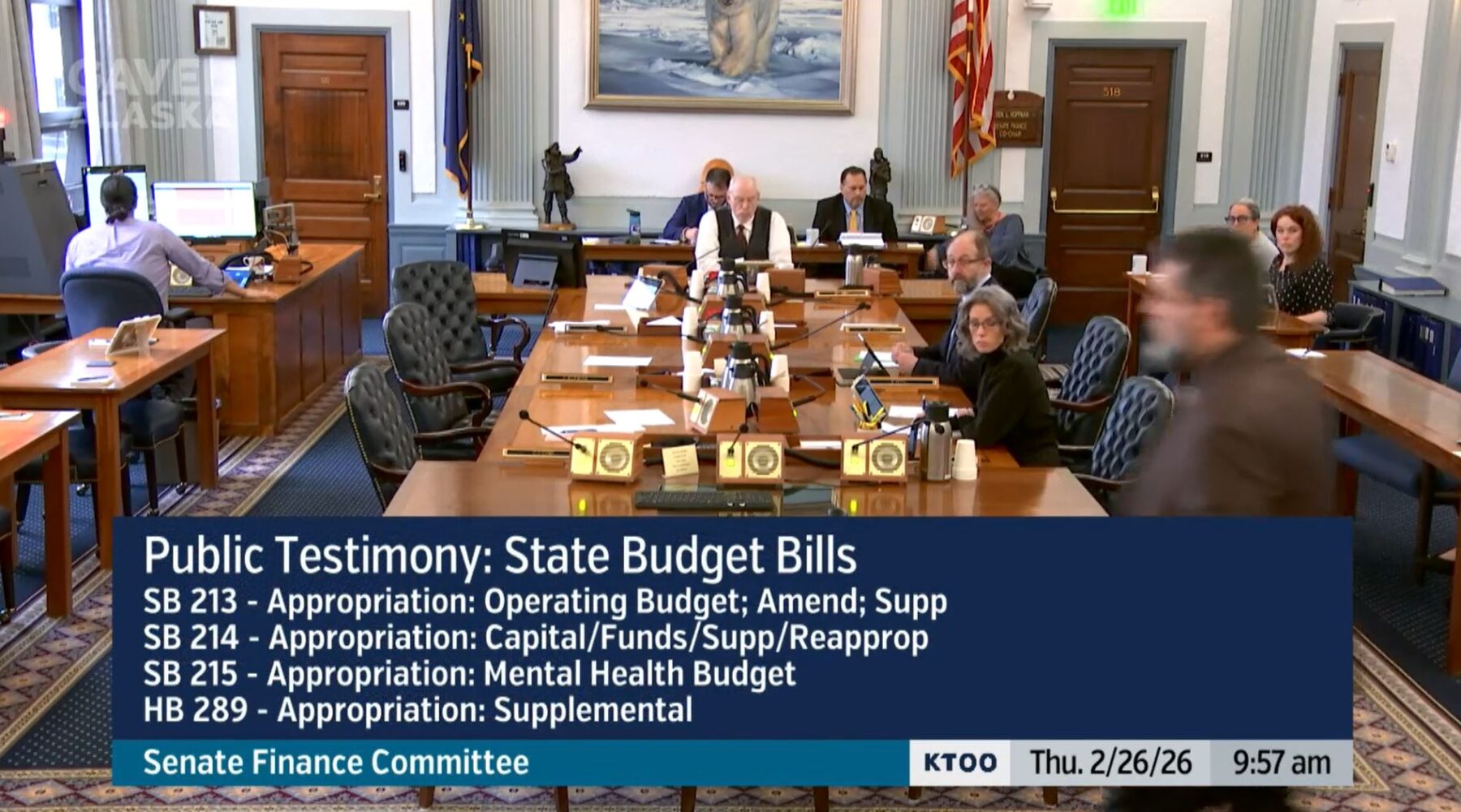
Alaskans from across the state delivered a clear message during Thursday’s Senate Finance Committee public testimony session: invest now in renewable energy, domestic violence services, early childhood programs, education, tourism marketing and transportation infrastructure to safeguard communities, stabilize budgets and prevent long-term costs. The next two-days of hearings will cover the FY27 operating budget (SB 213), capital budget (SB 214), mental health budget (SB 215) and the current-year supplemental adjustments in House Bill 289.
A resident from Ketchikan, speaking for Southeast utilities and the region’s economic development group, called for $14.2 million — the recent three-year average — or at minimum $10 million for the Renewable Energy Fund. He cited Alaska Energy Authority data showing REF projects already offset 13 million gallons of diesel annually, worth $52 million at conservative pricing — more than the Power Cost Equalization endowment can sustainably pay out. Without continued REF support, he warned, PCE pro-ration risks rise and rural schools, businesses and jobs in mining, timber and seafood would suffer higher energy costs.
Multiple residents from rural communities and hub towns, including those in Southeast and Kodiak, echoed calls for a $2.5 million increase to the Council on Domestic Violence and Sexual Assault grant line in the Department of Public Safety, with $500,000 specifically for civil legal services. One advocate from Prince of Wales Island described how flat funding since 2017 forces programs to cut emergency shelter, transportation and basic needs support even as demand rose 53 percent in her area last year. “We may be forced to do away with critical services,” she said, noting grocery prices alone have climbed more than 60 percent.
Education and early childhood priorities dominated testimony from Juneau and Southeast residents. A Juneau parent highlighted 600 open teaching positions statewide at the start of the school year and urged sustained base student allocation growth beyond last year’s $20 increase. Another Juneau resident, an early childhood professional, pressed for $5.72 million to restore and expand the Alaska Infant Learning Program, shifting eligibility from 50 percent to 25 percent developmental delay. She also supported full use of the $5.9 million FY26 childcare benefits appropriation and another round of Roots Awards retention stipends, noting turnover remains the biggest operational challenge for providers.
Tourism leaders from Skagway and Sitka framed marketing as economic infrastructure. A Sitka official requested $10 million in statewide tourism marketing funds, citing 5.6 billion dollars in total economic impact and 48,000 jobs supported last year. A Sitka business owner emphasized shoulder-season independent travel, noting that visitors who saw Alaska Travel Industry Association campaigns were twice as likely to visit and that such spending keeps coastal communities viable year-round.
Infrastructure and fiscal stability also surfaced. A resident from Cordova stressed the need for timely federal transportation matching funds to avoid delaying projects halfway through the short construction season, while a Sitka-area advocate urged repayment of the Higher Education Investment Fund. A Haines resident highlighted cost-effective home modifications in the mental health budget that keep seniors and veterans independent rather than in distant facilities.
General feedback on HB 289 — the current-year supplemental — showed strong alignment with the committee’s February 25 scrutiny of its $467.7 million package. Residents urged swift approval of the $70.2 million DOT match and disaster/fire suppression capitalizations to prevent construction delays and maintain response capacity amid ongoing events. Many echoed OMB Director Lacey Sanders’ warnings on oil revenue volatility and the value of headroom, while pushing for proactive REF and CDVSA investments to reduce future PCE and social service burdens. The Must Read Alaska report on the prior day’s session noted the committee’s focus on a $52 million revenue shortfall, $40 million disaster relief request and $98.7 million fire suppression need, with Sanders stressing urgency to avoid defaults. Public testimony Thursday reinforced those risks, calling for stable funding to avert compounding shortfalls.
One Juneau resident captured the prevailing sentiment: “We have the tools, we have the resources. We really just need the will.”
Public testimony continues today with northern and western regions. With HB 289 expected back next week, lawmakers face pressure to balance immediate supplemental needs against long-term FY27 priorities amid persistent revenue uncertainty.


