Political pollsters release data for a reason — usually because it influences public perception, builds momentum for a campaign, or helps persuade donors to give to a candidate whose race is close or political action committee.
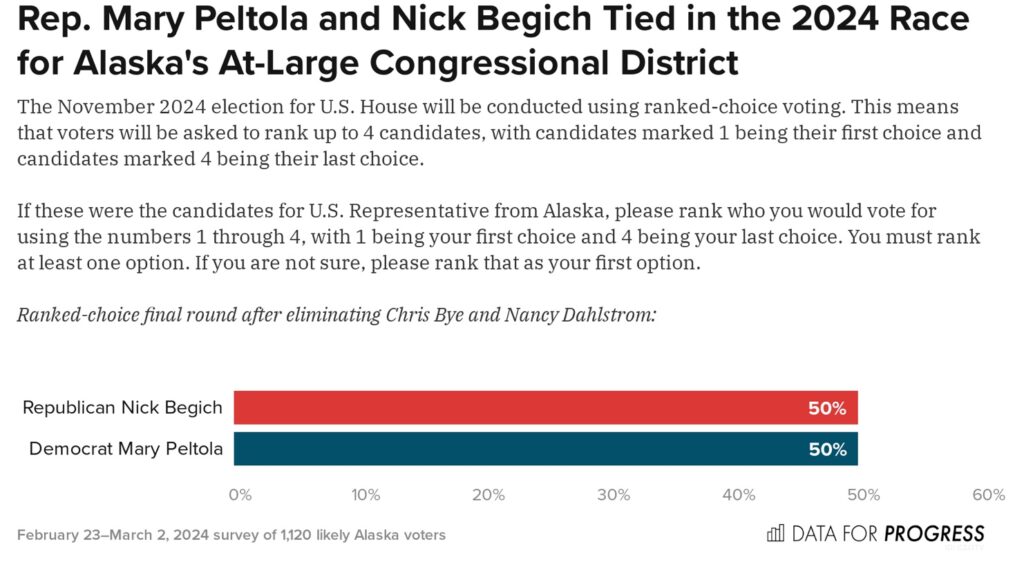
Data for Progress, a polling company that conducts surveys to inform leftwing candidates and causes, released a poll that shows how Republican candidate Nick Begich is dead even with Rep. Mary Peltola, if a ranked-choice election were held in which Peltola, Begich, Nancy Dahlstrom, and Chris Bye were the candidates.
On the surface, that information indicates that Begich is the one to beat. But why would a left-leaning polling company release such strategically valuable information? And why would it first release the information to public broadcasting?
The reason, according to people who are in the campaign management business, is to show the liberal political donor class that Peltola’s race is actually important. Currently, it’s been getting no traction from some of the major political action committees.

Across the country, political action committees have written off the Peltola campaign in order to focus on campaigns more likely to win. For example, MoveOn.org has identified 24 seats to focus on for wining back the House in 2024. Rep. Peltola did not make the cut.
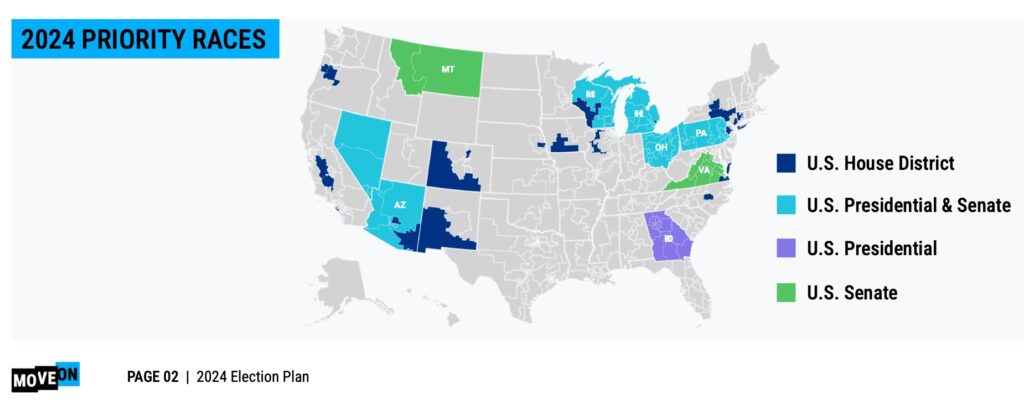
The Democrat Congressional Coordinating Committee also hasn’t prioritized Peltola on its list of target seats.
Thus, Data for Progress wants political action committees to notice that Peltola might actually lose in November, and the seat should not be taken for granted. The group surveyed 1,120 likely voters between Feb. 23 and March 2.
The Data for Progress poll also wanted to know what Alaskans thought about certain issues — these are the issues that Peltola and her surrogates would focus on to connect with voters. She is opposed to the Kroger-Albertsons merger and so are two thirds of Alaska likely voters, including 69% of the “independents” and 56% of Republicans. Voters can expect this to be one of her most dominant campaign themes.
The poll also shows strong support for banning trawling in general: Two-thirds of voters (67%) think the federal government should ban trawling in waters off the coast of Alaska.
Polling on the issues informs the candidates where the electorate is at.
But Data for Progress likely did not release everything it knows about the mood in Alaska. Data for Progress senior advisor Jason Katz-Brown moved to Anchorage recently and has been writing about Alaska attitudes on a range of issues, including legislative priorities. But it surely has information it is keeping within a small group of politicos.
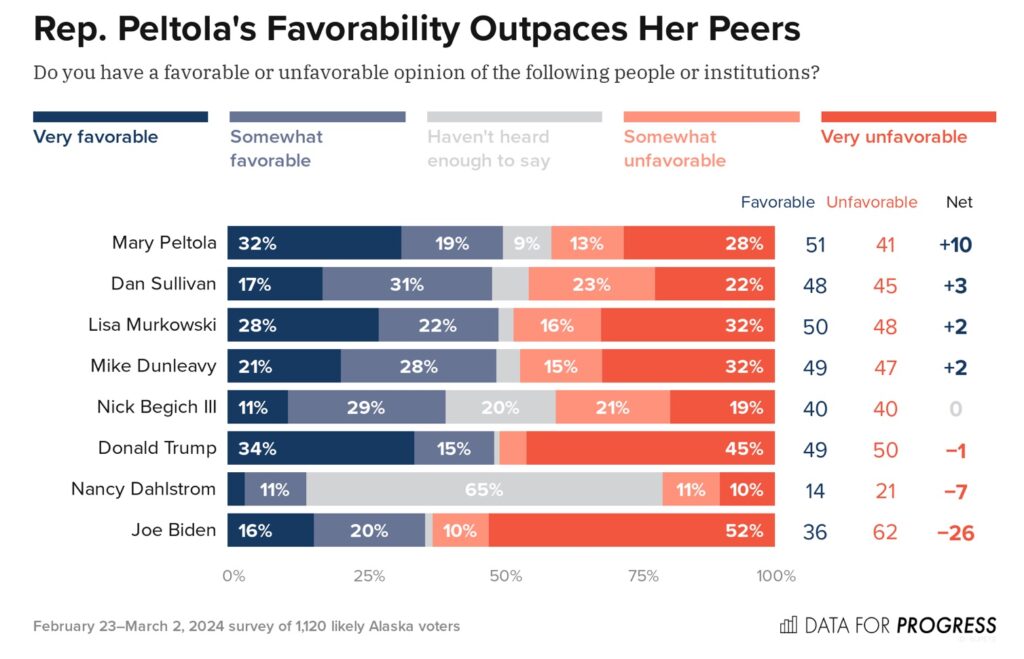
As for favorability, 51% of Alaska voters said they have a favorable opinion of Peltola, compared with 41% unfavorable, for a +10 net favorability. This is higher net favorability than the other members of Alaska’s congressional delegation, Senators Dan Sullivan and Lisa Murkowski, with +3 and +2 net favorability, respectively, the company said.
Nick Begich’s favorability is 40% favorable, 40% unfavorable, and 20% haven’t heard enough to say. Nancy Dahlstrom, currently Alaska’s lieutenant governor, is even more unknown, coming in at 14% favorable, 21% unfavorable, and 65% haven’t heard enough to say, the pollster said.
The poll shows that Dahlstrom, who joined the race late, still has a long way to go to get name recognition in Alaska. The August 20 primary is less than 160 days away.