
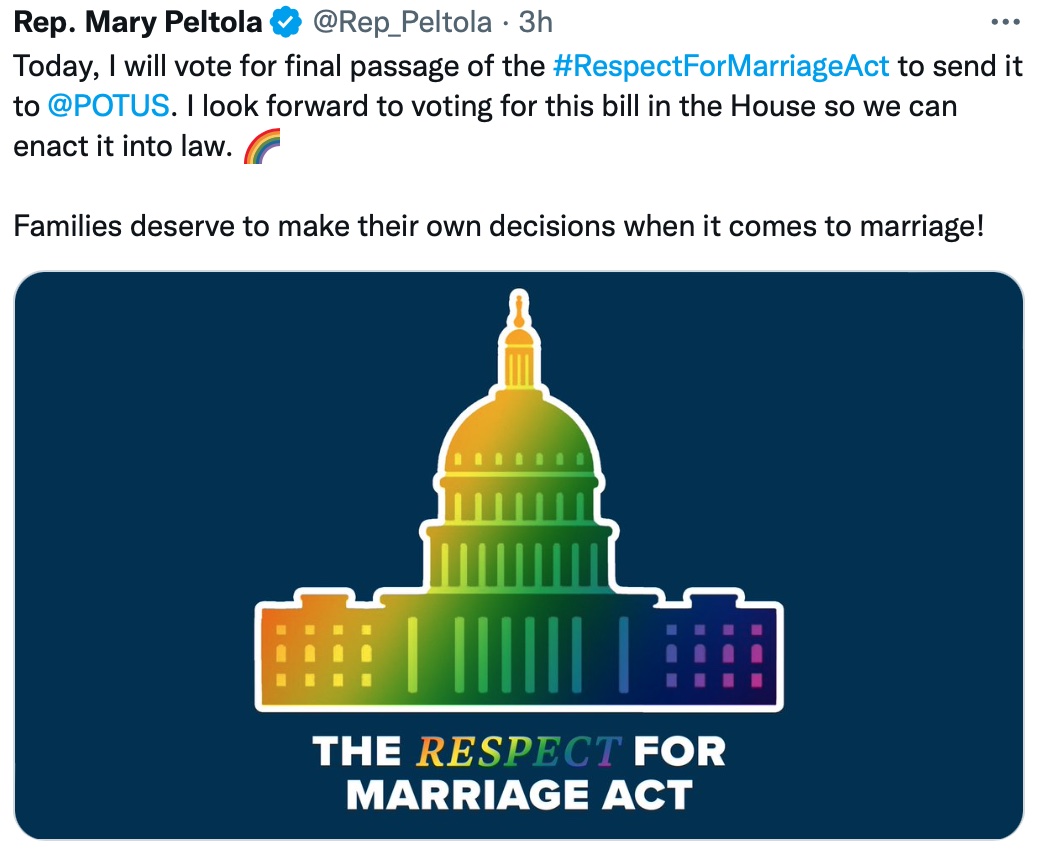
Alaska Congresswoman Mary Peltola has voted for the controversial Respect for Marriage Act, as it passed the U.S. House today, after passing the U.S. Senate last week with the support of both Alaska Sens. Lisa Murkowski and Dan Sullivan. Her vote is likely contrary to what her predecessor, Congressman Don Young, would have voted on this bill.
The bill makes marriage a federal concern, rather than a state matter, and codifies same-sex marriage across all states. Peltola, a Democrat, had signaled she would vote in favor of the bill, as amended by the Senate. In addition to all Democrats voting “aye,” 39 House Republicans voted for the bill, which is expected to be signed by President Joe Biden.
Peltola, like Murkowski, focused on the protections for same-sex partners who marry, ensuring that they cannot be discriminated against. Sullivan focused on the protections he says the bill also gives Christians and others who have religious objections, aspects that neither Peltola nor Murkowski found compelling.
Peltola’s statement said, “Today, I voted for final passage of the Respect for Marriage Act so that it can be signed into law. Enacting this important legislation is a major victory for freedom, privacy, dignity, and equality. The federal government should never stand in the way of someone marrying the person they love. I’m proud to have supported this bill which will strengthen the rights of millions of Americans.”
Roger Severino, vice president of domestic policy at The Heritage Foundation, says that several claims by Democrats about the Respect for Marriage Act are false.
Among them is the claim that the legislation provides religious institutions legally significant protections against being treated by government as the equivalent of bigots.
Severino writes that the issue is not the ability to believe in man-woman marriage, but the ability to live out those beliefs meaningfully in society and not be labeled a bigot by the government for doing so.
“Respect for mere beliefs in man-woman marriage gets people of faith little in this context. But more fundamentally, the bill doesn’t go even that far. It reads:
“”Diverse beliefs about the role of gender in marriage are held by reasonable and sincere people based on decent and honorable religious or philosophical premises. Therefore, Congress affirms that such people and their diverse beliefs are due proper respect.'”
Serverino says the accurate translation of that is “Diverse but wholly unspecified beliefs about the role of gender in marriage (whatever that means) are held by acceptable people based on acceptable premises. Therefore, such acceptable people who hold acceptable beliefs about marriage are due an acceptable level of respect.”
He adds that it is “hard to imagine crafting a more legally meaningless statement than that. The bill’s sponsors took great pains to avoid saying precisely what the bill’s defenders erroneously claim.”
Democrats also claim the bill can’t be used as a basis for the Internal Revenue Service to deny a tax-exempt status for religious organizations that adhere to and act upon their beliefs in man-woman marriage.
Severino says that is also false. “Although the bill clarifies through a rule of construction that it does not, by its own operation, revoke tax-exempt status for dissenting religious organizations, it gives ample grounds for the IRS and any other tax authority to do the actual dirty work.
“When Congress passed the Civil Rights Act of 1964, no one argued that it automatically revoked tax-exempt status for religious schools that engaged in racial discrimination. But the IRS did exactly that six years later and in 1983 the Supreme Court affirmed the action in the case of Bob Jones University v. U.S. The high court relied on the fact that Congress established a “national” or “fundamental” policy against racial discrimination through the Civil Rights Act following the court’s 1954 decision in Brown v. Board of Education.
“Congress could have added the exact same rule of construction contained in the Respect for Marriage Act to the Civil Rights Act of 1964 and it would not have prevented the IRS’ revocation of tax-exempt status, because the governmental interest in eradicating racial discrimination would have been deemed to be just as compelling.
“President Barack Obama’s top lawyer at the Justice Department admitted to the Supreme Court during the Obergefell argument that revoking the tax-exempt status of religious organizations that hold fast to man-woman marriage was “going to be an issue.”
“No rule of construction under the marriage bill will make this issue go away, but an affirmative defense, such as under Sen. Mike Lee’s proposed First Amendment Defense Act, would.
The marriage bill’s sponsors easily could have added a clause saying: “No federal, state, or local taxing authority shall revoke any tax-exempt status or tax benefit of any nonprofit organization because it believes or acts on the belief that marriage is the union of one man and one woman.” As Severino points out, that would have taken the tax issue entirely off the table, “which is precisely why the bill’s sponsors steadfastly refuse to adopt it.”
Read Severino’s analysis at this link.


