
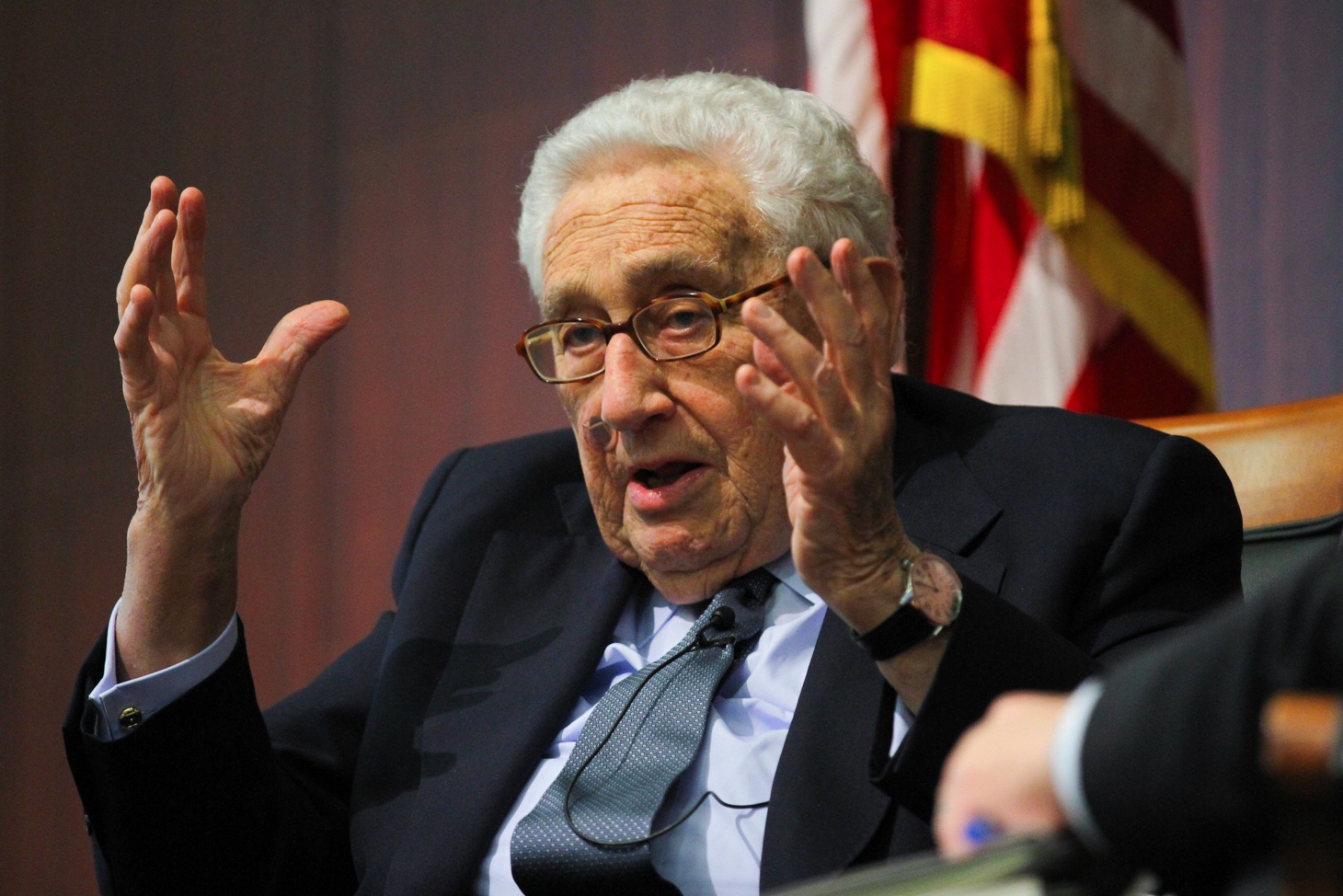
Former Secretary of State Henry Kissinger, who turned 100 in May, died Wednesday. He helped the country get out of the Vietnam War, which was started by President Lyndon Johnson, and he helped create a new, more peaceful relationship with China, which lasted until recently.
All this, while working under a complicated and flawed President Richard Nixon, whose second term came to a collapse and resignation in 1974, and President Gerald Ford, who succeeded Nixon.
After fleeing Nazi Germany with his parents in 1938, Kissinger arrived in America, joined the U.S. Army, fought the Nazis back in Europe, and was an intelligence analyst during the Battle of the Bulge.
He graduated from Harvard with advanced degrees and eventually joined President Nixon’s inner circle, rising to become U.S. Secretary of State. He was one of the only men who the notoriously suspicious Nixon trusted — to the bitter end.
During the time he served Nixon, Kissinger was the president’s assistant for National Security Affairs when he visited Alaska. During some particularly tense negotiations with Chinese Premier Zhou En-Lai, Kissinger was frustrated by then-Secretary of State William Rogers, with whom he had a competitive relationship.
It was in the summer of 1971 that Kissinger made a secret trip to China while on his way to Pakistan. While on his way, he ordered his jet to stop in Anchorage, Alaska, under the pretense of it needing “some repairs.” While his goal was to establish relations with China to set the stage for Nixon’s historic seven-day visit to China, there were many geopolitical complications over the growing Indo-Pakistani War of 1971. U.S. foreign policy under Nixon was heavily engaged in that conflict, during which the Pakistani military and Islamist militias killed between 300,000 and 3 million civilians in Bangladesh and as many as 10 million others fled Bangladesh as refugees to India.
To give sensitive events time to unfold, Kissinger, who was enroute to Pakistan with the secret China stop on his itinerary, made up a story about the plane needing repairs, thus stopping in Anchorage.
“THANK YOU FOR YOUR CABLES WHICH EXPLAIN A SITUATION WHICH IS NOW INTOLERABLE. NEVERTHELESS YOU SHOULD NOT RAISE DELAYED RETURN AGAIN. WE WILL STAY AT ANCHORAGE, CLAIMING NEED FOR SOME REPAIRS. SAN CLEMENTE WOULD GIVE US BETTER TIME BREAK BUT NO PR COVER,” his archived message stated.
In China, Kissinger is still revered for his role in bringing that country out of its isolation under Chairman Mao. Kissinger visited China more than 100 times in both his official capacity and as a retired statesman, as recently as in July, when he spoke with President Xi Jinping in Beijing.
“During his life, Dr. Kissinger attached great importance to China-US relations and believed that they were vital to the peace and prosperity of the two countries and the world,” said foreign ministry spokesperson Wang Wenbin, who called the elderly statesman an “old and good friend of the Chinese people.”
Kissinger was not universally admired, for he played a role in the carpet bombing of Laos and Cambodia during the Vietnam War. Rolling Stone magazine writer Spencer Ackerman, in a story about Kissinger’s death, called him a “notorious war criminal” and inventoried the less-noble aspects of the diplomat.
In 1975, Kissinger toured the Trans Alaska Pipeline with Sen. Ted Stevens and Congressman Don Young. In 2008, he met with then-Gov. Sarah Palin of Alaska, who was being given a crash course in U.S. foreign policy to during her role as vice presidential nominee for Sen. John McCain’s bid for the presidency.
One of the most well-traveled and well-connected people of his generation, Kissinger’s diplomatic visits and the leaders he met with are chronicled at the Office of the Historian at this link.


