Home Blog Page 457

On target: Resolution introduced to overturn Biden ban on small business exports of arms, ammo, parts

Rep. Mark Green of Tennessee and 80 fellow members of the House introduced a Congressional Review Act resolution to overturn a Biden Administration rule on firearm exports.

The Biden rule is a complicated set of regulations that impacts thousands of small businesses in America. Tennessee Sen. Bill Hagerty leads the effort in the Senate, which has 33 co-sponsors.

The resolution to deny the Administration’s attack on small businesses comes after the Department of Commerce Bureau of Industry and Security enacted a 90-day pause on licensing firearms and ammunition exports, a pause that lasted more than 200 days.

Back in October, B.I.S. locked down new export licenses involving certain firearms, ammunition, and related components, and it ended the export approvals for non-governmental end buyers in some countries where the Administration thinks crime is too high or where firearms sometimes end up in the hands of criminals. This meant the government can now sell arms to other governments, but firearms makers cannot sell their wares to private citizens in other countries.

During the lockdown, the Department has been crafting changes in the Export Administration Regulations it says will advance national security and U.S. foreign policy interests.

While Americans buy a significant number of their personal firearms from companies that make them overseas, the new regulations make it nearly impossible for small gunmakers to engage in legal commerce and sell their wares to legitimate overseas buyers. This ends up hurting their ability to hire and train workers, and be profitable in their chosen line of work.

The final rule is at this link and is in its 90-day comment period that ends July 1.

The new rule has an extensive checklist for evaluating all licenses, including the nature of end user, the destination of exports (foreign policy/national security risk factors), nature of item being exported, human rights considerations, and instances of past diversion.

Some of the decisions about whether an export license may be granted will be based on reports from non-governmental organizations, many of which are political in nature. They include:

  •   State Department Human Rights Country Reports
  •   Global Terrorism Index
  •   Corruption Perceptions Index
  •   Government Defence Integrity Index
  •   Amnesty International Reports
  •   Human Rights Watch Report
  •   Fragile State Index
  •   Global Organized Crime Index
  •   Small Arms Light Weapons Tracker
  •   U.N. Global Study on Firearms Trafficking
  •   Presidential Determination on Major Drug Transit or Major Illicit Drug Producing Countries (Majors List)

The countries currently include: Bahamas, Bangladesh, Belize, Bolivia, Burkina Faso, Burundi, Chad, Colombia, Dominican Republic, Ecuador, El Salvador, Guatemala, Guyana, Honduras, Indonesia, Jamaica, Kazakhstan, Kyrgyzstan, Laos, Malaysia, Mali, Mozambique, Nepal, Niger, Nigeria, Pakistan, Panama, Papua New Guinea, Paraguay, Peru, Suriname, Tajikistan, Trinidad and Tobago, Uganda, Vietnam, and Yemen.

“The Biden administration is out of control. It’s clear President Biden has ordered the Commerce Department to attack small businesses and firearm exporters. This is completely contradictory to the Department’s statutory duty ‘to create the conditions for economic growth and opportunity for all communities.’ Congress has the power and the duty to hold the Biden administration accountable for its egregious attacks against gun owners and American businesses. This Congressional Review Act will put a stop to BIS’ overreaching rule,” Green said.

Licenses, which were previously good for four years, are now approved yearly and on a case-by-case basis, which leaves manufacturers at the mercy of anti-gun bureaucrats in Washington, D.C., Green noted.

“Left unchecked, the Biden administration will go after thousands of other responsible, law-abiding businesses across the country. Congress is fully within its Constitutional purview to overturn the Biden administration’s interim final rule. The time for action is now,” Green said.

“In effect, this is an attempt to permanently extend the current “pause” on such export licenses and will rescind approximately 2,000 active export licenses for certain firearms. In addition to being an unlawful, unjustified exercise of regulatory authority, this will have a substantial, negative impact on these American manufacturers, their suppliers, and the jobs they support,” Hagerty said.

“This rule by the Biden Administration damages the firearm industry, which harms Tennessee manufacturers,” Hagerty said. “This politically motivated effort unlawfully circumvents the legislative process and destroys American exports, jobs, and small businesses that support the firearm and ammunition industry. I’m pleased to introduce this CRA to overturn the Biden Administration’s version of Operation Choke Point.” Operation Choke Point was an initiative of the Obama Administration to investigate banks that lent to firearms makers. Gun and ammunition dealers that were operating legally found their bank accounts were terminated without explanation.

House Cosponsors: Michael McCaul (R-TX), Elise Stefanik (R-NY), Richard Hudson (R-NC), Michael Guest (R-MS), Roger Williams (R-TX), Sam Graves (R-MO), Mike Bost (R-IL), Andy Ogles (R-TN), Diana Harshbarger (R-TN), David Kustoff (R-TN), Scott DesJarlais (R-TN), Tim Burchett (R-TN), Chuck Fleischmann (R-TN), Bob Good (R-VA), Andy Biggs (R-AZ), Chip Roy (R-TX), Michael Cloud (R-TX), Andrew Clyde (R-GA), Josh Brecheen (R-OK), Ben Cline (R-VA), Paul Gosar (R-AZ), Morgan Griffith (R-VA), Andy Harris (R-MD), Clay Higgins (R-LA), Mary Miller (R-IL), Barry Moore (R-AL), Troy Nehls (R-TX), Tom Tiffany (R-WI), Warren Davidson (R-OH), Dan Bishop (R-NC), Eric Burlison (R-MO), Byron Donalds (R-FL), Russ Fulcher (R-ID), Alex Mooney (R-WV), Greg Murphy (R-NC), Ralph Norman (R-SC), Guy Reschenthaler (R-PA), Blake Moore (R-UT), Bill Posey (R-FL), Glenn Grothman (R-WI), Dan Crenshaw (R-TX), Ann Wagner (R-MO), Russell Fry (R-SC), Rudy Yakym (R-IN), Tony Gonzales (R-TX), Aaron Bean (R-FL), Pete Sessions (R-TX), William Timmons (R-SC), Claudia Tenney (R-NY), Randy Weber (R-TX), Adrian Smith (R-NE), Tracey Mann (R-KS), Carol Miller (R-WV), John Moolenaar (R-MI), Kevin Hern (R-OK), Chuck Edwards (R-NC), Ashley Hinson (R-IA), Tim Walberg (R-MI), Greg Steube (R-FL), Cory Mills (R-FL), Pat Fallon (R-TX), Thomas Massie (R-KY), Mike Ezell (R-MS), Nick Langworthy (R-NY), John Rutherford (R-FL), Jack Bergman (R-MI), Scott Franklin (R-FL), Trent Kelly (R-MS), Keith Self (R-TX), Andy Barr (R-KY), Jerry Carl (R-AL), James Baird (R-IN), Laurel Lee (R-FL), Randy Feenstra (R-IA), Brian Babin (R-TX), Kelly Armstrong (R-ND), Barry Loudermilk (R-GA), Brad Finstad (R-MN), Scott Perry (R-PA), Joe Wilson (R-SC)

Senate Cosponsors: John Barrasso (R-WY), Marsha Blackburn (R-TN), John Boozman (R-AR), Mike Braun (R-IN), Katie Britt (R-AL), Ted Budd (R-NC), Shelley Moore Capito (R-WV), Bill Cassidy (R-LA), Tom Cotton (R-AR), Kevin Cramer (R-ND), Mike Crapo (R-ID), Ted Cruz (R-TX), Steven Daines (R-MT), Deb Fischer (R-NE), Josh Hawley (R-MO), Cindy Hyde-Smith (R-MS), James Lankford (R-OK), Mike Lee (R-UT), Cynthia Lummis (R-WY), Roger Marshall (R-KS), Markwayne Mullin (R-OK), Pete Ricketts (R-NE), James Risch (R-ID), Mike Rounds (R-SD), Marco Rubio (R-FL), Eric Schmitt (R-MO), Rick Scott (R-FL), Tim Scott (R-SC), John Thune (R-SD), Thom Tillis (R-NC), Tommy Tuberville (R-AL), J.D. Vance (R-OH), Roger Wicker (R-MS) 

D-Day: Three brothers, three fates in World War II

By SCOTT MCMURREN | ALASKA TRAVELGRAM

Each year, I turn the volume down in my life just a bit as we approach June 6, D-Day.

This year, it will have been 80 years since the largest seaborne invasion in history took place. Thousands died—and countless others were indelibly changed by the experience.

Here’s a brief story of how my family was affected on this day: The A. M. Smith family of Reno, Nevada, and a tale of three sons on one fateful day.

Alfred “Long Tom” Smith and his wife, Ivan, had four children: three boys and a girl.

“Long Tom” was a miner in Nevada and eventually became state engineer. On D-Day, the couple’s three sons were already commissioned officers in the U.S. Army Air Corps.

Their eldest son, Dale Smith, graduated the U.S. Military Academy in the class of 1934. He was fascinated with airplanes. He was assigned to the Army Air Corps and by 1943, he was a bomb group leader with the 384th Bomb Group (8th AF).

Most of his combat missions were over Germany, but in early June, he led bombing missions over France in support of Operation Overlord.

[Read Maj. Gen. Dale Smith’s biography here]

As commander of the 384th, Dale was a decorated flyer, with 31 combat missions (Air Medal with four oak leaf clusters, the Distinguished Flying Cross with three clusters, and the Croix de Guerre with palm).

Dale went on to  serve in leadership positions in Okinawa, as head of the 64th Air Divison and later as a strategic adviser to the Joint Chiefs of Staff.  He retired as a major general in 1964, 20 years after D-Day.

The second son, Thor Smith, was my grandfather. He was a newspaperman in the William Randolph Hearst organization. At the bidding of his brother, he applied for and was granted a commission in the Army Air Corps.

Thor rose quickly through the ranks until he was a press officer for Gen. Eisenhower at SHAEF headquarters in England at the time of the invasion. Thor accompanied Eisenhower to Paris and later to Germany during the liberation of the concentration camps.

After leaving the military with the rank of colonel, Thor returned to the Hearst organization. He was assistant to the publisher at the San Francisco Call-Bulletin.

Gen. “Ike” Eisenhower was Thor’s hero. In fact, my mother tells the story of when Ike was invited over to their house for dinner. She and my grandmother worked all day on dinner. When the doorbell rang, she went to answer…then fainted. They put her to bed and she missed dinner.

While his two brothers were on the scene for the invasion, Drew Smith graduated with the rest of his class at U.S. Military Academy at West Point on D-Day, June 6, 1944. Ike’s son, David, was his classmate.

Drew was anxious to fly and soon was checked out to fly the B-29s in Guam. Tragically, as he took off on June 11, 1946, his plane developed engine trouble. The B-29, fully-loaded wtih fuel, crashed into the ocean, killing all aboard.

As D-Day was a pivotal day in Western Civilization, it also affected families like ours at a very basic level. Mine is just one story—and I am proud to share it.

Scott McMurren is author and publisher at AlaskaTravelGram.com.  This column originally appeared in Must Read Alaska on the 75th anniversary of D-Day, and has been edited to reflect the 80th anniversary.

Do you have a story about D-Day and your family? Share it in the comment section below.

Biden threatens veto of veterans funding as he launches culture war over LGBTQI+ and taxpayer-funded abortion

By CASEY HARPER | THE CENTER SQUARE

U.S. House Republicans passed legislation Wednesday to fund the Department of Veterans Affairs and military construction, but a battle over abortion, sexuality and other issues may sink the bill.

The Military Construction, Veterans Affairs, and Related Agencies Appropriations Act, 2025 features $378.644 billion in spending. 

That funding includes $147.520 billion for the Department of Defense’s military construction, the Department of Veterans Affairs (VA), and “related agencies.”  

Wednesday’s legislation is one of 12 appropriations bills needed to fund the government, and was passed largely along party lines.

“I voted YES on the FY25 Military Construction and VA funding bill,” U.S. Rep. Ryan Zinke, R-Mont., wrote on X, formerly known as Twitter. “It fully funds programs for our nation’s veterans, bolsters our Indo-Pacific security, and defunds woke policies.”

“This morning, I voted in favor of the 2025 Military Construction, Veterans Affairs, and Related Agencies Appropriations Act,” Rep. Barry Moore, R-Ala., wrote on X. “This legislation fully funds veterans benefits, bolsters national security, and ends Biden’s mission to make our bases woke.”

President Joe Biden, however, has threatened to veto the bill because of provisions meant to take on “woke policies.”

The White House released a statement ahead of the vote saying the president will veto the bill if it makes it to his desk.

“Similar to last year, H.R. 8580 includes numerous, partisan policy provisions with devastating consequences including harming access to reproductive healthcare, threatening the health and safety of Lesbian, Gay, Bisexual, Transgender, Queer, and Intersex (LGBTQI+) Americans, endangering marriage equality, hindering critical climate change initiatives, and preventing the Administration from promoting diversity, equity, and inclusion,” the White House said in a statement.

Besides LGBT issues, the White House opposes the legislation’s limits on the use of taxpayer funds for abortions.

“The Administration strongly opposes section 255 of the bill, which would prevent VA from using funds to implement, administer, or otherwise carry out the Final Rule published on March 4, 2024, which expanded access to abortion counseling and abortion under limited circumstances for certain veterans and VA beneficiaries,” the White House said in a statement.

Murkowski declares birth control a ‘right’

Sen. Lisa Murkowski voted in favor of the Right to Contraception Act, which failed to advance in the Senate on Wednesday. It needed 60 votes to end a filibuster and move forward, and it had just 51 votes, with Murkowski and Sen. Susan Collins of Maine siding, as is their way, with the Democrats.

Murkowski then produced a video in which she declared, “a woman has a right to contraception.”

Is contraception a right under the U.S. Constitution? It’s a novel interpretation. Even food and shelter is not a guaranteed right, like the right to pursue happiness, as mentioned in the Declaration of Independence, and the right to free speech, to keep firearms, privacy and to not have to house soldiers in your home.

The government doesn’t buy people firearms, even though the right to bear arms is mentioned in the Constitution.

But the Democrats, Murkowski, and Collins believe that there is a right to either a contraption-type contraception, such as IUDs or condoms, or chemical contraception, such as birth control pills; neither were safely available during the time the nation was founded. The authors of the Constitution in 1787 would never have imagined such a right developing 237 years later.

Murkowski then said in her video that the way to reduce the number of abortions is to make contraception a right, and explained that this is a position she has had “for a very long time.”

Sen. Dick Durbin agreed it’s a right.

“It would codify the right to contraception that the Supreme Court first recognized in Griswold. It would also allow patients, providers, and the Justice Department to go to court to enforce these rights,” Durbin said.

He was saying the quiet part out loud: Taxpayers would be required to pay for birth control for all women and, presumably, men. Free condoms and vasectomies for all?

A few days earlier Murkowski said women have a right to abortion, which she sanitized as “access to reproductive health care.” She said women in Alaska are worried about access to reproductive, even though the Dobbs decision by the Supreme Court leaves abortion laws up to the states and the State of Alaska has one of the most liberal abortion legal interpretations in the country.

Rights that are guaranteed by the Constitution do not include things like the right to shoes, lava lamps, gym memberships, or even health care itself. Obamacare expanded and warped that constitutional understanding and made health care institutionalized as a right, which means taxpayers now have to pay for things like transgender surgeries and after-surgery care, and all other manner of health care, which has become an ever-expanding field.

This is the Democrat theme consistently voiced since the days of slavery — that people have a right to the fruits of the labor of another person.

In this case, if birth control pills are a right, then they must be provided free by force of law to everyone who wants them, and they must be paid for by everyone who doesn’t want to pay for them.

Those who get behind on their taxes to the government that provides these “rights” at a cost to someone else may find their wages garnished and their homes foreclosed on, because while things like birth control is a “right,” your income and your home are still not a right.

Major improvement: Data shows Alaska’s youngest students advancing after Alaska Reads Act passed

Gov. Mike Dunleavy announced today that the data demonstrates that Alaska’s youngest students are experiencing significant advances in early literacy as a result of the Alaska Reads Act.

The landmark legislation, co-sponsored by Gov. Mike Dunleavy and former Senator Tom Begich, was crafted to ensure all students can read at grade level by third grade and is reshaping Alaska’s education landscape, his office said.

The Alaska Reads Act employs evidence-based reading strategies, including professional development in the Science of Reading, and introduces new curricula and targeted interventions. This comprehensive approach led to significant gains in reading proficiency among kindergarten through third-grade students statewide.

Alaska is currently in the second year of implementing the Alaska Reads Act. The recently concluded school year is the first year of the law’s accountability requirements. 

At the start of this academic year, only 41% of students met early literacy benchmarks. By the school year’s end, the percentage of students meeting benchmarks rose to 57%.

Among kindergarten students, proficiency rates rose from 24% at the beginning of the year to 60% by the end of the year.

The State Board of Education selected Amplify to provide districts the early literacy screener required by the Alaska Reads Act. According to Amplify, “Alaska’s first year of statewide implementation of the mCLASS 8th Edition assessment has yielded improvements in student performance that surpass those observed in the rest of our national user base, which includes over two million students across schools in America.”

“I’m encouraged by the improvements Alaska’s students are already experiencing because of the Alaska Reads Act,” Dunleavy said. “As these results are beginning to show, when we implement effective education reform, Alaska’s students are capable of success.”

“The remarkable progress we’ve seen, especially among our youngest learners is a testament to the collective effort of Alaskans across the state,” said DEED Commissioner Deena Bishop. “These results not only highlight the effectiveness of the Alaska Reads Act, but also sets a promising trajectory for the educational future of Alaska.”

State Board of Education Chairman James Fields extended heartfelt gratitude to the educators, parents, and students for their dedication and hard work.

“This progress is a testament to the commitment and resilience of our teachers, students, and their families,” Fields said. “Together, we are making strides toward a future where every Alaskan child possesses the fundamental skills to succeed. Thank you for your relentless pursuit of educational excellence.”

For further details on the Alaska Reads Act first-annual report, visit The Alaska Reads Act – Education and Early Development.

Win Gruening: Ignoring the consequences of ship-free Saturdays?

By WIN GRUENING

Backers of a cruise initiative to block large cruise ships from docking in Juneau on Saturdays and the 4th of July say they have sufficient signatures to place the question on the ballot.

Now voters need to decide whether or not to vote for it on Oct. 1.

The “Ship-Free” social media campaign pages suggest that Juneau’s skies are choked with smoke, its waters fouled by pollution, hiking trails are overcrowded, and its downtown core is unlivable.

That isn’t the truth and most Juneauites know it.

Initiative boosters have accused opponents of the measure of ignoring quality of life issues and only caring about the economic benefits of the visitor industry.

But who is actually ignoring the consequences?

The economic benefits of the visitor industry directly enhance Juneau’s annual budget as well as its quality of life. To dismiss those benefits as less important is dishonest. 

Recognizing those contributions requires more than lip service. Can we start from an initial common set of facts and engage in honest communication?

Cruise supporters have, from the outset, acknowledged industry impacts, and have been willing to work to alleviate them. The Ship-Free folks are more interested in sabotaging the public process instead of working toward mutually achievable goals. 

Regrettably, this type of initiative campaign often devolves into an overwrought, fact-free litany of misconceptions and half-truths about the industry.

The initiative declares that “excess human presence… sullies the sentient, sacred, divine, and living ancestral natural environment necessary for cultural and spiritual health and growth.”

It says the city “failed to balance the economic benefits to some against the economic and other harms of the many.”

“Harm” is a very strong word that usually conveys deliberately inflicted physical injury. This emotional narrative discounts a long-standing cooperative relationship that has successfully mitigated many visitor impacts. The Ship-Free petition seeks to undermine years of successful, good-faith collaboration engaged in by the city and the industry.

Visitor industry businesses and their employees are actively engaged members of the community who contribute generously to a myriad of civic and non-profit endeavors. The cruise industry has agreed to liberal uses of passenger fees (over $20 million annually) allowing them to be allocated for a variety of projects benefiting all of Juneau, not just cruise passengers.

An Alaska DEC science panel concluded that cruise ship water treatment systems, “are the most advanced, effective, and proven treatment systems available and…are significantly more effective than most municipal systems.” Cruise ship smoke emissions are abated by state-of-the-art technology. Juneau, in concert with the industry, was the first port in the world to offer environmentally-friendly (hydroelectric) shore power for ships.

Under industry-backed Tourism Best Management Practices, many voluntary policies have been implemented including avoiding certain streets, local parks and trails, reducing flightseeing noise, staging traffic to minimize congestion, enacting stricter whale-watching rules, and staffing a Tourism Hot-Line for potential complaints.

Initiative sponsors are also short-circuiting the work of Juneau’s citizen-backed Visitor Industry Task Force. The initiative imposes a vote on a question neither the public nor the CBJ Assembly had a voice in formulating, despite the fact the city and industry just successfully concluded negotiations limiting daily passenger visitation.

Eighty-five large cruise ships are scheduled to visit Juneau in 2025 on Saturday and July 4, representing about 12% of all port calls. It will be almost impossible to accommodate them on other days due to scheduling conflicts, and the VITF-recommended 5-ship limit and proposed ban on “hot berthing”.

While estimates vary, when including purchases by passengers, crewmembers, and cruise lines, as well as passenger fees, the loss of direct spending could approach $40 million per year. City revenues could be reduced by $4 million annually. 

Can the Ship-Free boosters point to city programs and services that should be slashed to offset the revenue reduction? With city leaders loath to cut expenditures, Juneau property owners can expect their property taxes to increase commensurately. 

Juneau’s success in resolving tourism impacts argues for promoting cooperation, allowing voluntary limits to work, and negotiating changes if necessary.

Furthermore, the legality of blocking ships from visiting Juneau is questionable and most likely will be tested in court.

Juneau voters can decide which they prefer: expensive litigation or continuing collaboration.

After retiring as the senior vice president in charge of business banking for Key Bank in Alaska, Win Gruening became a regular opinion page columnist for the Juneau Empire. He was born and raised in Juneau and graduated from the U.S. Air Force Academy in 1970. He is involved in various local and statewide organizations.

Five days into Pride Month and who’s playing? NPS

For the past few years, Alaska Airlines took the lead in Pride Month antics, with videos, special fights to San Francisco, and extensive features on LGBTQAI+ workforce. This year, the airline has dialed it back a bit, keeping its pride videos off of X/Twitter and instead putting them on Instagram, where the crowd is decidedly more liberal and where Meta exerts its authority. Other airlines have also mellowed out on the Pride capers.

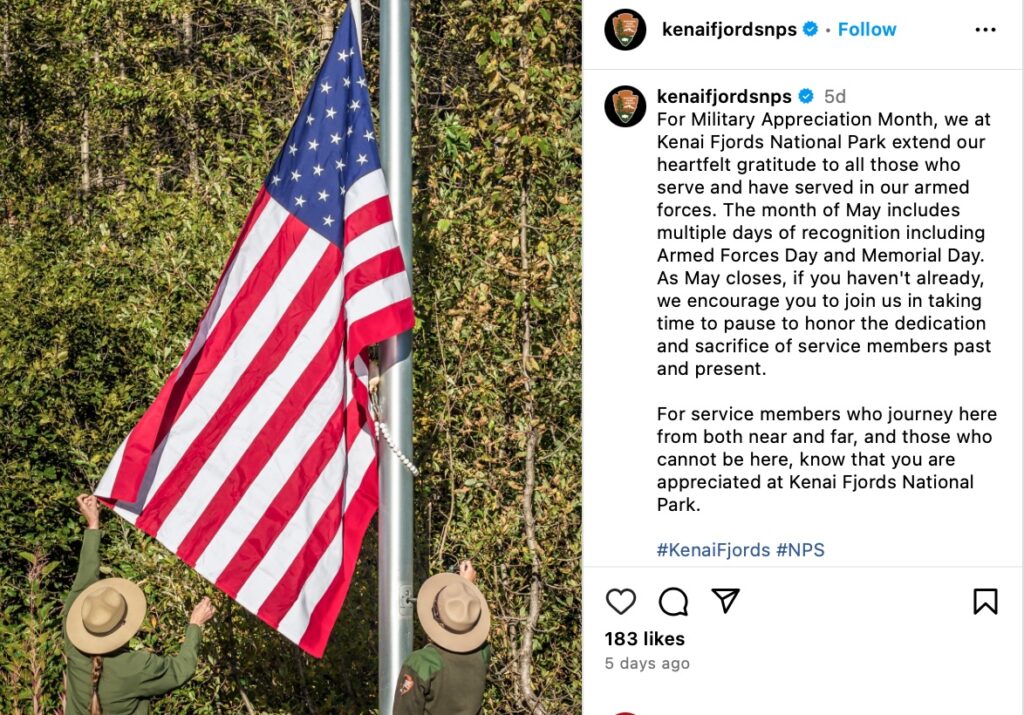
To note how much more liberal the Instagram crowd is, the drag queen post above by the Kenai Fjords division of the National Park Service received over 5,700 of “likes” in just one day, while a Kenai Fjords NPS post honoring Military Appreciation Month received only 183 “likes” in five days.

Pride Month, as designated by executive proclamation by the president, most urban mayors and Democrat-run states, fathers parades and social media celebrations by the FBI, the NSA, and every other alphabet agency of the federal government, including the National Park Service, whose Instagram account for Kenai Fjords National Park took the lead in Alaska.

Among those not acknowledging the sexual celebration month, so far, are at least teams of the National Football League, including Pittsburgh Steelers, Cleveland Browns, Cincinnati Bengals, Tennessee Titans, Kansas City Chiefs, Denver Broncos, Dallas Cowboys, Green Bay Packers, New Orleans Saints, Atlanta Falcons and even the Seattle Seahawks have balked at putting the rainbow on everything, sticking to a re-post from Lumen Field, the team’s home arena.

Bud Light has chosen to focus its social media on a “fight night” theme on Instagram and X this month, whistling past the graveyard it dug for itself during the Dylan Mulvaney marketing fiasco of 2023. It launched Pride Month with a push for Ultimate Fighting Championship bouts, altogether the opposite of Mulvaney’s prepubescent girly come-on campaign from last year.

Dustin Poirier – The Diamond UFC fighter – promoting Bud Light during Pride Month.

Lawfare: One person filed 5,590 civil rights complaints with Department of Education in 2023

By BRENDAN CLAREY | CHALKBOARD NEWS

Over two-thirds of all Title IX complaints came from one individual to the Department of Education’s Office of Civil Rights, as the agency seeks to increase its staff for the next fiscal year. 

The branch of the education agency that enforces federal funding statutes tied to civil rights legislation said 5,590 out of 8,151 complaints related to alleged sex discrimination came from one person, continuing a consistent trend where an individual has filed thousands of cases every year. 

According to the annual report to the president and secretary of education, the OCR said that it had seen the largest number of complaints ever during the 2023 fiscal year (FY).

“In FY 2023, OCR confronted the highest volume of complaints in our history, receiving 19,201 complaints,” the report reads. “That number represented a 2% increase over our previous record high in FY 2022 of 18,804 complaints.”

“Nonetheless, we kept pace with the high volume, resolving 16,448 cases compared to the previous fiscal year’s 16,515 cases, and achieving the third highest number of complaint resolutions in OCR history,” the report reads. 

The report later highlights that the vast majority, nearly 69% of complaints related to allegations of sex-based discrimination were filed by one individual, which moved the majority of complaints away from disability allegations.

“In FY 2023, however, a single individual filed 5,590 complaints raising sex discrimination allegations,” the report reads. “This high volume altered the ratio of complaint filings for this fiscal year.”

Put another way, the individual would have had to file an average of over 15 complaints every day, including weekends and holidays. 

As The 74 reported last year, there were 18,804 civil rights complaints filed last year, but nearly 7,400 Title IX-related ones were filled by one individual. That person was reportedly the same one who filed over 6,000 claims in 2016. 

Under former Education Secretary Betsy DeVos, the OCR changed its case processing manual to allow staff to dismiss complaints filed by the same individual, as was reported by The New York Times in 2018. 

Catherine E. Lhamon, the current and former assistant secretary for civil rights during the Obama administration, criticized the decision at the time, saying the OCR should never filter cases and that the OCR should function more like the Justice Department. 

“The thing that scares me is when they get to say ‘we won’t open some cases because it’s too much for us,’ or ‘we don’t like the complainant,’ or ‘it’s not our week to work on that,’ you start to change the character of the office,” Lhamon told The New York Times in 2018.

In a request to Congress asking for more federal taxpayer funds to operate the OCR, the Department of Education cited its increasing caseload, which includes those filed by the individual complainant.

The OCR is asking for nearly $20 million more in fiscal year 2025 to hire 86 more full-time enforcement employees, according to a congressional justification document. That document said that the agency’s funding for employees “have not kept pace with case demand” with funding for three fewer employees since 2013. 

“At the same time, the number of complaints received increased by 93%, from 9,950 complaints in fiscal year 2013 to 19,201 in fiscal year 2023, which is the highest total complaints received on record,” the justification document reads.

EaglExit: Summary of local government options, citizenship, and American Republicanism

By FORREST A. NABORS, PhD

Part I of a four-part series

A borough charter is a form of a constitution, or, an organic law of a people by which a government is framed and maintained. 

The purpose or end of a constitution is the kind of government and way of life that the framers of the constitution wish to have.

The general character of a people – their convictions, habits, customs – and the form of their government shape each other and depend upon each other.

Therefore, the framers of new constitutions of all types must consider what kind of government and way of life they wish to have and what kind of government the existing character of their people can support. 

That is, existing conditions – the existing character of a people – constrain what framers of constitutions can immediately do. The saying, “Rome cannot be built in a day,” captures this point. The constitution of a people and the character of a people must fit each other.

However, Rome was built and can be built, albeit over many days. A wisely constructed constitution can cement the pathway of a political society’s future development towards loftier achievements.

Let us assume that aim of the founding generation of the new borough is that the government will be frugal, fair and effective in securing the safety of the people. These are simpler, attainable ends, which can be achieved by drawing from common sense and experience. Prudent institutional devices can be framed that limit future opportunities for corruption, profligacy, injustice and inefficiency.

It is also within the range of local government to do more in securing the happiness of the people consistent with liberty. This is a harder task than say, inexpensive and sanitary garbage disposal, but today, is a necessary task, because liberty in our country is fading. As this paper will contend, one of the few, powerful resources left to renew liberty in America is local political societies.

A wisely-constituted and administered local government can re-animate those virtues from which American government in its original form sprang, and upon which all of our governments – local, state and federal – always depended: intelligence, honesty, industry, frugality, self-reliance, self-respect, courage, good will, modesty, charity, etc. 

At its origin, American republicanism was, in fact, the simple government and way of life of one local community. A tiny group of English settlers, far fewer than the population of Eagle River today, formed the nucleus of the colony of Massachusetts Bay beginning in 1620. Led by their faith, those settlers developed a way of life and a style of local government that grew, matured and then spread. Their small political society became a model, replicated by other townships and other colonies. The character of the New England people was such that when tyranny violently confronted them in 1775, they could not submit. It was easier for them to die than to surrender their liberty.

Admiring them, the other colonies joined them in rebellion. When the battle was won, the other colonies, now states, adopted New England’s system of government. New England republicanism became American republicanism, broadcast across the North American continent, superadding new states, also modeled on the image of the New England, and finally including Alaska in 1959. 

Is that character achievable today? Americans look around themselves in 2024 and are mortified. A sense of loss, as if a beloved member of the family had died, cuts into the souls of millions of us. We hear the “mystic chords of memory” within us, but when we look around, the song we hear is a sad dirge for the death of American principles and our old virtues. Many who understand and love what we once were, confess that they can barely recognize our country today.

Yet in reviewing the case of the first shipload of settlers on the Mayflower, we must admit that from little things, great things are born, and from fragile beginnings, strength and greatness. Hounded by relentless religious persecution, they crossed the dangerous North Atlantic, formed a political compact – a constitution – cut an embryonic republic out of the howling wilderness and entrusted their fate to God. Their only care was to build a “City on a Hill,” a model of Christian charity. Their “City on a Hill” became many such cities, and their systems of government and way of life became the basis for a great nation. 

The new borough may be but a small community, but great character is great achievement enough. The regeneration of liberty, even in a small area, is worth the striving. Perhaps a successful founding might one day produce sons and daughters who will spread out into Alaska and America as new apostles of freedom’s restoration. Perhaps a successful founding will inspire others in America to copy this one.

We cannot know. But we, like millions of fellow Americans, do know that something must be done, and since the people of Eagle River require a new constitution of government, they can do more. In any event, if we honor the character and deeds of our forebears, it is our duty to take substantial steps towards rebuilding a true home for freedom in our locality that rejects encroaching tyranny in our country and our world today, and to entrust the results to God. 

If we want to make the best effort we can to establish freedom anew in our small corner of the country, we must understand, especially in these times, so hostile to liberty, how freedom grew from a tender plant and thrived.

The Eaglexit Board would like to thank Forrest Nabors for his support and efforts. This is the first of a four-part series. Check back for Part II of this series this weekend. Please consider joining the cause and keeping up on our progress at Eaglexit.com. Our next public meeting is June 20 at 7pm at the Elks Lodge.