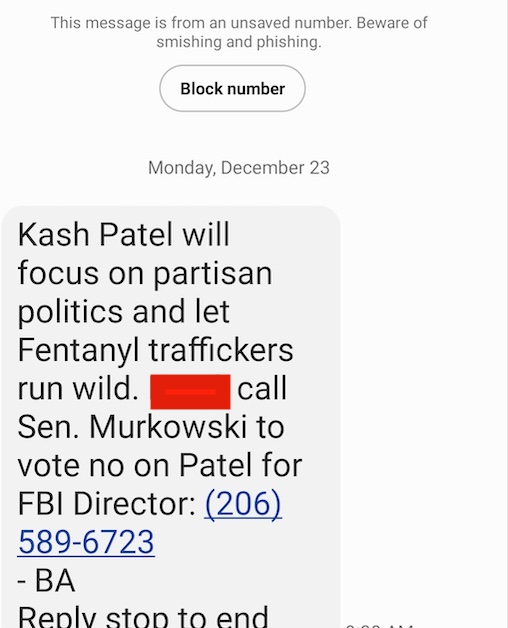
Sen. Lisa Murkowski is being targeted by Democrats. Alaska Democrats and voters who fit the liberal modeling are getting text messages urging them to call Sen. Lisa Murkowski’s office and pressure her to vote against the nomination of Kash Patel as the next director of the Federal Bureau of Investigations.
The text message comes from a burn phone that is not traceable. It tells the recipient that Patel will “focus on partisan politics and let Fentanyl traffickers run wild.”
The group has been identified by Must Read Alaska sleuths as “Building America,” a Democrat political action committee of out Los Angeles, Calif. that supported Kamala Harris for president and is part of a network of dark money organizations.
Sen. Lisa Murkowski is considered a hold-out vote in the Senate Republican majority, and she has not indicated her decision on most of the nominees that require confirmation by the Senate. But she’s likely to be a no vote on Patel, and that’s what the Democrats want to make sure happens, with the help of public pressure. These kinds of text campaigns from Democrats usually revolve around abortion issues, not presidential appointments and certainly it’s new for Democrats to be concerned about fentanyl.
Patel has received a warm response from conservative Republicans, including Sen. Dan Sullivan, who said he had a good introductory meeting with him, as Patel makes the rounds to meet the senators who will vote on him.
Patel “understands the importance of restoring public trust at the FBI. After our conversation today, it’s clear to me that his experience at the NSC, the DNI, and the Pentagon, and as a public defender and DOJ prosecutor make him more than qualified to lead this critically important law enforcement agency. I look forward to working with Kash and the rest of the Trump administration to ensure we rein in violent crime, including in Alaska where the drug cartel presence, fentanyl, and domestic violence remain serious issues,” Sullivan said after meeting with Patel.
The nominee can only afford to lose three votes and it’s unclear if Murkowski and Maine Sen. Susan Collins will be two of them. Murkowski and Collins anchor the far left of the Republican caucus of the Senate.
The U.S. Department of Defense hid data, and military members suffered and lost their careers. The Defense Department knew that the military had reached herd immunity, yet it mandated unnecessary Covid vaccinations anyway.
The early Covid years were fraught with confusion and misinformation, which the government used to control the population. The mainstream media were accomplices in this fear mongering tactic.
This fear led to mandates, lockdowns, mandatory shots, and neighbor against neighbor. Vaccine mandates became the “norm” to stop the spread of Covid-19.
Defense research showed that the military had reached herd immunity in June of 2021, two months prior to the vaccine mandate. Why did the government push for the mandate and hide the information from the public?
Once the first Covid gene therapy shots (mRNA) became available, Dr. Anthoniy Fauci, then director of the National Institute of Allergy and Infectious Disease and the president’s top Covid adviser, told us we needed to get 70 to 85% of the population vaccinated to gain herd immunity.
Herd immunity occurs when a certain percentage of the population is immune to a virus, develops resistance against that virus, the infection rate falls, and the amount of disease in the population decreases.
The first Emergency Use Authorization (EUA) was given to the Pfizer vaccine in December, 2020.
Then Dr. Fauci stated we could achieve herd immunity against Covid by “the end of the second quarter 2021” once vaccines were widely distributed.
In August, 2021, Secretary of Defense Lloyd J. Austin III issued a memorandum that mandated COVID-19 jabs for all service members. This decision was made with “careful consultation” of medical experts, military leaders and with President Joe Biden’s support. DOD spokesperson John Kirby stated this mandatory compliance was “necessary to protect the health and readiness of the force”.
Despite available data that clearly demonstrated the military had already achieved herd immunity, the DOD hid that information and forced military members to take the jab or be discharged from service.
Over two years, 8,339 service members were discharged for failing to follow a “lawful” order because they refused to take the jab for religious/personal reasons.
The Pentagon had no choice but to repeal its Covid-19 vaccine mandate when that requirement was added to the 2023 National Defense Authorization Act. In doing so, the Pentagon warned such action could put service members at risk of serious illness.
The bad outcomes that the Pentagon predicted did not occur.
The Gateway Pundit published an article in November on studies of military members early in the pandemic. According to a series of eight interim reports, “the Department of Defense (DOD) engaged in a longitudinal SARS-CoV-2 (coronavirus) seroprevalence study of 29,000 members of the U.S. military between May 2020 and June 2021. Active, Guard, and Reserve components were included in the study.”
To prevent these reports from being released outside the Defense Department, they were marked “For Official Use Only” or “Controlled Unclassified Information.” This would have prevented the reports from being subject to the FOIA act. These documents were provided by an unnamed military whistleblower.
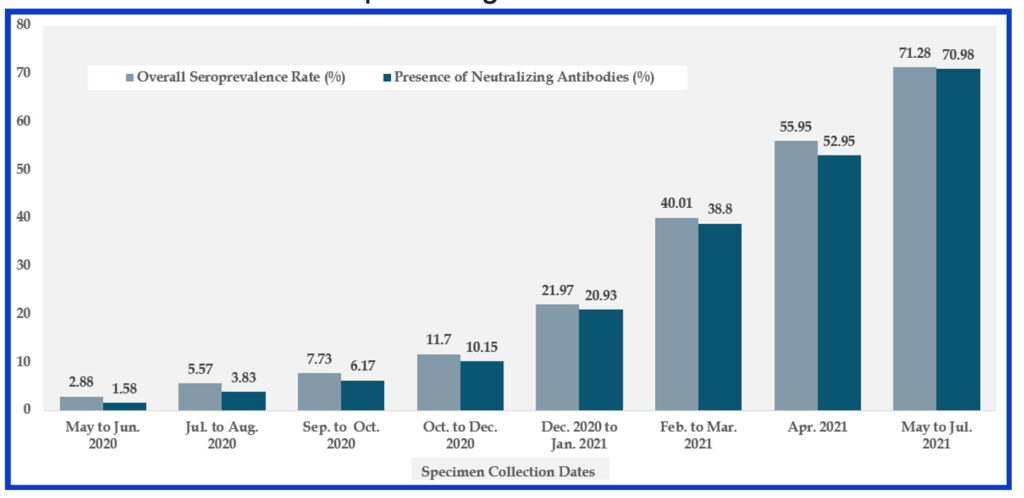
The results of these studies showed in May and June of 2020, the seroprevalence rate was 2.88% but it rose dramatically in May and June of 2021, surpassing 70%. Seroprevalence is defined as “the percentage of a population who have the presence of neutralizing antibodies in their blood, showing they have been exposed to a virus or other infectious agent.”
In the same research population it was demonstrated that the neutralizing antibodies had also risen above 70%. Neutralizing antibodies defend the cell from pathogens or organisms that cause disease—say Covid-19. This production occurs whether through “vaccines” or from getting the infection.
In other words, as early as June 2021, the study verified from a sample across active duty members, reserves and guard that the military had met the definition of herd immunity established by Dr. Fauci.
The graph below shows how the changes in antibody levels occurred over time. Note that the overall percentage in June of 2021 was over 70%.
According to the dates in the reports, Army Col. Kevin Taylor, was the responsible point of contact for action around July of 2021. It is not known what he did with this information, nor is it known if Sec. Austin knew of this report prior to making the jab mandatory for all service members in August of 2021.
Apparently, this herd immunity information was hidden from everyone.
Based on the scientific data there was no need for military members who refused the shot to be discharged for refusal.
The military could have just given the jabs to those who wanted it and allowed those who did not want it for personal or religious reasons to remain in the military.
Fast forward to now. What we do know is herd immunity wasn’t going to happen to the extent Dr. Fauci and others stated. The virus is great at mutating, and it continues to do so causing an annual jab to now be the government solution.
Even though there is increased concern about its safety and that the newest jab “drastically reduced efficacy among a population with high immunity levels and rising costs.”
But Big Pharma really thinks you need to continue to “protect” yourself even if the latest version is not overly effective on the current mutant coronavirus.
Why was this information withheld and marked as confidential to prevent its release?
Why was such a hard line taken when the data clearly demonstrated the military already had herd immunity without Covid jab mandates?
What purpose or whose agenda did it accomplish to hide the truth?
How many military members have been forced out or voluntarily separated when the mandate business started?
Do those members deserve to be reinstated with back pay?
Who should be held accountable for hiding the truth?
This mess could have been avoided if we had only followed the actual science, as Dr. Fauci repeatedly told us to do.
Linda Boyle, RN, MSN, DM, was formerly the chief nurse for the 3rd Medical Group, JBER, and was the interim director of the Alaska VA. Most recently, she served as Director for Central Alabama VA Healthcare System. She is the director of the Alaska Covid Alliance/Alaskans 4 Personal Freedom.
Those who read Must Read Alaska at the website can also become newsletter subscribers. We hope you are already a subscriber.
Our famous newsletter goes out to nearly 33,000 Alaskans on Monday, Wednesday, and Friday every week (except some holidays.) The newsletter a quick overview of news of importance to Alaskans and those who love Alaska who are center-right politically. We balance out the legacy media and ensure that the “rest of the story” is told.
You can give a gift subscription to family members or friends, and by doing so you help spread the word, keep the mainstream media honest, and ensure Must Read Alaska can continue as a Force for Good, as we move into our 10th year of publication.
Thank you in advance, and Merry Christmas and Happy Hanukkah to all our subscribers and readers. We appreciate you reading, commenting, and supporting this labor of love for Alaska.
Feel extra generous? Already a subscriber to the newsletter? Think this conservative endeavor is worth a Christmas bonus?
You can always make an extra donation to this MRAK project at this link:
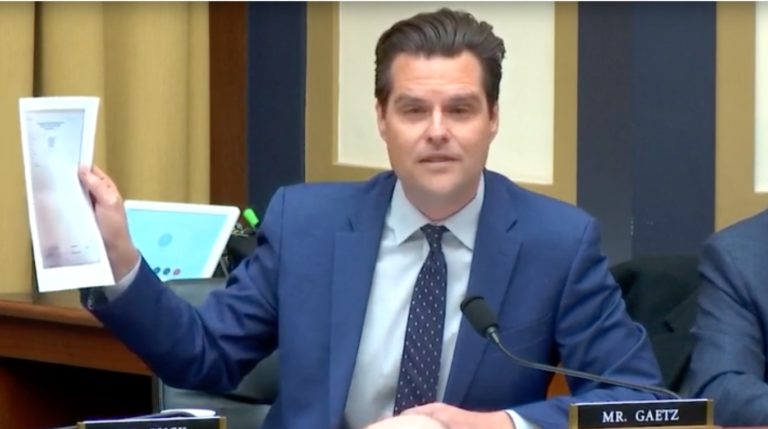
Ahead of the House Ethics Committee report on Rep. Matt Gaetz of Florida, the report was leaked to CNN, which reported on the allegations that Gaetz may have paid women and a 17-year-old for sex, and that he was a user of various illegal drugs while he served in Congress.
It’s unclear who leaked the report, but signs point to Democrat Rep. Rep. Susan Wild of Pennsylvania, who is the top Democrat on the committee and who was absent all last week during the committee meetings and decisions about whether to release the report and when. Wild was defeated for re-election by Republican Ryan Mackenzie in November.
The report says the committee found it probable that Gaetz used cocaine, ecstasy, and cannabis repeatedly between 2017 and 2020, at parties and at events. According to the allegations, Gaetz set up an email account to coordinate his marijuana purchases.
Gaetz has denied the allegations and did not cooperate with the Ethics Committee during its investigation, which started in 2021.
From at least 2017 to 2020, Representative Gaetz regularly paid women for engaging in sexual activity with him.
In 2017, Representative Gaetz engaged in sexual activity with a 17-year-old girl.
During the period 2017 to 2019, Representative Gaetz used or possessed illegal drugs, including cocaine and ecstasy, on multiple occasions.
Representative Gaetz accepted gifts, including transportation and lodging in connection with a 2018 trip to the Bahamas, in excess of permissible amounts.
In 2018, Representative Gaetz arranged for his Chief of Staff to assist a woman with whom he engaged in sexual activity in obtaining a passport, falsely indicating to the U.S. Department of State that she was a constituent.
Representative Gaetz knowingly and willfully sought to impede and obstruct the Committee’s investigation of his conduct.
Representative Gaetz has acted in a manner that reflects discreditably upon the House. Based on the above, the Committee concluded there was substantial evidence that Representative Gaetz violated House Rules, state and federal laws, and other standards of conduct prohibiting prostitution, statutory rape, illicit drug use, acceptance of impermissible gifts, the provision of special favors and privileges, and obstruction of Congress. The Committee did not find sufficient evidence to conclude that Representative Gaetz violated the federal sex trafficking statute.
Although Representative Gaetz did cause the transportation of women across state lines for purposes of commercial sex, the Committee did not find evidence that any of those women were under 18 at the time of travel, nor did the Committee find sufficient evidence to conclude that the commercial sex acts were induced by force, fraud, or coercion.
On Monday, President Joe Biden announced that he commuted the sentences of 37 men on federal death row. Those men will have their sentences reclassified from execution to life without the possibility of parole.
Biden’s announcement came out of the White House at 4:30 a.m. Eastern Time, 28 days until the end of Biden’s term in office.
“President Biden has dedicated his career to reducing violent crime and ensuring a fair and effective justice system. He believes that America must stop the use of the death penalty at the federal level, except in cases of terrorism and hate-motivated mass murder – which is why today’s actions apply to all but those cases. When President Biden came into office, his Administration imposed a moratorium on federal executions, and his actions today will prevent the next Administration from carrying out the execution sentences that would not be handed down under current policy and practice,” the White House said.
Three men did not have their sentences commuted: Dzhokhar Tsarnaev, one of the men involved with the Boston Marathon pressure-cooker bomb that killed three; Robert Bowers, who was convicted of the mass shooting at the Tree of Life Synagogue antisemitic attack that killed 11; and Dylann Roof, who killed nine churchgoers in what was called a racially motivated shooting in South Carolina.
Some of the men who had their sentences commuted killed more people than Tsarnaev, the Chechen-born Boston Marathon bomber.
Among those whose death sentences have been commuted are rapists, kidnappers, bombers, and murderers, such as Brandon Basham and Chadrick Fulks, who raped and killed two women during a 17-day crime spree across several states.
Also being spared is Kaboni Savage, a drug dealer, organized crime leader, and mass murderer who ordered the firebombing of a house where a federal witness lived, killing six people, including the witness.
Shannon Wayne Agofsky, who murdered a bank president and dumped his body in a lake in Oklahoma in 1989, will also be spared the death penalty. During his time in prison he has murdered a fellow inmate.
Jurijus Kadamovas and Iouri Gherman Mikhel are Soviet Union-born serial killers who immigrated to the United States from Lithuania and Russia, respectively. They kidnapped and killed five people over a four month period beginning in late 2001, and demanded ransom. They will be spared by Biden.
Alejandro Enrique Ramirez Umana, aka “Wizard,” murdered several people over a period of time across several states as part of his role in the Mexican gang MS-13. He is an illegal immigrant from El Salvador.
At the time of his death penalty sentencing in 2010, the FBI agent in charge said, “The jury’s finding today sends a message to those gang members who think they can avoid responsibility for their deeds. We will not stop going after them. The people and agencies that took part in this investigation and prosecution prove perseverance and commitment pay off.”
Daniel “Homer” Troya and Ricardo “Ricky” Sanchez, Jr. were convicted of carjacking, death and other felonies for the 2006 deaths of Jose “Lou” and Yessica Escobedo, and their sons, ages 4 and 3. Their bodies were found riddled with bullets off the side of the road near Port St. Lucie, Florida.
Biden has already pardoned, commuted the sentences, or granted clemency to over 8,000 people, the most in history, including his own son, Hunter Biden, for whom he gave a blanket pardon for all crimes known and unknown from 2014 to December of 2024.
The names of all 37 men and their federal inmate numbers who have been spared by Biden’s actions on Dec. 23, 2024:
Reading the news and commentaries as we close out 2024 is interesting, especially when one reads the comments from readers.
My column, “What’s known about gas levels in Cook Inlet warrants immediate action,” of Nov 25, 2024 resulted in a lot of comments from people who were engrossed in taking shots at the other commenters. Very few seemed to have much interest in actually solving the problem of ensuring sufficient Cook Inlet gas availability until long into the future. I was hoping for some increase in positive thinking about the availability of natural gas in Cook Inlet.
It seems everyone has forgotten that the federal administration has provided negative support for oil and gas activity in Alaska, including for Cook Inlet gas. In addition to that, the ESG (Environmental, Social and Government) pressure on financial institutions and oil and gas companies strongly discourages oil and gas development because of the greenhouse gas craze. As a result there has been negative support for anyone trying to develop additional resource in Cook Inlet.
Reading other articles, I find the commenters dislike Hilcorp more than they dislike the anti-Alaska development forces that have been discouraging investment in Cook Inlet and other Alaska projects. Hilcorp is a reputable and reliable oil and gas producer that is faced with all the same negative support for oil and gas production that others face and are up against all the same environmental encumbrances the rest of us must battle, and they are still producing energy Alaskans need.
The Must Read Alaska column by Luke Saugier of Hilcorp, Hilcorp Alaska: Powering Southcentral Alaska’s past, present and future, was more convincing of Hilcorp’s commitment to Alaska energy than one commentor’s suggestion that Alaskans should support of a Renewable Portfolio Standard (RPS) would be preferable to Hilcorp’s threats and empty promises.
Hilcorp has been drilling new wells and producing gas, so they are meeting their commitment and promise.
Apparently one reader did not understand that the gas demand is fairly well fixed, with Hilcorp supplying most of that demand so that other producers cannot readily flow natural gas into the supply line without Hilcorp adjusting to allow more flow from an alternate source.
Arthur Miller, CEO of Chugach Electric and Mark Wiggin, Chair of the Chugach Electric board of directors co-authored a commentary on Monday in which they stated that CEA has co-invested with Hilcorp for new gas wells, and indicated they were looking forward to energy that will be available from renewables, imported LNG, possible North Slope gas and new gas from Cook Inlet.
For a correction to my article, I was advised that all the oil and gas tax incentives had been paid to Furie, so that wasn’t really part of the problems that Furie had to overcome, but there were various issues with financial support of oil and gas activities in Cook Inlet in recent decades that did have impact.
The summer 2024 edition of the Alaska Alliance LINK noted that one factor that slowed the royalty bill in the Alaska Senate was a delay in hiring a consultant who would model the effects of royalty reduction. The consultant and the State Division of Oil and Gas were both reported to have reached the decision that reducing the royalty was the quickest way to production of new gas. The whole idea of the reduced royalty on gas is not to make things more profitable for the producer but to make the gas supplied less expensive to Alaskans, to make our energy more affordable. During this next legislative session Cook Inlet gas production will, hopefully, receive more aggressive attention.
One bright spot this week was the commentary by Pedro Gonzalez in MRAK on Sunday, Dec 15.Gonzalez seemed to be confident that there is sufficient gas available to ensure a secure energy future for Southcentral Alaska. The certainty of Cook Inlet gas is better than the speculation on imported LNG, or North Slope Gas or renewables. Once we have confidence that Cook Inlet will be available for the foreseeable future, we can take our time to development the other sources of energy and avoid the extra expensive of rapidly building new infrastructure and rapidly develop new energy sources.
For the education portion of the title of my article I will reiterate my comment in an earlier article that there should not be an increase in funding for education without some offer of performance criteria for school districts for math, reading and capitalism; a reduction or elimination of social engineering indoctrination in the schools without parental consent; and improved graduation rate for students.
Gov. Dunleavy has stated for each budget that he expects a performance criterion before he will support increased funding for schools. That should put the burden on school boards and school districts around the State. We want our students to be qualified to become properly qualified engineers and scientists to work on our energy solutions and make real scientific decisions concerning our environment.
The environment comment I have is to make here deals with the pressure on the oil and gas industry. It is time to recognize that the climate change we have experienced is only a recovery from the Little Ice Age and is not due to greenhouse gas emissions. It is time for scientists to admit that the planet had higher temperatures before the Little Ice Age than we have now. Forests that are found beneath retreating glaciers should be one very good representation that the earth has been warmer than now, in the not too distant past.
It is time to get scientists to admit that they have been subverting good science, and have been perpetrating a lie. Fossil fuels are not a cause for warmer temperatures or the atmospheric rivers. If one keeps track of the position and route of the jet stream they will see where the high pressure areas will form to cause “heat domes.” There is no basis for court cases against the oil and gas companies concerning changes in climate.
Now is the time to remove the impediments to progress in oil and gas development in Alaska so our Cook Inlet natural gas production will become popular again, and increased production of oil from the North Slope can once again be a major focus for our efforts.
That is where our economy will be built and which will ensure our ability to put forth balanced budgets in the future, while still providing full Permanent Fund dividends to our citizens.
Robert Seitz is a professional electrical engineer and lifelong concerned Alaskan.
President Donald Trump told a convention of conservatives in Phoenix on Sunday that he will, by executive order, end the current and growing practice of child genital mutilation, also known as transgender surgery.
Transgender surgery has become a profit center for doctors and has grown into an ideology, where people are believing that their sexual identity is something that is a social, rather than biological attribute.
Trump was the keynote speaker at Turning Point USA’s America Fest, on the fourth day of the four-day gathering of what is typically a young conservative crowd.
Spotted at AmFest from Alaska were Rep. Jamie Allard, Alaska Republican Party Chairwoman Carmela Warfield, and Jason Warfield, her husband.
President Trump promises “Day 1” action to end child mutilation and get “transgender lunacy” out of schools, the military, and women’s sports.@realDonaldTrumppic.twitter.com/ZIof2divzW
“When he said he will end child sexual mutilation, the crowd gave him a roaring standing ovation,” said Allard. She has been at the forefront in Alaska in protecting girls in sports from the invasion of boys who are being allowed to play on girls-only teams. “He is bringing sanity back to the White House.”
Trump also said, “I will immediately sign a new executive order to cut federal funding for any school pushing critical race theory, transgender insanity, and other inappropriate racial, sexual, or political content on our children.”
Other conservatives who were not at Am Fest applauded Trump’s bold remarks.
Chloe Cole, a 20-year-old woman from San Fransisco whose own breasts were removed at age 16 before she outgrew her transgender phase, was present at the convention.
Alaska Republican Party Chairwoman Carmela Warfield and child advocate Chloe Cole at America Fest on Dec. 22, 2024
Cole said, “This statement got one of the loudest cheers in the entire speech. Let’s destroy the entire gender industry!!”
“This is why America came out for Trump and why the Democrat Party got destroyed. America had enough,” commented Sen. John F. Kennedy of Louisiana.
President Joe Biden is only a few weeks away from the end of his time in office, and one key part of his legacy is undeniable: inflation.
Biden has battled inflation from the start, but critics say he helped fuel it with trillions of dollars in deficit spending during his four years in office. Federal debt spending is offset in part by printing money, which increases inflation.
Biden has boasted bringing inflation rates down from about 9% earlier in his term to roughly 2.5% currently.
While the rate of inflation has slowed, that doesn’t mean prices have decreased. In fact, they continue rising, albeit slower than earlier in his term.
The federal government released a a key inflation marker Friday, its Personal Consumption Expenditure index, which rose 2.4% last month, a bit less than expected.
Overall, though, prices have risen more than 20% since Biden took office.
According to the federal CPI inflation calculator, $100 in January 2021, when Biden took office, has the same buying power as $120 as of November of this year. That means $100 went much further in 2021 than it would today.
The price of groceries actually rose faster than overall inflation, increasing more than 22% since Biden took office.
Those higher prices have given Republicans plenty of fodder for their attacks on the incumbent president.
“The Biden-Harris Administration’s parting gift to the American people is as welcome as a lump of coal at Christmas: higher prices that keep rising,” House Ways and Means Committee Chairman Jason Smith, R-Mo., said in a statement Friday. “Families have been hammered by a 20 percent spike in prices under President Biden that has made the cost of living unaffordable. The American people are ready for the Trump presidency and a return to a strong, prosperous economy that created good-paying jobs.”
Polling data showed that despite some positive economic indicators this year — relatively low unemployment among them — Americans still had a poor view of the economy. At least one reason why was undeniably that costs, for groceries in particular, have soared since Biden took office.
Polling after the November election showed voters cited higher prices as a key consideration in their vote.
A poll from May of this year showed that Americans’ confidence in Biden’s handling of the economy hit a “historic low.”
Obama’s confidence ratings were at least 50% each year except for one (42% in 2014). Biden has fared much worse as confidence in his economic management dropped precipitously in 2022 from 57% to 40% amid sharply higher inflation, and it has been below 40% since then. Only Bush earned lower confidence from Americans than Biden has since last year – by the end of his second term, amid the Great Recession, when just 34% of Americans expressed confidence in his economic abilities.
Gas prices spiked during Biden’s term as well, topping a historic national average of $5 per gallon before dropping, in part, because Biden emptied out much of the Strategic Petroleum Reserve.
When Biden took office, the national average price for a gallon of gas was about $2.39 per gallon.
Currently, the national average price for a gallon of unleaded gasoline is about $3.00 per gallon, according to AAA.
Anchorage Mayor Suzanne LaFrance on Friday announced four new members of her senior staff.
Mark Spafford is the deputy municipal manager. A licensed professional engineer with more than 20 years of experience as a manager of people and projects in the realms of water, wastewater, solid waste, recycling, telecom, and electrical utilities, he has served as the general manager of the Solid Waste Services Department and as the operations and maintenance director at Anchorage Water and Wastewater Utility. In his new role, he will provide leadership and oversight for the Anchorage Hydropower Utility, Public Transportation, Safety, Solid Waste Services, Municipal Airports, and Anchorage Water and Wastewater Utility, while also helping to drive Mayor LaFrance’s climate and energy agenda.
Marjorie Harrison is the new library director. She has worked as a librarian, coordinator, and director in libraries across America, including Arkansas, Nebraska, Michigan, Colorado and Washington, and managed research and library services for the Oregon state legislature and executive branches, including citizen access to documents and historical resources. Most recently, she served as executive director of Calcasieu Parish Public Library in Lake Charles, Louisiana where she was responsible for a 13-branch library system. She has a master’s degree in library science from Wayne State University and will start at the Anchorage Public Library in early 2025.
Bart Rudolph has accepted the permanent position of Public Transportation director, after serving asthe department’sacting director since August. He has workedas the department’s planning and communications manager since 2015, overseeing the planning, marketing, and RideShare divisions, and coordinating with partners and the public as the department’s public information officer. Before joining the Municipality, he worked at the Alaska Department of Transportation and Public Facilities, as well as Metropolitan Planning Organizations in Kansas and Missouri. He has two decades of transportation experience planning experience.
Greg Soule has accepted the position ofDevelopment Services director and building official. He served as the acting director for Development Services since May 2021 and has worked for the municipality since 2001 as a project engineer, private development engineer, and private development manager. A professionally licensed civil engineer, he has 26 years of structural, geotechnical, and transportation engineering experience.