Police SWAT members were sent to a hotel in midtown Anchorage on Friday morning, where a man was said to be holding five hostages, including a woman and children. After a long standoff, there was an exchange of gunfire and the perpetrator was shot dead. None of the children appeared to be physically injured.
The shootout occurred in a second-story room at the Hampton Inn hotel. Two people in the room communicated with police, and at one point, one of them shot bullets through the door at the police. Then, police somehow observed a crime being committed against one of the adults in the room, and police entered the room and fired at least once at the perpetrator, killing him.
A woman and children left the building and were helped into an ambulance. In all, there were six people in the room, including the alleged hostage-taker.
Gov. Mike Dunleavy has introduced new legislation aimed at enhancing food security and fostering economic growth by permitting finfish farming in Alaska.
Currently, Alaska law strictly prohibits finfish farming, except for private nonprofit salmon hatcheries. However, House Bill 111 (HB 111), introduced on Friday, would grant the commissioner of the Department of Fish and Game—working in consultation with the commissioner of the Department of Environmental Conservation—the authority to permit the cultivation and sale of specific finfish species in inland, closed-system water bodies.
The proposed legislation includes several key provisions:
Sterile Fish Only: All finfish farmed under the permit must be sterilized triploids, ensuring they cannot reproduce.
Salmon Prohibition: The bill prohibits the cultivation of pink, chum, sockeye, coho, chinook, and Atlantic salmon.
Secure Containment: Finfish farms must be enclosed within natural or artificial escape-proof barriers.
Private Stocking for Personal Use: Individuals may stock private lakes with finfish for personal consumption without a permit, provided the lake is enclosed within an escape-proof barrier.
“This legislation is a continuation of my administration’s efforts to grow Alaska’s food security by creating a new fish farming industry,” Governor Dunleavy stated. “Alaska can join other regions of the world by raising fish that can be sold and consumed here in Alaska and be available for export. This legislation will yield new jobs, economic growth, and a new food source for all Alaskans.”
The economic potential of finfish farming is substantial. According to the USDA’s 2023 Aquaculture Census, food fish aquaculture sales reached $819.6 million nationwide. While catfish made up more than half of that value, trout ranked second, followed by tilapia. If enacted, HB 111 could position Alaska to tap into this growing industry while maintaining environmental safeguards.
The bill will now move to the state legislature for consideration, where it is expected to generate debate among lawmakers, environmental advocates, and the fishing industry. If approved, it could mark a significant shift in Alaska’s approach to aquaculture and food production.
As the Trump Administration attempts to ramp up its crackdown on immigration, the president signed an executive order this week aimed at ensuring “taxpayer resources are used to protect the interests of American citizens, not illegal aliens.”
The move sent ripples through the networks of non-government organizations that rely on these resources to carry out activities that support those illegally residing in the United States. Must Read Alaska recently reported on one such entity, the Alaska Institute for Justice.
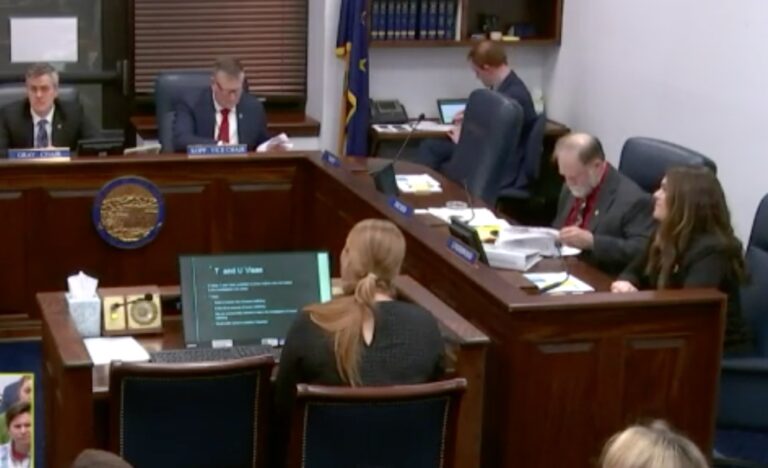
On Wednesday, Anna Taylor, the group’s deputy director, participated in a revealing presentation before the House Judiciary Committee. Taylor appeared alongside Mara Kimmel, an AIJ co-founder and the executive director of the ACLU of Alaska. Kimmel is the wife of former Anchorage Mayor and Democrat Rep. Ethan Berkowitz, who left elected office in a shroud of controversy.
At the outset, Kimmel stated that Alaska has the fourth-highest rate of naturalized citizens in the country. She also touched on the visa types used by employers in the state, such as the H-1B. According to Kimmel, that particular program is used to hire people for jobs in industries that range from oil and gas to education.
When it was Taylor’s turn to speak, she outlined AIJ’s various services and programs. Much of what she said overlapped with Kimmel’s remarks, focusing on legal immigration, visas, and a variety of statistics.
The subject of illegal immigration was notably absent from the presentation. An awkwardness descended on the room when Republican Rep. Jubilee Underwood of Wasilla brought it up.
“My question would be, on the flip side of that, do you guys have any lists of things that would be considered illegal immigration and what that looks like?” Underwood said. “If so, what does your organization believe is the solution for that?”
Taylor struggled to formulate a response.
Illegal immigration is “complicated because immigration law is so complicated,” Taylor said.
She seemed to be grasping for a way to deflect from Underwood’s question and ultimately did by focusing on terminology.
“Illegal and legal, I tend to use the words ‘documented’ and ‘undocumented’ because that’s focusing on someone’s status, and it’s a more precise term because people’s status can change so much,” Taylor continued. “It’s a complicated answer.”
According to the White House, it’s not so complicated and the public, for now, more or less agrees with that position.
A recent NPR/Ipsos poll found that “a plurality (48 percent) of respondents say they support Trump’s call for mass deportation of all immigrants living in the U.S. without legal status.”
That is also why money received by organizations that work against removal efforts has become a hot topic.
During the hearing, Democratic Rep. Genevieve Mina asked about AIJ’s funding. Taylor replied that a good deal of the services they offer are “free” thanks to federal grants.
Except it’s not technically free. Taxpayers are subsidizing it. Many of them would likely object to this use of public funds or would at least like a say. Voter frustration with this state of affairs contributed to the election of Trump, as immigration was and is a top issue for the American electorate.
As previously reported by Must Read Alaska, the institute has received more than 30 percent of its support and revenue from such grants in the last two years.
Underwood’s remarks and Taylor’s responses start around 37:38 at this link.
Alaska’s education system is broken. It has failed our children, our parents, and our communities. Despite having one of the highest per-student spending rates in the nation, Alaska’s students rank at or near the bottom in national education performance metrics. Graduation rates, literacy levels, and college or career readiness remain shockingly low, despite decades of increased funding and bureaucratic oversight.
Our current public education system, governed by Title 14 of the Alaska Statutes, has become an expensive, ineffective, and unaccountable bureaucracy that prioritizes compliance over outcomes, administration over instruction, and institutional self-preservation over student success. It is time for a fundamental transformation that restores the power of education to parents, local communities, and students rather than a failing state-run bureaucracy.
The solution: “The Alaska Education Freedom and Local Control Act.” I’ve done all the legwork for any legislator who wants to be its prime sponsor:
This proposed bill would repeal Title 14’s failed framework and establishes a new education model that:
Directs funding to parents through Parental Education Accounts, ensuring that funding follows the child rather than being trapped in a failing bureaucracy.
Empowers local governments and communities to determine their own education policies, school structures, and instructional methods without state-mandated interference.
Eliminates wasteful bureaucracy, dissolving the Department of Education and Early Development as a management entity and redirecting resources to students and teachers.
Encourages innovation and competition, allowing for a diverse education landscape that includes public, private, charter, homeschool, online, and vocational pathways tailored to Alaska’s unique needs.
Rationale: The Failure of Alaska’s Current Public Education System
Abysmal student performance despite high costs
Alaska ranks among the worst in the nation in math, reading, and science proficiency.
Only 29% of Alaska’s fourth graders are proficient in reading—a foundation for all future learning.
Despite per-student spending exceeding $19,000 per year, outcomes remain stagnant or in decline.
A bloated bureaucracy that diverts resources away from the classroom
Administrative spending has skyrocketed, while teacher pay has remained stagnant.
School districts employ more bureaucrats than teachers in some cases, creating layers of inefficiency.
Compliance-driven mandates, rather than student-centered policies, dictate classroom instruction.
Lack of accountability for failing schools
The state has no effective mechanisms to intervene in persistently failing schools.
Parents have no real choice when their children are stuck in underperforming schools.
Schools receive funding regardless of performance, creating no incentive for improvement.
One-size-fits-all policies that fail to serve Alaska’s unique student population
Rural and urban education challenges require different solutions, but the current system treats them the same.
Vocational and technical education remains underfunded, despite Alaska’s strong career and trade economy.
Special needs and high-performing students alike are neglected under an outdated, bureaucratic system.
The Alaska Education Freedom and Local Control Act: A New Vision for Education
1. Parental Education Accounts: Funding Follows the Student
Every child in Alaska will receive a direct education funding allocation into a Parental Education Account (PEA).
Parents can use these funds for public school tuition, private school tuition, homeschooling resources, online learning, vocational training, and more.
Accountability measures will ensure funds are spent only on approved educational expenses.
2. Local Control: Communities Determine Their Own Educational Models
Boroughs, cities, and local school cooperatives will have full authority to design and manage their education systems.
State-mandated curriculum and oversight will be eliminated, allowing local innovation.
Charter schools and private school expansion will be streamlined, offering more choices to families.
3. Eliminating Bureaucracy & Reinvesting in Teachers
The Department of Education and Early Development (DEED) will be dissolved as a regulatory body.
Funding that currently pays for bureaucrats and compliance enforcement will be redirected toward teacher salaries and student programs.
Schools will be free to hire and pay teachers competitively, rather than adhering to state-mandated contracts that discourage performance-based pay.
4. Expanding Educational Choices for Families
Public school choice will allow students to attend any school statewide.
Charter and private school expansions will remove artificial caps and restrictions, allowing more high-quality options.
Career & Technical Education (CTE) programs will receive equal funding treatment to traditional academic programs.
Restoring the True Purpose of Public Education
Article VII, Section 1 of the Alaska Constitution states: “The legislature shall by general law establish and maintain a system of public schools open to all children of the state and may provide for other public educational institutions. Schools and institutions so established shall be free from sectarian control. No money shall be paid from public funds for the direct benefit of any religious or other private educational institution.”
This bill fulfills this constitutional mandate while ensuring:
A system of education exists for all students, but parents—not the state—decide the best educational path for their children.
Public funds remain in public control but are used efficiently to benefit students directly.
Education is free from excessive government control, fostering local innovation and community-led solutions.
Alaska has the opportunity to lead the nation in education reform that puts students first, eliminates bureaucracy, and empowers parents and local communities. For decades, politicians and special interests have promised improvements while pouring billions into a failed system. It is time to fund students, not bureaucracies and return education to those who care about it most: parents, teachers, and local communities.
Alaska Education Freedom and Local Control Act
An Act to Repeal and Replace the State’s Public Education System Under Title 14
BE IT ENACTED BY THE LEGISLATURE OF THE STATE OF ALASKA:
Section 1: Repeal of Title 14 Public Education Management and Operation
(a) The following provisions of Title 14 of the Alaska Statutes are hereby repealed in their entirety:
AS 14.03 (General Provisions)
AS 14.07 (Powers and Duties of the Department of Education and Early Development)
AS 14.08 (Regional Educational Attendance Areas)
AS 14.12 (School Districts and Teachers)
AS 14.14 (Local Administration of Schools)
AS 14.17 (State Aid to Public Schools)
AS 14.20 (Teachers and School Personnel)
AS 14.30 (Students and Educational Programs)
AS 14.43 (Scholarships, Grants, and Loans)
Any other statutory provisions that grant direct management, funding control, or oversight authority of public education to state agencies.
(b) The Department of Education and Early Development (DEED) shall be dissolved as a managing entity of public education, retaining only advisory and reporting functions to track compliance with constitutional requirements.
(c) School districts are dissolved as state-mandated entities. Local governments, school cooperatives, and parent-led initiatives may establish schools consistent with local community values and educational needs.
Section 2: Localized Education Management and Parent-Controlled Funding Model
(a) Parental Education Accounts (PEAs)
Direct Funding to Parents
The State of Alaska shall allocate Education Empowerment Funds (EEF) directly to Parental Education Accounts (PEAs) for each child.
PEAs shall be used for:
Tuition at public, private, charter, or homeschool programs.
Educational resources, materials, or technology.
Special education services and tutoring.
Extracurricular programs and career training.
Annual Allocation & Accountability
The per-student amount shall be equivalent to the current Base Student Allocation (BSA)adjusted for local cost differentials.
Unused funds shall remain in the account until the student graduates or transfers out of state.
Mandatory annual audits of PEAs ensure funds are used solely for educational purposes.
(b) Local Government Authority over Education
Municipal Control
Cities, boroughs, and local communities may establish, fund, and operate schools according to their unique needs.
No state-imposed curriculum mandates. Local education providers determine academic programs.
School Choice and Competition
Parents may choose any accredited school or program without geographical restrictions.
Public, private, homeschool, and hybrid models may compete for students and funding.
(c) Teacher Employment and Accountability
End of State-Mandated Tenure & Certification Requirements
Teachers shall be employed at the discretion of local schools, cooperatives, or parent-led institutions.
Schools set their own hiring and retention standards.
Parents and local governing bodies shall determine teacher accountability and retention policies.
Funding to underperforming schools may be reallocated by parent or community vote.
Section 3: Constitutional Compliance and Transition Provisions
(a) This Act shall be implemented consistent with Article VII, Section 1 of the Alaska Constitution, ensuring:
Equal access to education for all children.
Protection of public funds for legitimate educational purposes.
(b) The transition period shall commence July 1, 2025, with full implementation by July 1, 2026.
(c) Any remaining funds held by dissolved school districts shall be redistributed to PEAs and local education initiatives.
Conclusion
The Alaska Education Freedom and Local Control Act empowers parents, removes bureaucratic waste, and returns education oversight to communities. This funding-first, government-last model prioritizes student success, efficient spending, and meaningful local control.
In the wake of President Donald Trump’s executive order aiming to expand educational opportunity for students and families, the U.S. Department of Education has taken steps to support charter school growth.
The Biden administration had required federal review of “how states approve select entities’ (e.g., private colleges and universities) authorization of charter schools in states where they are already lawful authorizers.” The department announced that it had removed that requirement Thursday in an effort to promote state autonomy in educational decisions and make more schools readily accessible to students and families.
“This decision will allow states like South Carolina to innovate and expand on high-quality charter schools in our state,” said the state’s Superintendent of Education Ellen Weaver, in response to the department’s action.
States like South Carolina and Utah “also faced new requests for information that exceeded the standards typically outlined” in the Charter School Program grant application process, according to a press release from the department.
The department called the former requirement “overly bureaucratic” and “burdensome.”
The new application process is supposed to “[reduce] federal micromanagement” and “[eliminate] ideological overreach,” according to the department.
The department also announced the release of $33 million in grant funding to charter management organizations in January.
In his executive order promoting school choice, Trump directed the departments of education, health and human services, defense and the interior to uncover ways federal funding can be used to support educational alternatives to public schools
Just when you think it can’t get any worse, new information has surfaced on the bad health effects from the Covid-19 jab.
Yale University scientists have linked the Covid-19 shot to an incredibly rare, yet alarming syndrome referred to as “post-vaccination syndrome.” Akiko Iwasaki, an immunologist at Yale, led the study.
Have you ever suffered from these symptoms after getting a Covid shot: brain fog, dizziness, tinnitus, and poor tolerance to exercise? Then you may have post-vaccination syndrome. Additionally, there are biological changes that include changes in immunity cells and coronavirus proteins, even years after getting the shot.
These same scientists determined that the shot can wake up dormant viruses in your body such as the Epstein-Barr virus.
Epstein-Barr is a common virus that occurs in about 50% of children under five and 95% of adults over a lifetime. When reactivated, it can cause symptoms such as an “enlarged spleen, swollen liver, swollen lymph nodes in the neck, and a rash.”
In some cases, it leads to mononucleosis and can on rare occasions lead to cancer.
Professor Iwasaki played down the results of her study. She stated that there is still a lot of work to be done, and this is just the first step in determining what is going on with people who have had these effects. She believes the next step is to determine how many people have been affected and who may be most vulnerable.
Suffice it to say, this is just the latest example of serious medical problems incurred from taking the Covid jab.
This study was only published on the preprint server. Mainstream medical journals have refused to publish it. The sample size was small, but the data were statistically significant.
Fortunately and rather unbelievably, The New York Times chose to get the truth out.
I consider this a good beginning to vindicate those who have said there were bad side effects from the jabs. Vaccine injuries are real.
Recently, Dr. Deborah Birx, who served as the White House coronavirusresponse coordinator in the first Trump White House, confirmed the Covid shots weren’t designed to prevent against infection. Also, they were to be rolled out to the elderly with co-morbidities. In an interview with Piers Morgan, she went on to say:
“When we say that we’re following the science and the data, we need to follow the science and the data. And the science and the data said people primarily over 65 or people with significant co-morbidities were at risk for severe disease. Those are the individuals that should have been immunized first. And we should have put our science behind our immunization schedule and protected those most at risk,” she said.
Wow, that’s not the message I heard. By their plan, everyone had to get it. If you didn’t get it, you were killing your neighbors and grandmother. It was supposed to prevent the disease, which it didn’t. It was supposed to give immunity, which it didn’t. I could go on.
We suffered through four years of hell thanks to Big Pharma, misinformation from Big Government, and lies from Dr. Science (Anthony Fauci.)
I can safely say more needs to be done. The American people have lost trust in the medical community and that community needs to work especially hard to get it back.
Thankfully, Robert F. Kennedy Jr was just confirmed as Secretary of the Department of Health and Human Services. He has the will and the power to unravel the lies. We Americans await the truth to emerge. After so many lies, it will be refreshing.
It is truly time for accountability from our government.
It is truly time for individuals to be held fully accountable.
I hope there is enough time before the next “pandemic” to get that accountability.
Linda Boyle, RN, MSN, DM, was formerly the chief nurse for the 3rd Medical Group, JBER, and was the interim director of the Alaska VA. Most recently, she served as Director for Central Alabama VA Healthcare System. She is the director of the Alaska Covid Alliance/Alaskans 4 Personal Freedom.
America’s Best Hotel in Spenard is the scene of another structure fire. The Anchorage Fire Department had several units on location this morning. The photo above, posted on the Anchorage Road Conditions Facebook page, shows the fire raging.
In 2022, the hotel caught fire and a major portion of it was made unusable, with dozens of tenants displaced.
The hotel has been used to house homeless people in the past and the area around has become a vagrant hangout.
In 2020, former Mayor Ethan Berkowitz proposed buying the hotel to use as a homeless shelter, using CARES Act money that came available from the federal government during the Covid pandemic.
The Anchorage Fire Department reported it had had received multiple 9-1-1 reporting a fire in the abandoned building in the 4300 block of Spenard Road.
“Firefighters arrived on scene within minutes. They could see the flames engulfing part of the building and four individuals huddled on a balcony trapped by the fire. Firefighters quickly rescued all four of the individuals by using an aerial ladder truck and began efforts to extinguish the blaze. None of the rescued individuals reported any injuries to AFD personnel.
“Initially more than 30 firefighters responded. Shift change occurred while crews were on scene requiring them to swap out with the next shift. This is a large event that will require AFD personnel to be on scene much of the day. The cause and origin of the fire is under investigation,” the Fire Department said on Facebook. “Thank you to the Anchorage Police Department for showing up to secure the scene and having our back!”
Congressman Nick Begich showed his statesmanship side on Thursday, delivering his first formal address as a U.S. representative to the joint session of the Alaska House and Senate.
In his remarks, Begich stayed true to his conservative values of smaller government and more private sector opportunity for Alaskans, while disarming the Democrat narrative of division and partisan politics. He even took a moment to give a courtesy mention of his predecessor Mary Peltola.
At the end of his 20-minute speech, Begich took questions. Senate President Gary Stevens allowed questions primarily from Democrats, with only a couple of Republicans in the House and Senate being allowed to ask Begich a question. Democrats harped on the narrative of there being not enough federal funding for the state.
Alaska is unique and it is different, Begich said, acknowledging that it is harder to provide services in such as big state, and that size, distance, and remoteness makes it more expensive.
Alaska is the second most federally dependent state in country, second only to New Mexico, he said. Alaska needs to open up resource development to reinvigorate the economy. He reminded his audience that during the statehood debate, the question was whether Alaska could develop its resources and not become essentially a colony.
Instead, he said, the federal government has done everything it could to shut down Alaska’s ability to actually break free of that colonial status. That is something he is working to change.
Among his topics were the development of a natural gasline and not only producing raw materials, but doing more of the processing of minerals, rather than sending them off to China only to have them returned in the form of cell phones.
“Beyond our ports, Alaska needs better connections to the Lower 48, and that means finally establishing a rail-to-rail connection through Canada. This project has enormous potential to lower shipping costs, improve supply chain reliability, and create new trade opportunities. I’m committed to working with stakeholders at the state and federal levels to move this vision forward,” Begich said. “We also need to preserve and strengthen the Alaska Marine Highway System, which is a lifeline for so many coastal communities. I’m working to ensure federal transportation policies recognize and support this critical service.”
He also spoke about his work to expand affordable and reliable energy.
“I’m focused on expanding power generation to lower energy costs and making sure our power transmission infrastructure is resilient enough to handle our extreme conditions. Whether it’s securing investments for microgrids in rural Alaska or pushing for better interconnection between regions, this is a priority that affects every Alaskan—families and businesses alike,” Begich said.
Alaska Sen. Lisa Murkowski and Maine’s Sen. Susan Collins broke with Republicans and voted with Democrats against the confirmation of Kash Patel to head up the Federal Bureau of Investigation.
However, Sen. Mitch McConnell of Kentucky voted in favor of Patel, who passed confirmation on a vote of 51-49 in the Senate.
Murkowski had not indicated how she would vote, and so her decision came somewhat as a surprise. To date, Murkowski has only voted against two of President Trump’s nominees: Secretary of Defense Pete Hegseth and Patel.
She wrote on X: “I will oppose Kash Patel’s confirmation to serve as Director of the Federal Bureau of Investigation. The FBI’s mission is “to protect the American people and uphold the Constitution of the United States.” Mr. Patel and I agree the bureau has crept past that mission, become an increasingly political agency, and eroded the public’s trust. We have had multiple frank and open discussions about how best to restore that trust. I agree with Mr. Patel that it begins by getting agents out in the field, doing what they signed up to do, rather than sitting behind an administrative desk. My reservations with Mr. Patel stem from his own prior political activities and how they may influence his leadership. The FBI must be trusted as the federal agency that roots out crime and corruption, not focused on settling political scores. I have been disappointed that when he had the opportunity to push back on the administration’s decision to force the FBI to provide a list of agents involved in the January 6 investigations and prosecutions, he failed to do so. If confirmed, I wish a successful tenure at the helm of this agency, and will endeavor to work with him to help address issues in Alaska, improve Tribal law enforcement across the country, and make needed changes within the FBI. I truly hope that he proves me wrong about the reservations I have of him today.”