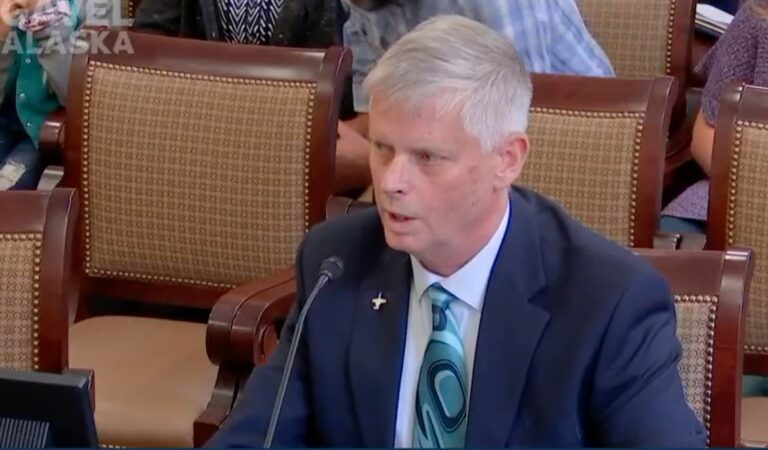
Alaska Gov. Mike Dunleavy, who traveled to Washington, DC this week with a few dozen business leaders in Alaska, got a private meeting on Tuesday with President Donald Trump.
Although details of that meeting have not been revealed, it was likely concerning the Alaska LNG Project, which Dunleavy has been working on for many months, along with the Alaska Gasline Development Corporation and the Alaska Industrial Export and Development Authority.
The gasline is also one of President Trump’s major priorities, articulated by him on the first day of his presidency when he signed an executive order to unleash Alaska’s energy potential.
Dunleavy and several Alaska business leaders, such as Alaska Oil and Gas Association Executive Director Kara Moriarty, also met with Interior Secretary Doug Burgum while in the nation’s capital.
The next steps on the gasline might be an announcement in coming weeks related to front end engineering and design (FEED) and partners for Phase 1, which would prioritize getting gas to Alaskans, apart from the export facilities.
The Legislature is also a factor. House Minority Leader Rep. Mia Costello has a resolution in support of the project, a resolution that would give investors some comfort that the Legislature supports the project. As the Legislature is in the home stretch for the FY 26 budget, decisions about the AGDC budget may send a critical message to oil and gas investors.
As the saying goes, nothing good happens after midnight. It applies to downtown Anchorage, where the city blocks continue to be congested with sleeping or inebriated people often found right at the doors of businesses.
Visitors venturing downtown at night are likely to encounter this scene all summer, as Mayor Suzanne LaFrance finishes her first year in office. She ran on “competence,” accusing the former mayor of lacking the competence to run the city, after having led the opposition against his plans for a navigation center for those without shelter.
Earlier this month, Must Read Alaska gave readers a tour of some of the elaborate shelters being built in the greenbelts of Anchorage, where the city’s trails are no longer safe for citizens to use. Some of the structures have become multi-story sprawling shantytowns such as you might see in a third-world country. That pictorial tour can be seen here:
Downtown Anchorage is where the vagrants without the ambition to set up shantytowns have made their stand, so to speak. The city workers are found most mornings hosing off the sidewalks in front of buildings such as City Hall and the Alaska Performing Arts Center, where human excrement is evident, sometimes smeared across buildings.
Here’s a gallery of what we found late Tuesday night and early Wednesday morning in downtown Anchorage:
Mayor LaFrance has not been engaged in solving the downtown vagrancy problem, but she has been busy.
Last week, LaFrance announced the winners of her city snowplow naming competition. The winning names of the snowplows are: The Berminator, Taylor Drift, Blizzard Wizard, Luke Sidewalker, and Bladey Gaga.
“Now – just in time for the plow equipment’s spring hibernation – the ‘win’-ters have been selected and names have been assigned,” her press team merrily wrote on her behalf. “For the Municipality’s graders, Berminator froze out the competition, coming in first place. Bladey Gaga clinched second, and The Big Leplowski and Plowasaurus Rex tied for third. Other winning names for graders include Ctrl Salt Delete, Darth Grader, Knik of Time, Plowabunga, Betty White-Out, Blizzard Buster, Austin Plowers and Arctic Blade.
“Taylor Drift was the top name for the city’s sidewalk clearers. Blizzard Wizard and Luke Sidewalker tied for second place, while Flurrious George and Sweeping Beauty came in third. Other winning names include Clearopathra, Pathfinder, Drift Destroyer, Drift Lifter, Edgar Allan Snow, Nunhdecheni (“One that eats snow”) and Snow Big Deal.”
In March, the mayor announced $5 million in federal funds that would be distributed directly to people in the form of housing assistance grants, and in April, she announced that she will create 10,000 more homes in Anchorage in 10 years.
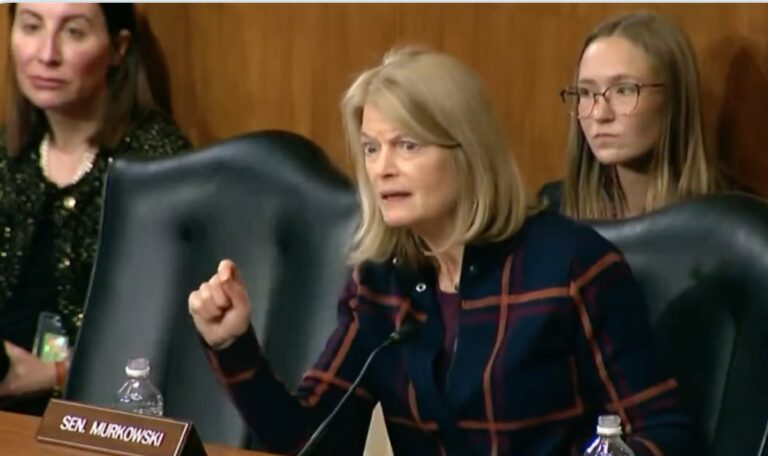
Just before the May Day protests schedule for Thursday, Alaska Sen. Lisa Murkowski took to the statewide airwaves to encourage Alaskans to protest President Donald Trump.
On Alaska Public Radio’s “Talk of Alaska,” she praised the 50501 group that has been organizing regular resistance activities against Trump since Inauguration Day, Jan. 20. The group has been active in all 50 states, including Alaska.
Murkowski spent an hour on the show, with much of her time focused on criticizing the Trump Administration. She was speaking to her base of Democrats, but over 54.5% of Alaska voters cast their ballots for Trump, so she was speaking to the resistance. Murkowski found not one good thing to say about the president.
May Day protests will take place on May 1. It’s the socialist holiday that is being repurposed into another “never Trump” day for Democrats. Big protests are expected across Alaska and the nation.
“I think that type of engagement is important and people shouldn’t feel discouraged because, ‘well, I haven’t seen anything change since the last week that I went to go protest.’ Keep the engagement up,” she told the listening audience.
Earlier this month, she told nonprofit leaders in Anchorage that “We are all afraid,” of President Trump and even she fears speaking out against him.
Murkowski is increasing her profile as the leader of the opposition to Trump, along with Sen. Bernie Sanders. She has a memoir coming out in June about her life as a politician, and all publicity is good publicity for sales as she nears her book launch.
I’ve been following the twisting path of education legislation this year in Juneau. Education seems to dominate the conversation every year, as lawmakers fervently search for a compromise that manages to annoy both sides equally. This year is no different.
House Bill 57, recently passed by the Senate, now appears to be the leading “education bill” of this legislative session and a textbook example of the “annoy everyone” approach.
Democrats are unhappy because their original demand was for a 30% increase in formula funding with no strings attached.
Republicans are equally displeased. Their initial position called for little to no increase in formula funding, preferring instead targeted investments in reforms proven to yield results in other states.
The compromise? HB 57 delivers a modest 12% increase in formula funding but is light on meaningful reform. In other words, everyone’s unhappy.
We have a divided government. Democrats narrowly control both the Senate and the House. The Republicans’ only real leverage is the Governor’s veto pen — an extremely powerful tool given the slim majorities in both chambers.
While the veto can help Republicans win some battles, overusing it carries long-term strategic risks.
Unfortunately, the nuances of the Republican position are difficult to explain in the kind of bumper-sticker sound bites that seem to resonate most with low-information swing voters — the very people who will determine the future makeup of our state government.
Republicans face a tougher messaging challenge. They must counter the simplistic and widespread belief that more money automatically equals better outcomes in education.
I’ve tried to make it clear over the years that there is no consistent correlation between increased K–12 spending and improved student performance. Sadly, most voters aren’t as well-informed as the regular readers of this column.
I, too, am disappointed in HB 57, although it isn’t entirely without merit. One positive: it incentivizes early reading by rewarding schools for students who are at grade level or showing improvement in reading through grade six.
However, the bill does little to address the core problem in Alaska’s education system: the lack of meaningful competition for the existing education monopoly.
At this point, time is likely running out to sway the outcome of this session from “good enough” to “could be better.”
Should the current agreement fall apart, it would empower the “burn it all down” faction that’s pushing for a “no agreement” end to the session. That outcome wouldn’t just harm our kids, it would also complicate Republican messaging in the next election, particularly with swing voters drawn to simplistic narratives.
The most successful education reform efforts in the country have come from states with strong Republican majorities. I’d love to see those reforms in Alaska. But to borrow a phrase from President Trump: Right now, “we don’t have the cards.”
If the few reforms we’ve managed to pass in recent years begin to show real results, perhaps we’ll be better positioned to build the majorities needed for major change.
Bob Griffin is on the board of Alaska Policy Forumand served on the Alaska Board of Education and Early Development.
The Wisconsin Supreme Court suspended a Milwaukee judge facing two federal charges for allegedly trying to help a man illegally in the country escape from immigration officials.
The order, released late Tuesday, said Milwaukee County Judge Hannah Dugan faces two federal charges – one a felony and one a misdemeanor – and it is in the public interest to relieve her of her duties temporarily.
“The court is charged in the Wisconsin Constitution with exercising superintending and administrative authority of the courts of this state. In the exercise of that constitutional authority and in order to uphold the public’s confidence in the courts of this state during the pendency of the criminal proceeding against Judge Dugan, we conclude, on our own motion, that it is in the public interest that she be temporarily relieved of her official duties,” the order reads.
Dugan is charged with obstruction of a federal proceeding and concealing an individual to prevent discovery or arrest. The obstruction charge could result in up to a $100,000 fine and a year in prison, while the second concealment charge can result in up to five years in prison and a $250,000 fine.
The defendant is accused of concealing Eduardo Flores Ruiz, who was previously deported and came back to the U.S., where he was facing charges in Milwaukee of domestic battery and abuse.
Federal Bureau of Investigation Special Agent Lindsay Schloemer wrote in the complaint against Dugan that law enforcement often makes arrests at the courthouse because “not only the fact that law enforcement knows the location at which the wanted individual should be located but also the fact that the wanted individual would have entered through a security checkpoint and thus unarmed, minimizing the risk of injury to law enforcement, the public, and the wanted individual.”
Dugan is scheduled for a pretrial hearing on the federal criminal charges on May 15.
Defense Secretary Pete Hegseth signed a directive ordering a top-down review of the medical conditions that disqualify individuals from joining the US military.
The memorandum, signed April 24 and addressed to senior Pentagon leadership, sets in motion a 30-day evaluation of current medical waiver policies under Department of Defense Instruction 6130.03, Volume 1, which governs the medical standards for enlistment, appointment, or induction into military service.
The initiative comes amid growing concern that an increasing number of medical waivers may be undermining the effectiveness of US forces. According to a Defense Department Inspector General review, roughly 17% of new recruits in 2022 were granted waivers for conditions that previously would have barred their service — a sharp increase from 12% in 2013.
The Navy alone issued 15,900 medical waivers in 2022 of the 41,964 new recruits (active-duty and reserve, enlisted and officers.) That’s nearly 38% of recruits getting waivers for medical conditions.
“Applicants for military service must be physically and mentally able to perform their duties under the harshest of conditions without risk to themselves or others,” Hegseth stated in a video released on the Department of Defense’s social media channels.
The review will focus on identifying which medical conditions should be categorically ineligible for waivers and which may warrant case-by-case consideration — particularly those requiring approval from a military department secretary.
Among the current list of waiver-eligible conditions are schizophrenia, paraphilic disorders, congestive heart failure, and chronic oxygen use — ailments that raise red flags for long-term viability in demanding operational environments.
“Service members need to be medically ready to fight,” Hegseth said. “We need clear, high, and uncompromising medical and mental standards to match the realities of today’s missions.”
Medical experts and military planners have voiced concern that certain serious health conditions may not only prevent recruits from completing initial training but also pose risks to unit cohesion and mission success. Studies cited in the memorandum note that disorders like schizophrenia may deteriorate under combat stress, and conditions such as heart failure or respiratory dependency are incompatible with high-stress, physically taxing deployments.
The directive places responsibility on the Under Secretary of Defense for Personnel and Readiness to propose updates to accession standards and submit them for final approval within 30 days. This review is expected to serve as a blueprint for aligning medical policies with the military’s operational requirements.
Hegseth’s action reflects a broader effort under the current administration to restore and uphold traditional standards of excellence within the armed forces.
“High standards equal lethality,” Hegseth said. “Under President Donald J. Trump, we’ve seen a huge surge of Americans who want to join a military with high, clear standards.”
The Defense Department is expected to release findings from the review in late May, potentially reshaping how the military evaluates the fitness of future recruits.
As the Alaska legislative session grinds toward its final days, Alaska Education Commissioner Deena Bishop has issued a call to action to school superintendents across the state.
In a letter sent Monday, Bishop emphasized the importance of including specific education reform initiatives in the final education bill to ensure comprehensive improvements in the state’s education system.
The Commissioner outlined four primary reforms for advocacy:
Reading Incentive Grants: Provision of $450 per student in grades K-6 who demonstrate grade-level proficiency or significant improvement in reading, aiming to bolster literacy rates statewide.
Enrollment Expansion Options: Policies to allow students to attend schools outside their designated districts, enhancing flexibility and school choice for families.
Charter Language Updates: Adjustments to streamline the application process for charter schools, including allowing proposals to be submitted directly to the state board, and clarifying fund balance provisions.
1.0 ADM for Correspondence Students: Ensuring full Average Daily Membership funding, same as neighborhood school funding, for each student enrolled in correspondence programs, supporting alternative education pathways.
Commissioner Bishop said that failure to incorporate these reforms could lead to challenges similar to those faced in previous years, including potential vetoes of the education bill or reductions in funding components by Gov. Mike Dunleavy.
She urged superintendents to personally reach out to their legislative representatives to advocate for these changes, highlighting the direct impact on their respective districts.
The proposed reforms are part of Dunleavy’s broader education agenda, which emphasizes school choice, literacy improvement, and support for alternative education models. The governor’s education bill, introduced earlier this year, includes similar provisions aimed at overhauling the state’s education system. But lawmakers have chosen to use an alternate bill as a mule for their funding ideas and their own priorities, some of which are unconstitutional.
The Voice of the Arctic Iñupiat (VOICE), a coalition representing the majority of North Slope local governments, Alaska Native corporations, tribal non-profits, and federally recognized tribes, has announced its opposition to a new congressional proposal seeking to restrict activity in the Arctic National Wildlife Refuge (ANWR).
The legislation, introduced by California Democrat Rep. Jared Huffman, who was an ally of former Rep. Mary Peltola, was met with firm condemnation from North Slope Iñupiat leaders, who say the bill was developed without their input. The co-sponsor in the Senate is Sen. Ed Markey of Massachusetts, who has never visited the Arctic communities but has repeatedly signed on to legislation that impacts the people of the Arctic.
The legislation would limit development and access within ANWR’s 19-million-acre expanse, including the Coastal Plain, a region that is culturally vital to the Iñupiat people of Kaktovik, the only community that is actually located within the refuge’s boundaries.
In Washington, DC today, Sen. Dan Sullivan, while meeting with a group of Alaskans, took a copy of the bill and ripped it up to show his disapproval of the legislation that would harm Alaska Native communities.
“It is deeply concerning that, once again, legislators in Washington are attempting to advance policy to interfere with Kaktovik’s future, without any opportunity for our people to engage in the process,” said Charles Lampe, President of the Kaktovik Iñupiat Corporation.
Mayor Nathan Gordon, Jr. of the City of Kaktovik also voiced strong opposition to the bill, calling it a “misguided attempt by outsiders to regulate our homelands” without local consultation.
The North Slope Borough, which encompasses ANWR’s Coastal Plain, was established to allow local communities to benefit from and guide regional development.
The Borough’s tax base, composed almost entirely of infrastructure development, funds essential services including schools, healthcare, water and sewer systems, and wildlife management.
These services have had measurable impacts: In 1969, the average life expectancy for residents was 34 years.
Today, the lifespan of residents has more than doubled to 77 years, an increase VOICE points out is the largest of its kind in the US during that time span.
VOICE President Nagruk Harcharek criticized the lack of consultation in the bill’s development and expressed frustration with what he sees as selective support for Indigenous voices. “These individuals are beholden to so-called progressive organizations, the lot of whom only care about the Indigenous perspective when it is aligned with their policy priorities,” he said. “As stated by the 2023 Arctic Peoples Conference, ‘climate change cannot be an excuse to infringe on our distinct rights as Indigenous Peoples.’ As such, we overwhelmingly reject Representative Huffman and Senator Markey’s bill.”
The opposition signals a deepening divide between Democrats and Indigenous communities regarding land use and self-determination in the Arctic. Huffman and Peltola worked closely together during her two years on office.
A growing number of American voters are expressing deep skepticism toward public opinion polls following the 2024 presidential election, according to a new Rasmussen Reports national survey. The poll shows that just 10% of likely US voters say they have “a lot” of trust in polls sponsored by major media outlets, while more than half say they have little to no trust in them.
The findings come in the wake of widespread polling failures ahead of the 2024 election, where most major polls projected a win for Democrat Kamala Harris. In contrast, Rasmussen Reports stood out as one of the few pollsters to correctly predict a victory for Republican Donald Trump.
The survey, conducted over three days last week among 1,083 likely voters via telephone and online interviews, asked three questions relating to trust in media-sponsored polling and the perceived motivations behind inaccurate predictions.
When asked how much trust they have in polls from TV networks and other major media organizations, 34% of respondents said they had “not very much” trust, and 17% said they had “no trust at all.” Another 33% indicated they had “some” trust, while only 10% expressed high confidence in such polls.
The survey also probed deeper into public skepticism, with 59% of respondents saying it is at least somewhat likely that many public pollsters adjust their results to fit media political narratives. A significant portion believes these polls may have been used to influence public perception rather than reflect it.
In a particularly pointed question, voters were asked which scenario they found more believable: That some pollsters were deliberately adjusting their numbers to support Kamala Harris, or that most pollsters simply lack the ability to accurately predict elections.
A plurality agreed with the former, suggesting a widespread perception that polling may have been weaponized for political ends during the campaign.
The Harris campaign, after the election, acknowledged that their internal data never showed her leading Trump, contradicting public polling that frequently put her ahead. This discrepancy has only fueled voter suspicion and eroded trust in the polling industry.
With the 2024 election still fresh in voters’ minds, these numbers signal a credibility crisis for mainstream pollsters.
Rasmussen Reports voters if they think the checks and balances of the US Constitution are still working. In the responses, nearly 75% of Democrats said they believe President Donald Trump is a “fascist” dictator.