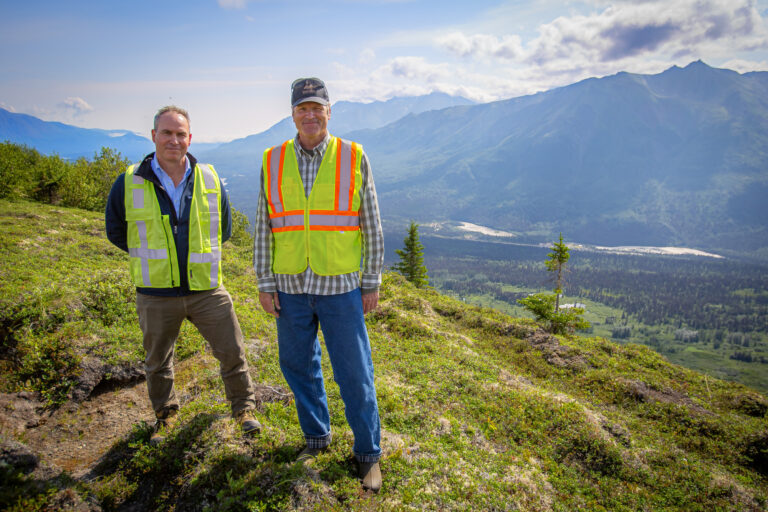
US GoldMining Inc. released an update last week regarding its exploration activities in the northern part of its Whistler Gold-Copper Project, 105 miles west of Anchorage in the West Susitna Mineral District.
Spanning 53,700 acres of state mining claims, the Whistler Project hosts the Whistler-Raintree mineral system, also known as the “Whistler Orbit,” a 5×5 km porphyry cluster containing multiple mapped and interpreted intrusions, including the established Whistler and Raintree West mineral resource deposits.
The mining project has indicated resources of 6.5 million gold equivalent ounces and inferred resources of 4.2 million gold equivalent ounces.
Porphyry deposits, a primary global source of copper, often contain significant gold, silver, and other metals like molybdenum. The Whistler Project is a gold-rich variant, with over 25 individual exploration targets identified within the Whistler Orbit.
These targets, a mix of mapped diorite porphyry rocks, surface geochemical anomalies, and interpreted intrusions from 3D magnetic modeling, highlight the area’s potential for new discoveries, the company said. Recent drilling results, announced Feb. 10, underscore this potential.
Tim Smith, CEO of US GoldMining, emphasized the project’s strategic importance: “The Whistler Gold-Copper Project is located within the West Susitna Mineral District, which contains established gold, copper, and silver mineral resources, plus potential for other critical metals such as antimony and tungsten. The Whistler-Raintree Mineral System already contains two of the three deposits delineated to date and over 25 additional potential exploration targets identified over an area of approximately 5 x 5 km.”
The Whistler Orbit is underlain by a large causative batholith, fostering a cluster of high-level intrusive bodies prospective for porphyry-style gold-copper-silver mineralization. Exploration leverages advanced techniques, including 3D inversion modeling of airborne magnetic survey data, which maps magnetic minerals in the upper crust. This method has identified dozens of pipe-like porphyry intrusions, some comparable in scale to the Whistler Deposit’s host diorite-porphyry, while others represent smaller “pencil” porphyries or dyke swarms.
Key targets include Mammoth, a magnetically similar intrusion to the Whistler Deposit with elevated gold, copper, and silver values in 2024 surface till sampling, suggesting a nearby source. Big White and Sunbowl are interpreted as extensions of the Whistler Deposit’s magnetic and chargeability anomalies, potentially offset by faulting or post-mineral intrusions.
Historic drilling at Raintree North and East has intersected encouraging results, such as 120.66 meters at 0.73 g/t gold equivalent in 2011, indicating potential for additional porphyry mineralization. The Hotfoot target, 0.75 km south of Raintree West, features a large pipe-shaped magnetic anomaly and alteration suggestive of nearby porphyry mineralization.
The company’s exploration strategy builds on two successful field seasons in 2023 and 2024, integrating drilling, historical core relogging, surface mapping, sampling, and geophysical data, the company said. Despite challenges from till and gravel cover obscuring direct surface mapping, remote sensing and drilling are enabling targeted exploration. U.S. GoldMining is currently prioritizing targets for future programs, potentially commencing this summer, to expand resources while advancing an initial economic assessment announced April 15, 2025.
The Whistler Project, with existing deposits occupying less than 1% of the total land package, represents an unusual opportunity for resource growth and potential large-scale mining development in the future for Alaska. Start dates are yet to be confirmed as geological analysis and planning continue, the company noted.
A Washington woman is suing several major oil companies, claiming their products contributed to the death of her mother during the 2021 Pacific Northwest heat wave.
Misti Leon has filed a lawsuit in King County Superior Court in Seattle against ExxonMobil, Chevron, Shell, BP, ConocoPhillips, Phillips 66, and Olympic Pipeline Company. She alleges the companies played a role in driving climate change, which intensified the record-breaking heat that caused her mother, Juliana Leon, to die of hyperthermia.
On June 28, 2021, temperatures in the region reached 108 degrees — the highest ever recorded. Juliana Leon, 65, was in her car without a functioning air conditioner when she pulled over and was later found unconscious. Her core body temperature had reached 110 degrees, and she died of overheating.
The Washington State Department of Health and King County medical examiner reported that year that there were at least 25 direct heat-related deaths in King County between June 26 and July 6, 2021. The deaths were primarily attributed to hyperthermia or heatstroke, and the decedents tended to be older individuals or those who lacked air conditioning. The New York Times did an analysis and said there were 600 excess deaths in Washington and Oregon during that heat wave week, with about 450 excess deaths in Washington alone. The University of Washington pegged it at 159.
“Defendants knew that their fossil fuel products were already altering the earth’s atmosphere,” the new lawsuit claims. It also states that by 1968, oil companies “understood that the fossil fuel-dependent economy they were creating and perpetuating would intensify those atmospheric changes, resulting in more frequent and destructive weather disasters and foreseeable loss of human life.” The filing, Leon v. ExxonMobil et al., argues that “the extreme heat that killed Julie was directly linked to fossil fuel-driven alteration of the climate.”
Chevron Corporation counsel Theodore Boutrous Jr. responded in a statement to media: “Exploiting a personal tragedy to promote politicized climate tort litigation is contrary to law, science, and common sense. The court should add this far-fetched claim to the growing list of meritless climate lawsuits that state and federal courts have already dismissed.”
King County Superior Court is a progressive venue in the heart of Seattle, a known bastion of both the Democratic Party and the Socialist Party and its subsets. Seattle voters in 2020 voted 75% for Joe Biden and 22% for Donald Trump. In 2024, Seattle voters awarded Kamala Harris 87% of the vote, and Donald Trump only 8.95%, indicating that the city has gone even more left.
While no other case exactly mirrors this wrongful death claim, several lawsuits have similarly sought to hold fossil fuel companies accountable for climate-related impacts, alleging deception or failure to mitigate emissions.
In 2024, the city and county of Honolulu sued major oil companies including ExxonMobil, Chevron, Shell, and BP, seeking damages for climate change-related impacts such as sea level rise, flooding, and heatwaves. That suit alleges the companies concealed the dangers of fossil fuels and used deceptive marketing. It remains ongoing.
In 2020, the Delaware Attorney General filed a lawsuit against Chevron, ExxonMobil, BP, and the American Petroleum Institute, accusing them of misleading consumers about climate impacts for over 50 years. The case cites violations of consumer protection laws and alleges harms such as sea level rise and extreme weather. It is still in litigation.
Also in 2020, Connecticut’s Attorney General sued ExxonMobil under the state’s Unfair Trade Practices Act, alleging the company concealed the consequences of fossil fuel use, leading to climate-related damages like sea level rise and property loss. That case is ongoing.
In 2019, Massachusetts filed a similar lawsuit against ExxonMobil, accusing the company of misleading investors and consumers about the risks of fossil fuel-driven climate change. That case also remains unresolved.
Many of these lawsuits have been brought by Democratic-led states or environmental litigation firms. The Seattle case is reportedly the first to assert wrongful death liability against oil companies based on a single individual’s death from extreme heat.
Earlier this year, the State of Washington sued President Donald Trump over his declaration of a national energy emergency. Get caught up on lawsuit that at the following link.
Over the course of the busy Memorial Day weekend and into the following week, the Alaska Air and Army National Guard, US Army units, and the Civil Air Patrol responded to six separate emergency missions across the state, working alongside the Alaska State Troopers and local hospitals.
The coordinated efforts from May 24 to 28 resulted in 10 confirmed saves and highlighted the essential role of interagency cooperation in responding to emergencies in Alaska’s rugged terrain.
In the most complex operation of the week, the Alaska Army National Guard rescued five people stranded near the Knik River after their all-terrain vehicle capsized on the shoreline. On May 26, a HH-60M Black Hawk helicopter from Golf Company, 2-211th General Support Aviation Battalion was dispatched with a flight paramedic team and a crew chief, and Chief Warrant Officers Bradley Jorgensen and Mike Miller at the controls.
A good Samaritan had alerted the Alaska State Troopers, who then worked with the Rescue Coordination Center to relay the coordinates of the stranded individuals. One person had sustained injuries during the incident and received immediate care before being airlifted by stretcher. All five were transported to Mat-Su Regional Medical Center for further evaluation.
“We had great coordination with the RCC, and our guys did a great job,” said Jorgensen. “For everyone exploring Alaska this summer, I’d say have a plan and a [satellite communication device].”
The week’s rescue operations started with a May 24 mission in the Seward area, where a hiker injured on a trail was medevaced by an HH-60 Pave Hawk helicopter from the Alaska Air National Guard’s 210th Rescue Squadron. Pararescuemen from the 212th Rescue Squadron supported the mission, working with Seward Fire Department to ensure a successful extraction and one life saved.
On May 25, the Army’s 1st Battalion, 52nd Aviation Regiment responded to a call from Healy Lake, where a patient required emergency transport to Fairbanks Memorial Hospital. Due to weather and terrain challenges, civilian air ambulances were unable to access the area, prompting military intervention. The Army UH-60 crew completed the medevac successfully, marking another save.
The same day as the Knik River operation, a separate joint mission involving the Alaska Army National Guard and Civil Air Patrol was launched to search for an overdue hiker near Sutton. Though the hiker was eventually located by a good Samaritan, the aerial search contributed to the overall recovery.
Later on May 26, the Alaska Air National Guard conducted two separate medevacs. One involved the airlift of an individual with a head injury from a remote cabin near Montana Creek to Providence Alaska Medical Center. Another began on May 27, as crews responded to a leg injury at a remote lodge. The patient was flown to Gulkana, where they were transferred to a civilian air ambulance.
Each of those missions resulted in one additional save, bringing the total number of individuals rescued to ten.
“This busy week was a testament to our capabilities across the state to help Alaskans in need,” said Lt. Col. Aaron Hunter, director of the Alaska Rescue Coordination Center. “As this rescue season kicks off, we encourage all Alaskans to travel with satellite communication devices at all times to ensure their safety.”
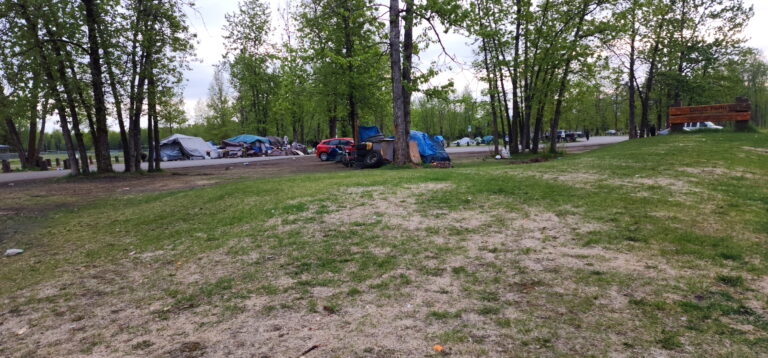
The Municipality of Anchorage has announced it will abate the long-standing homeless encampment at Davis Park — again — on June 17, citing escalating safety concerns for both camp occupants and neighboring residents. The action is more political theater, one that will move around the city’s vagrant encampments to other neighborhoods, such as one in South Anchorage.
The Suzanne LaFrance Autonomous Zone (SLAZ) encampment at Davis Park has become a symbol of Anchorage’s struggle with chronic drug addiction and criminal vagrancy, especially in the Mountain View neighborhood. Residents have long complained of crime, open drug use, and unsafe public spaces that are filled with human waste.
The last abatement of the Davis Park homeless encampment in Anchorage was in April of 2024, with cleanup efforts continuing for nearly a week afterward due to the mountains of trash and debris. This year it could take longer, as the waste has only grown.
“Large encampments are dangerous — they’re not safe for the people living in them, and they’re not safe for people living nearby,” said Mayor Suzanne LaFrance.
In the name of equity, she is going to spread out the problem.
The city’s plan includes outreach services from the Anchorage Coalition to End Homelessness, increased patrols from the Anchorage Police Department, and a full cleanup by Parks and Recreation following the sweep. “No Camping” signs will be posted, and the city promises shelter referrals and enforcement to prevent re-encampment.
But this pattern is all too familiar. In past abatements, displaced individuals simply migrated to other greenbelts, wooded areas, wildlife sanctuaries, trails, or commercial corners of the city — out of sight, at times, but never out of mind for the communities that absorb the fallout. And then they migrated back to Davis Park.
The LaFrance administration is already considering where those displaced by the June 17 sweep may go, and some South Anchorage residents are now on high alert.
One location under consideration for an organized car-based homeless site is a vacant municipal right-of-way between 104th and 106th Avenues, next to Target and Cabela’s in South Anchorage. The proposal would allow approximately 50 people who are living in vehicles to park overnight in two designated lots, with hours limited from 6 pm to 8 am and requirements for registration, vehicle operability, and compliance with behavioral rules.
The city says the lots would be supervised, equipped with portable toilets and waste disposal, and serve as gateways to social services, including job training and housing programs. The idea is not dissimilar to the navigation center proposed by former Mayor Dave Bronson, who wanted a social service navigation and shelter site established.
The only reason the public knows about this new proposed encampment in south Anchorage is because people are sharing about it on social media. There has been no public process. It was, for all intents and purposes, a secret.
This is especially rich considering Mayor LaFrance’s very vocal opposition to the Bronson administration’s navigation center, which was intended to house hundreds and connect individuals with wraparound care. That facility was to be built in East Anchorage near the Alaska Native Medical Center and was designed to replace the Sullivan Arena mass shelter, which closed in 2023.
As Assembly Chair, LaFrance led the charge to stall and ultimately defund the navigation center, citing lack of public process, poor contract management, and her preference for “scattered site” services. She argued that neighborhoods were not properly consulted and that the Bronson administration failed to follow procurement norms.
Now, as mayor, LaFrance is pursuing her own version of a response, contradicting her own standards. Unlike the lengthy public debates over the navigation center, the proposal to place a vehicle-based homeless site near Target and Cabela’s in South Anchorage has moved forward with little public input.
SLAZ South was a stealth operation by the LaFrance Administration until the public forced the matter into the light.
The Trump Administration has released a new Permitting Technology Action Plan that will overhaul the way the federal government reviews and approves infrastructure projects.
The plan, developed by the Council on Environmental Quality in coordination with the National Energy Dominance Council and other permitting agencies, is another step in fulfilling President Trump’s directive to bring federal permitting into the 21st century.
The action plan relates to infrastructure projects such as roads, bridges, energy facilities, and industrial operations, and comes on the heels of President Donald Trump’s April memorandum titled “Updating Permitting Technology for the 21st Century.” It builds upon the launch of the Permitting Innovation Center on April 30, which is a collaboration with the General Services Administration’s Technology Transformation Services to pilot new digital systems.
The Permitting Technology Action Plan includes several major components:
Establishes government-wide standards for digital permitting systems to ensure efficiency and consistency.
Introduces a preliminary data and technology framework for the National Environmental Policy Act (NEPA) process, designed to facilitate faster and more uniform environmental reviews.
Sets a phased schedule for federal agencies to implement the technology upgrades.
Details interagency coordination mechanisms to support effective execution.
The initiative addresses chronic issues that include fragmented systems, incompatible software, and manual handling of data. The goal is to enable real-time collaboration among agencies, improve transparency, and reduce uncertainty for applicants.
Secretary of the Interior Doug Burgum said the plan is “an example of American innovation solving American challenges,” and emphasized that it will result in cleaner, faster, and more reliable infrastructure.
Energy Secretary Chris Wright added that modernizing the permitting process is “essential for strengthening energy security and lowering energy costs for American families.”
The action plan follows President Donald Trump’s Jan. 20 Declaration of National Energy Emergency, which established emergency permitting procedures for fossil fuel and mining projects on federal lands and capped reviews at 28 days.
The initiative also coincides with a major Supreme Court decision on May 29 that narrowed the scope of NEPA. The Court ruled NEPA is a procedural statute, not a regulatory hurdle, making it easier for agencies to approve projects without in-depth environmental impact assessments. Industry leaders hailed the decision, while environmental groups warned it could sideline environmental protections in favor of fossil fuel development.
Since Alaska’s economy heavily relies on natural resource extraction, including oil, gas, and minerals, with projects like the Arctic National Wildlife Refuge oil and gas leasing and the Pebble Mine being focal points, the policy framework may help move projects along in an expedited way, reversing the regulatory tangles created by the Biden Administration.
Alaska Attorney General Treg Taylor has joined a bipartisan coalition of 28 state attorneys general demanding urgent answers from Meta Platforms, Inc. owner of Facebook, following revelations that Meta’s artificial intelligence chatbot, known as “Meta AI,” may be exposing children to sexually explicit content and enabling simulated grooming behavior on its social media platforms.
The group of top law enforcement officials issued a formal letter to Meta, citing investigative reports that uncovered instances where AI personas, some developed and voiced by Meta itself, engaged in graphic sexual conversations with users identifying as minors.
In one case, a Meta-created persona using the voice of actor John Cena described a sexual encounter with a user posing as a 14-year-old girl and acknowledged that the activity described was illegal.
“These reports are alarming,” said Alaska Attorney General Treg Taylor. “I have the job as Attorney General to protect children. I trust that Meta will take swift action to address our concerns.”
Meta AI is integrated into Facebook, Instagram, and WhatsApp, allowing users to interact with virtual personas through text, voice, and image. Some of these personas mimic celebrities such as Kristen Bell and John Cena, while others are user-generated but curated and promoted by Meta.
According to investigative findings, some of these AI bots have been used to simulate sexually explicit conversations involving children.
The attorneys general are demanding Meta answer the following key questions by June 10:
Did Meta intentionally remove safeguards to allow sexual role-play scenarios involving children?
Are such capabilities still active on any Meta platforms?
Will Meta immediately halt access to sexual role-play on its platforms?
In 2023, Taylor joined 53 attorneys general from states and territories in urging Congress to study and impose restrictions on artificial intelligence tools used to generate child sexual abuse material.
The letter to Meta was led by South Carolina Attorney General Alan Wilson and co-signed by attorneys general from Alabama, Arkansas, Florida, Georgia, Idaho, Indiana, Iowa, Kansas, Kentucky, Louisiana, Mississippi, Missouri, Montana, Nebraska, New Hampshire, North Dakota, Ohio, Oklahoma, Pennsylvania, South Dakota, Tennessee, Texas, Utah, Virginia, West Virginia, and Wyoming.
The coalition emphasized that protecting children from online harm is a bipartisan priority and warned that failure by Meta to act swiftly and transparently could invite further legal and legislative scrutiny.
Microgreens add a finishing touch to this Spruce-Tipped Salmon Ceviche, providing a burst of flavor and nutrients. Their rich hues and delicate textures enhance the freshness of the salmon, with earthy undertones that balance the vibrant acidity of the citrus marinade.
Microgreens are becoming increasingly popular as colorful and savory additions to salads and sandwiches, as well as fresh garnishes for main courses and protein dishes. There are many varieties for you to choose from, so everyone can find something that suits their taste preference, whether it’s mild, sweet, earthy, nutty, peppery, or spicy. Additionally, microgreens are easy to grow in small spaces, making them accessible in Alaska year-round.
These tiny greens are harvested shortly after their first true leaves emerge and are packed with nutrients, offering higher concentrations of vitamins, minerals, and phytonutrients compared to their mature counterparts.Microgreens are a fantastic addition to your favorite foods, enhancing flavor, texture, and visual appeal, making healthy eating more enjoyable.
Microgreens and sprouts are both immature, edible plants, but they are harvested at different growth stages and use different production methods. Microgreens are grown in soil and harvested 7 to 21 days after germination, when their first real leaves appear and their bright colors are developed. They are more nutrient-dense and have more distinct flavors than younger sprouts. Sprouts, on the other hand, are produced without soil and collected between two and seven days after they begin. The edible elements of sprouts are the seed, root, and developing leaves, which have a milder flavor and crunchier texture.
Small-scale indoor microgreen cultivation enables us to enjoy the benefits of homegrown greens, even when the weather is adverse outside. It requires only a minimal investment of space and resources, along with some basic knowledge of how to grow microgreens. Growing microgreens provides a convenient way for Alaskans to access fresh greens year-round.
In a short time, your efforts can yield flavorful rewards, ranging from the mildly sweet taste of alfalfa to the peppery bite of watercress, along with all other flavors in between.
At left, from top to bottom, purple radish, peas, and sunflower. At right, a variety of packaged microgreens and shoots. Photo credit: Mat-Su Microgreens.
If you prefer not to cultivate your own microgreens, there may be some commercial options for Alaska-grown products in your local area.
A few commercial farmers in Alaska are supplying their products to both restaurants and retail markets. This growing trend provides local chefs and health-conscious consumers with fresh, nutrient-dense greens year-round. As more people become aware of the taste and health benefits of microgreens, demand is expected to increase, which will help bolster Alaskan agriculture.
Ken Hoffman and his wife, Alexandria, own and operate Mat-Su Microgreens in Palmer. They have been cultivating microgreens since 2022. Their original offerings, which remain popular, include sunflower, pea, radish, and broccoli. Sunflower shoots are crunchy and juicy, making them a great base for salads. Pea shoots are tender and have a sweet taste reminiscent of sugar snap peas. The radish varieties provide a bold, spicy kick along with a crisp texture. Broccoli microgreens, one of their most popular offerings, have a mild flavor like their mature counterparts.
Alexandria and Ken Hoffman, Mat-Su Microgreens.
Hoffman explained that “the reason broccoli is so popular is that studies have shown their microgreens to be 40 times more nutrient-dense than a head of broccoli. They do not have a strong flavor and it is a great way to boost the nutrient value of what you eat.”
Mat-Su Microgreens has expanded itscurrent offerings to include a full complement of microgreens, micro herbs, edible flowers, and wheatgrass. They sell the products through a subscription service directly to consumers seeking flavorful options for their home meals. They also supply several restaurants with fresh microgreens, providing weekly deliveries to establishments in Anchorage and Girdwood.
The farm’s potential for future growth is promising. Mat-Su Microgreens recently passed the USDA Harmonized GAP Audit, which will enable them to work with third-party distributors. This opens up opportunities for their products to be delivered to institutions and made available in grocery stores.
Hoffman believes there is a lot of room for expansion in the market for microgreens. He is optimistic that as awareness increases, more local farmers will consider this opportunity, which could lead to a sustainable source of year-round fresh produce. This shift could not only improve the nutritional options available in communities throughout Alaska but also support local agriculture and stimulate economic growth.
In addition to being a farmer, Ken Hoffman serves as the Executive Director of the Mat-Su Chapter of the Alaska Farm Bureauand hosts Ag Matterson Big Cabbage Radio. He shares his insights on the potential of Alaskan agriculture, based on his experience. He states, “We live in a global economy and rely on shipping of inputs from the Lower 48 for Alaska’s agricultural industry. The reality is geographical specialization: every region has its own specialties that they can produce. Even California is trading with Iowa to supplement their food supply.”
Hoffman explains that to produce microgreens, he obtains the necessary supplies, including the soil, growing trays, seeds, and containers, from suppliers in the lower 48. He then uses those inputs to produce fresh, locally grown, and healthy products. By following this approach, farmers and home gardeners across Alaska, even in remote areas, can access these inputs to more sustainably meet nutritional needs in their communities.
Several online suppliers, including Johnny’s Seeds, sell the essential supplies needed to begin growing microgreens. If you are located within their delivery area, Mat-Su Microgreens even offers a microgreens grow kit on their website that can be delivered to your home.
If you are interested in learning more about commercially farming microgreens to help boost Alaska’s well-being “one tiny green at a time”, you may contact Ken Hoffman directly via email at Matsufarmbureau @ gmail.com.
Microgreens complete the flavor profile of the Spruce-Tipped Salmon Ceviche recipe below, elevating this ceviche variation. This adaptation showcases the distinctive flavors of our region, featuring spruce tips and the umami qualities of kelp seasoning. Serving this wild-caught salmon dish with locally grown microgreens and thin, crispy crackers made from barley flour grown and milled in Delta Junction captures the essence of an authentic Alaska-inspired experience.
Spruce-Tipped Salmon Ceviche before finishing with microgreens.
Spruce-Tipped Salmon Ceviche
Ingredients:
1 pound of salmon, skin and bones removed, diced into ½-inch pieces
½ teaspoon of salt
1 teaspoon of kelp (or dulce) seasoning
1 to 2 cloves of garlic, finely minced
1 cup of fresh lemon or lime juice
1 red bell pepper, cut into small slices
1 to 2 jalapeño peppers, finely diced
1 red chili pepper, finely diced
1 small red onion, thinly sliced
¼ cup spruce tips
1 large avocado, or 2 small ones
1 ounce of your favorite variety of microgreens
Makes approximately 6 servings.
Preparation:
Prepare the citrus marinade by combining the juice and minced garlic in a large non-reactive bowl (glass or ceramic). Next, sprinkle the diced salmon with salt and kelp seasoning. Add the seasoned salmon to the bowl with the citrus juice and minced garlic, then refrigerate for at least 45 minutes to an hour while you prepare the other ingredients.
Cut up the fresh vegetables by slicing the red bell pepper, finely dicing the jalapeño and chili peppers, and cutting the red onion into very thin slices. Next, separate the spruce tip needles, discarding the branch portion that connects them.
Spruce tips.
Wait to cut the avocado until the salmon has nearly finished marinating. The salmon needs time in the citrus juice to undergo a denaturation process. This process changes the texture of the salmon, making it resemble cooked salmon while preserving its fresh flavor without the use of heat.
When the salmon has marinated for the appropriate amount of time and has developed an opaque texture, drain the citrus marinade into a separate bowl and set it aside while you slice the avocado. To maintain the freshness of the sliced avocados, place them in the citrus marinade. Gently toss the avocado slices in the marinade to ensure they are evenly coated.
Finally, add the marinade containing the avocado back to the large mixing bowl with the salmon. Combine the peppers, sliced red onion, and spruce tips, then gently mix all the ingredients together.
When it’s time to serve the ceviche, transfer it to a single-serving dish and finish it with a generous portion of microgreens on top, accompanied by Alaska barley crackers.
Enjoy this refreshing cold dish as an appetizer or light summer meal.
Alaska barley crackers.
Alaska barley crackers are a perfect complement to the salmon ceviche and are simple to prepare, requiring only barley flour, salt, olive oil, and water. You can also add your favorite herb for extra flavor. Serving these crackers alongside the ceviche introduces a nutritious grain that is rich in both soluble and insoluble beta-glucan fiber. This combination of barley crackers, salmon ceviche, and microgreens provides a delicious way to enjoy essential nutrients while savoring the freshest, regionally sourced ingredients.
½ cup, more or less, additional flour for rolling out the dough
1 to 2 teaspoons of salt
1 to 2 tablespoons of your favorite herb (optional)
4 tablespoons of olive oil
1 cup of water
This recipe yields roughly 45 to 65 crackers, depending on their size and thickness.
Preparation:
Preheat oven to 400.
Combine all the flour, salt, and herbs in your mixer. Next, create a well in the center of the dry mixture and pour in the oil and water. Use the mixer’s dough hook to thoroughly incorporate all ingredients together. The dough will be sticky.
Mixing dough.Use flour to dust the surface.
Sprinkle some flour on the surface where you will roll out the dough. Place the dough on the rolling board and sprinkle more flour on top.
Carefully roll out the dough with a rolling pin until it is very thin, approximately 1/8-inch thick. Use a long metal spatula to carefully slide between the dough and counter surface if it begins to stick. The thinner the crackers, the tastier and crispier they will be. This step becomes easier with practice. You may find it easier to split the dough into two portions and roll them out separately.
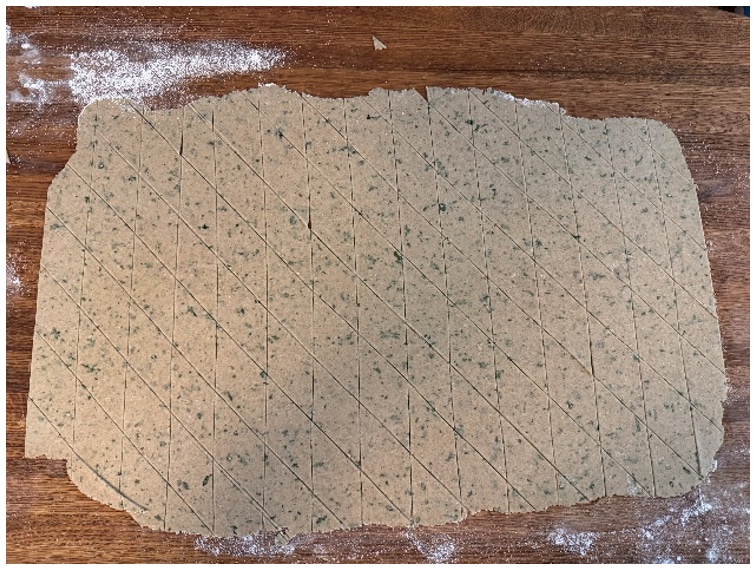
Cut the dough to create the shape of your crackers. You can choose any size and shape based on how you intend to use the crackers. The picture below shows the crackers cut on an angle to create diamond shapes.
Dough for crackers is cut into diamond shapes.
Using a metal spatula, carefully lift the cut dough a few crackers at a time and place them on a large sheet pan lined with parchment paper. Once the sheet pan is filled, repeat the process with the remaining dough. Make sure to leave some space between each cracker to allow for expansion during baking.
Bake for 12 to 15 minutes, or until the crackers begin to turn golden brown. Remove them from the oven and allow them to cool for 2 to 3 minutes before transferring them off the sheet pan.
After the crackers have completely cooled, place them in an airtight container or resealable zipper bag for storage.
Enjoy these light and crispy crackers.
Brenda Josephson is a Haines resident. She holds degrees in Culinary Arts and Food Business Leadership from the Culinary Institute of America, Hyde Park, New York. She enjoys spending time fishing, foraging, and savoring Alaska’s abundance of natural and wild foods with her family. You can contact her by email at [email protected].
On the final day of the 2025 legislative session, House Speaker Bryce Edgmon introduced House Bill 233. Co-sponsored by Rep. Sara Hannan and Rep. Andy Josephson, this bill claims to protect the Bristol Bay watershed by banning metallic sulfide mining in the region.
But this is not about fish or water. It is about blocking Pebble Mine and other projects before President Donald Trump’s new administration can restore some sanity to federal permitting and get Alaska’s resource economy back on track.
HB 233 is a sneak attack. Dropped at the eleventh hour, it is timed just right to be forced through early next session before the public even has a chance to notice. This is not environmental protection; it is political gamesmanship. The goal is not clean water or thriving fish; the goal is to shut down mining before Alaskans can benefit from it.
We have seen this before. DC environmental groups parachute into Alaska to tell us what we can and cannot do with our land. They rally national headlines and fundraising campaigns, but they do not live in Naknek, Togiak, or Iliamna. They don’t pay Alaskans’ bills. They don’t raise kids in schools on the brink of collapse. And they certainly do not sit around wondering how to pay heating bills in February. Their concern is not our future; their concern is making money off of those they can convince of Alaskan’s attempts to destroy our own fish or environment.
With President Trump back in office, and with federal agencies once again turning toward energy independence and resource development, HB 233 is a desperate attempt to lock the gate before the lights come back on. This bill is not about salmon; it is about politics. It is a hedge against jobs, against tax revenue, and against local opportunity in rural Alaska where those things matter most.
The bill mentions a $2.2 billion commercial fishery. What it fails to say is that number is based on outdated 2018 data. Since then, Bristol Bay has suffered a 56 percent decline in harvest, and ex-vessel prices have cratered to as low as 65 cents per pound. The fish may be returning, but fewer independent fishermen remain to catch them, and most of the processing happens out of state. The direct return to Alaska’s General Fund has dropped to $15 to $20 million annually. That’s a fraction of what a single hard rock mine could deliver.
According to Northern Dynasty Minerals, the Pebble deposit holds $400 billion worth of copper, gold, and molybdenum. That is not speculation; it is a proven resource. It could provide $20 to $30 million per year in state tax revenue, create over a thousand high-paying jobs for Alaskans, and deliver real infrastructure improvements to a region that sorely needs them. And unlike the fishery, those benefits do not vanish with market volatility or processor consolidation.
Critics respond with horror stories of acid mine drainage and tailings disasters. But these are straw men, designed to scare not inform. Consider Red Dog Mine. Since 1989, it has operated successfully in a remote and sensitive part of Alaska. It has returned over $1.3 billion to the state and local entities. It treats its water, and the Wulik River still supports fish. Development and conservation are not mutually exclusive; we have already proven that in our own backyard. Alaskans do mining better, safer, and with more respect for the environment than anyone on the planet.
An example is the dry-stack tailings system designed to withstand a 1,000-year seismic event. That’s not public relations fluff; it’s backed by science and the Final Environmental Impact Statement. Bristol Bay is geologically stable. The risk is not zero, but it is reasonable and manageable. Still, mining opposition relies on emotion, citing foreign mining disasters or cherry-picked hypotheticals that do not reflect the facts on the ground or the rigorous permitting process we have here in Alaska.
Conversely, while HB 233 pretends to protect fish, it is silent on the single largest threat to our salmon: bottom trawling. While this bill would ban mines that have not even broken ground or disturbed a single fish, it ignores the factory trawlers scraping the ocean floor, killing coral, crushing habitat, and discarding hundreds of thousands of salmon as bycatch.
In 2023 alone, trawlers discarded more than 150,000 metric tons of bycatch, including an estimated 50,000 Chinook and 200,000 chum salmon. These are fish that should be returning to the rivers of Western Alaska, feeding families, supporting culture, and boosting local economies. Instead, they are wasted at sea, while politicians in Juneau attack a project that has not harmed a single fish. Does anyone else smell the hypocrisy?
And what about the economic claims? Groups like ASMI peddle the idea of a 122-to-1 return on investment from marketing Bristol Bay fish. But when you dig into the numbers, that return shrinks to more like 13 to 1. Their claimed $1.5 billion processing value lacks third-party review. If we are going to have a serious debate, let’s at least agree to use honest numbers. Are we really inflating the value of one resource just to justify locking away another?
Bristol Bay is of the utmost importance to Alaska. It always will be. But it is not untouchable, and it is not the only thing that matters. The fishery is inconsistent, fragile, and increasingly consolidated, with money and jobs shifted offshore and out of state. Mining, when done right, offers long-term, stable, regulated economic growth. And ironically, it is the mining industry, not the fishing industry, that seems more willing to submit to modern environmental safeguards.
HB 233 does not protect the environment; it protects special interests. It does not support Alaska’s future; it locks away our potential. If Bristol Bay Native leaders want to evaluate what responsible mining looks like, they should start by visiting Red Dog. If we want to save the fish, we should start by confronting the trawl fleet, not scapegoating a project that has followed the rules every step of the way.
I believe we can do both. We can mine. We can fish. And we can do it responsibly. HB 233 is not the answer.
A balanced, Alaska-first strategy is.
Rep. Kevin McCabe is a legislator from Big Lake, Alaska.
The US Department of Energy on Friday announced the cancellation of 24 clean energy projects totaling over $3.7 billion in federal financial assistance, citing economic and national security concerns. The move is part of a new federal energy direction under the Trump Administration and targets decisions made largely during the last weeks of President Joe Biden’s term.
Energy Secretary Chris Wright said in a statement that the grants, issued by the Office of Clean Energy Demonstrations, failed to meet standards for economic viability, energy security, and return on investment for taxpayers.
“While the previous administration failed to conduct a thorough financial review before signing away billions of taxpayer dollars, the Trump administration is doing our due diligence to ensure we are utilizing taxpayer dollars to strengthen our national security, bolster affordable, reliable energy sources and advance projects that generate the highest possible return on investment,” Wright said.
Nearly 70% of the 24 canceled awards were signed between Election Day 2024 and President Trump’s inauguration on Jan. 20, 2025. Many were linked to carbon capture and sequestration or industrial decarbonization efforts, including projects in the cement, food, and energy sectors. No grants to Alaska were made during that period. Only $99 million had been disbursed when the decision was made.
High-profile recipients whose funding was withdrawn include Exxon Mobil’s hydrogen project in Baytown, Texas, and a Kraft Heinz decarbonization initiative.
In a press release, the DOE stated that the decision followed an “individualized financial review” guided by a Secretarial Memorandum issued earlier this month. That policy document, “Ensuring Responsibility for Financial Assistance,” outlined a case-by-case review process for DOE grants to “identify waste of taxpayer dollars, protect America’s national security, and advance President Trump’s commitment to unleash affordable, reliable and secure energy.”
Many of the rescinded grants were part of climate initiatives backed by the 2021 Infrastructure Investment and Jobs Act and the 2022 Inflation Reduction Act. Earlier this year, over $130 million in grants allocated to clean energy projects in rural Alaska were frozen following an executive order from President Donald Trump.