Saturday, December 27, 2025
Home Blog Page 1719

Bright, shiny objects: Events

0

Oct. 25, 5:30 PM – 7:30 pm: Midnight Sun Republican Women’s Club annual membership meeting, Morris Communications Building conference room, 301 Arctic Slope Drive, Anchorage. Side door. Speakers are Natasha von Imhof, Liz Vazquez, and Jennifer Johnson, all candidates for office.

Oct. 26, 6 pm: District 25 meeting at 1227 E. 75th Street. Agenda includes electing new vice-chair for district. Contact: mistymmay at hotmail dot you-know-what.

LISA MURKOWSKI DEBATES
Oct. 26 – Senate Debate on the Arctic, hosted by Iñuit Arctic Business Alliance (IABA) in Barrow
Nov. 3 – Debate for the State, hosted by Alaska Public Media in Anchorage

DON YOUNG DEBATES

Oct. 24: Fairbanks Chamber of Commerce Candidate Forum, Carlson Center, Fairbanks
Nov. 3: Debate for the State, Alaska Public Media


johnston-giessel

screen-shot-2016-10-22-at-8-55-04-pmscreen-shot-2016-10-22-at-10-41-59-am

Sally Jewell: Feds are all-in on Native-federal land trust

0

screen-shot-2016-10-21-at-4-31-28-pm

Secretary of the Interior Sally Jewell met with Gov. Bill Walker for a good three hours on Thursday during the Alaska Federation of Natives’ annual convention in Fairbanks.

It was a private, unnoticed meeting prior to Jewell’s Friday announcement that she has signed Order 3342, which directs her department to cooperate and collaborate with Alaska Native tribes on more of a government-to-government basis.

The directive follows court actions that unwound provisions of the Alaska Native Claims Settlement Act, whereby reservation land was disallowed in Alaska. Gov. Walker chose to not fight the court ruling to the Supreme Court.

Today’s eight-page ruling directs the federal government to begin working toward co-management of Native lands. The new relationship between the tribes and the federal government makes no mention of the State of Alaska as an entity with any  cooperative or collaborative standing. The State of Alaska simply doesn’t factor in with tribes who align with the federal government.

The action came after the settling of Akiachak Native Community v. Department of the Interior, which allows the Bureau of Indian Affairs to begin taking title to land in Alaska on behalf of Alaska tribes. This is the introduction of “Indian Country” into a state that has been without it for decades. It will leave the State of Alaska with no civil authority over large sections of Alaska land. There will be no taxes paid by the lands that go into federal trust. It’s a whole new world.

The order includes collaborative management of fish, wildlife, plant material, historical sites, landscapes, resources, maintenance and information relating to tribal, cultural, or educational activities.

No announcement of the Jewell meeting or reaction to the order was given by the Governor’s Office or Lieutenant Governor’s Office. Lt. Gov. Byron Mallott has long been a proponent of Indian Country in Alaska and has patiently prodded Gov. Walker to not challenge the court ruling in favor of tribes and against the State of Alaska.

“This Secretarial Order reflects the Obama Administration’s deep commitment to strengthen respect between the United States government and Native American and Alaska Native leaders and communities while boosting our efforts to increase tribal self-determination and self-governance,” said Secretary Jewell in a statement. “This kind of collaboration with tribal nations will help ensure that we’re appropriately and genuinely integrating indigenous expertise, experience and perspectives into the management of public lands.”

The order applies to all the agencies in the Department of Interior, including the National Park Service, Bureau of Land Management, U.S. Fish and Wildlife Service, Bureau of Ocean Energy Management and Bureau of Reclamation, directing them to identify opportunities and try to partner with tribes in the management of their lands and waters.

Together for Alaska uses grieving widow to attack Coghill

0

When Brandy Johnson’s husband was killed by gunfire on May 1, 2014, she and her three daughters were left grieving and without health coverage.

That’s because her husband was Sgt. Scott Johnson, an heroic Alaska State Trooper, and his health care benefits ended along with his life when he was shot while responding to a call in Tanana with fellow trooper Gabriel Rich, who also died that spring day.

Gov. Sean Parnell responded quickly to the situation and directed the state to pay health care benefits for the widow and her children, at a cost of about $66,000 a  year. They continue to this day.

Now, Johnson is being used in Together for Alaska’s latest savage political attack ad against Sen. John Coghill.

In the ad, Mrs. Johnson infers that Coghill is what’s wrong with the system that left her and her children without health coverage.

Except that they weren’t without coverage. Parnell made sure of that.

together-dividing-2

TOGETHER FOR STRAFING ALASKANS

Together for Alaska, funded by a union under the umbrella of the AFL-CIO and Gov. Walker’s surrogate lawyer Robin Brena, are using the same scorched earth tactic that Mark Begich used against now-Sen. Dan Sullivan, when Begich rolled out a patently false portrayal of Sullivan’s culpability in the Jerry Active murder case.

It backfired on Begich badly.

There’s no disputing the tragedy in Tanana reverberates through the lives of survivors, who will feel the pain for the rest of their lives, as their beloved family members never return to the family table.

But Brandy Johnson has been transformed into blunt instrument against a man of character, principle and faith; a man who has always tried to do the right thing for the people of Fairbanks.

Her grievance is House Bill 66, which didn’t pass the Legislature last session. HB 66 would change current state retirement policy and provide health care coverage for families of those killed in the line of duty, until they can claim retirement benefits. The children of the deceased law enforcement officer would have health care coverage until age 26, covered by the State of Alaska.

The tug of war over the bill happened mainly in the House, because the bill had some problems.

Coghill’s only interaction with the bill was in trying to squeeze it into SB 91, the criminal justice reform bill. Lawyers said that violated single subject rule.

The remedy? Have the bill introduced again this session. Make it a single subject bill. Help it be the right bill that passes a constitutional test. Ask the Fairbanks delegation to introduce it.

Instead, Together for Alaska has taken advantage of a grieving widow. Brandy Johnson has received her benefits for two years, and there’s no reason to think she will not continue to receive her benefits far into the future.

In fact, if she wanted these benefits to be codified, rather than part of the operating budget, she needs only to prevail upon Gov. Bill Walker to promulgate regulations, which he could do in a heartbeat. Why doesn’t he? Perhaps he prefers the pomp of an actual bill.

The tragedy of Sgt. Johnson and Rich’s deaths touch us Alaskans deeply, but dividing Alaskans in this way is something that Together for Alaska has gotten away with for months.

Who will call Together for Alaska Chairman Tom Wescott, and main funders lawyer Robin Brena and Union Boss Joey Merrick out on this video, which is intended to prop up support for Democrat Luke Hopkins through treachery?

We will — it’s beneath them and it’s an affront to all that Alaskans stand for.


Young, Lindbeck at forestry forum

0

img_4390

Alaska Congressman Don Young prevailed like a boss over Democratic challenger Steve Lindbeck during Thursday’s Alaska Forest Association / Resource Development Council Forum.

Compared to debates on the national level, the exchange was positively civil. Only friendly jabs were thrown and the two men, who have known each other for decades, landed no big punches.

In fact, during the forum at the Captain Cook Hotel, Lindbeck agreed with almost all of the positions espoused by Young, with the exception of these:

  1. Lindbeck feels Young should have intervened in a private contractual matter involving escort vessels in Prince William Sound. Rep. Young said it would be an ethics violation to try to pick winners and losers in the business-to-business dealings of Alyeska Pipeline Service Company.
  2. Lindbeck believes that Hillary Clinton will be elected president and that if the former journalist wins Alaska’s only congressional seat he’ll have access to the White House. Young feels that the majority of a congressional representative’s job is in Congress and he hopes Hillary Clinton doesn’t win.
  3. Lindbeck said the Pebble Mine is a bad project. The mine was prevented from proceeding with an application for permits by an overreaching Environmental Protection Agency and Lindbeck admitted that the EPA had exceeded its authority. Young offered no opinion on the project but said he is mad that the company was denied its due process: It wasn’t even allowed to present its plans for evaluation.

OLD GUYS MATTER

Both candidates think the other is too old. Lindbeck said: “Forty-three years is a long time to get a lot of post offices named.” He wondered rhetorically why Young had not fixed all the problems he identified with the EPA, federal overreach, and the Endangered Species Act. “It’s not rocket science. I don’t think it’s impossible to figure out how to work in Congress. I will represent Alaska’s interests by working with everyone.”

Young joked that Lindbeck was getting a late start at the ripe old age of 61: ” If you were elected you…wouldn’t be chairman of anything for 20 years, and you are a little long in the tooth for that.” He left it alone that Lindbeck was conflating him with former Sen. Mark Begich, whose only bill ever passed was to name a post office. Of the 77 bills that Young has gotten passed, not one named a post office or courthouse.

“I do work with everyone,” Young added, offering as proof that he is one of the top four lawmakers in Congress for getting legislation passed.

FIXING IT FOR THE UNION

A theme Lindbeck returns to time and again in his campaign is Alyeska Pipeline Service Company’s inking of a 10-year deal with Louisiana shipbuilder Edison Chouest to escort tugs in Prince William Sound. Lindbeck is upset that Young did not intervene and keep the contract with Crowley.

However, Crowley did not bid on the contract when it came up for renewal. It’s a contract it had held for decades.

Lindbeck has made that grievance a centerpiece of his campaign. “This is Alaska oil going through Alaska waters. We cannot make our economy stronger if we outsource the jobs to other companies. I will stand up for Alaska workers.”

Edison Chouest is based in Galliano, La. fully 600 miles closer to Alaska than Jacksonville, Fla., where Crowley is headquartered.

The matter really boiled down to this: Edison Chouest is a nonunion shop. Crowley is union. Lindbeck won the support of the union representing the Crowley workers.

IF THEY VISIT, THEY’LL UNDERSTAND US

Lindbeck offered that the way to get federal cooperation is to make sure that decision makers in DC understand Alaska. He would bring other representatives and officials to see the state for themselves, as then they would understand the size and potential for resource development.

Without acknowledging the irony, he mentioned the John Sturgeon case is an example of how federal officials should have helped a stranded hunter get safely home, rather than cite him for navigating a river in his air boat.

Of course, having federal officials on the ground in Alaska did little to help curb their appetite for overreach in the Sturgeon case, when Park Service officers harassed rather than aided a hunter, but Rep. Young let the opportunity pass to slap at Lindbeck’s logic. He didn’t need to: The audience already had identified the cognitive dissonance.

NO PEBBLE FOR LINDBECK

Finding the proposed Pebble Project the “wrong mine in the wrong place,” Lindbeck waffled on the proposed Donlin Mine, saying he would be interested to know if the local people think Donlin is the right project for them: “We’ll wait and see what the people of Southwest Alaska decide,” he said.

Donlin has received little of the negative attention that Pebble received, possibly because the proposed mine is on Native-owned land, while Pebble is on state-owned land. Environmental groups may be averse to taking on a Native corporation for political reasons. The mining project is located in the Calista Region and has one of the largest known undeveloped gold deposits in the world.

Young said that federal permitting roadblocks and overreach, such as the Environmental Protection Agency pre-emptively ending the permitting process on Pebble, is a deterrent for investment in Alaska. That likely was the position of 99 percent of the audience at the Resource Development Council.

CLOSING THE SALE

In his opening statement, Lindbeck said, “I come to you as an Alaskan Democrat, in that order. I will work with whoever it takes to get things done on behalf of our state. As you can imagine, I will be taking issue with my party on some issues.” He supports opwning the Arctic National Wildlife Refuge to hydrocarbon development. He supports Outer Continental Shelf drilling. He supports mining, but not the Pebble mine. He wants enough timber harvest in the Tongass National Forest to keep a small industry alive.

In his closing statement, Lindbeck was gracious in thanking the organizations for the opportunity to debate, while Rep. Young passionately asked the audience for their vote:

“This is about the Congress, and whether we have a freshman or a senior, a fighter or a beginner,” he said. “I’m the one who will speak up and has done the job and will do the job. I’ve still got the fire. Alaska is my home, and Alaska is my pride. I will fight for you side by side. I’ve put my hands in traps, I have been somewhat aggressive at times. But I do it because I believe I am the best person for this job all the time.”

“I am your fighter and because of that I believe you will vote for me,” Young said. “I do it because of my friendship, my compatibility, and yes sometimes as I mentioned, I’m different. I am a fighter. I’ve always been, I always will be. I’ll never give up. Perserverance overcomes intelligence and I’m a classic example of that.”


The video Vince Beltrami doesn’t want you to see

0

screen-shot-2016-10-19-at-12-07-06-pm

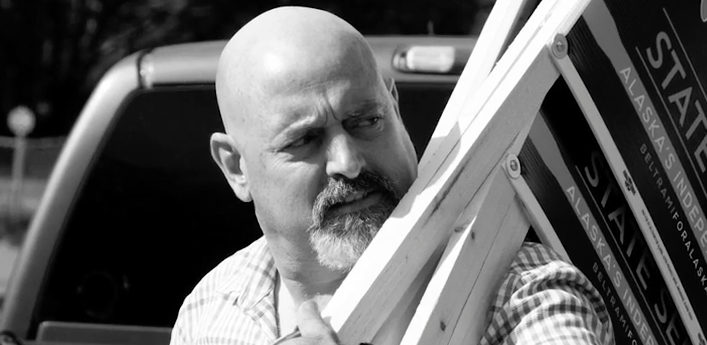
It’s a brave new world in social media and politics. Vince Beltrami found that out when a video featuring some pictures of him from his Facebook newsfeed popped up on the newsfeeds of Alaskans who have Facebook accounts.

Word has it that the Beltrami camp lodged a complaint with Facebook, and all of a sudden the video was taken down — by Facebook managers. Something about how the photos were his intellectual property.

What was it about the video that was so offensive? We reviewed it and it seems pretty mild. There’s no nasty language or character assassination — just facts and speculation. You know, politics.

Beltrami is a chameleon — a Democrat running as an independent to attempt to fool voters. He’s the AFL-CIO president who is trying to unseat Sen. Cathy Giessel. Trying to take the video down is like chasing a rainbow. Besides, is he trying to abridge someone else’s political viewpoints?

The video still lives over at YouTube. While Beltrami evidently controls Facebook in his quest for world domination, he hasn’t caught up to the YouTube version yet.

Watch and download it here it before it, too, disappears under the thin skin of Beltrami.

[Read a related story: http://mustreadalaska.com/is-vince-beltrami-todays-bill-allen/]

The Libertarian candidate for president

0

CANDIDATE PROFILE YOU DIDN’T SEE IN THE OFFICIAL ELECTION PAMPHLET

Gary Johnson, Libertarian candidate for U.S. President

Gary Earl Johnson is an American businessman, author, politician, and the Libertarian Party nominee for U.S. President. The Alaska Division of Elections did not print his biographical information in the Official Election Pamphlet, but Must Read Alaska has cobbled together an unofficial biography for interested voters, condensed from Wikipedia:

screen-shot-2016-10-19-at-10-41-33-amGary Johnson was the 29th governor of New Mexico from 1995 to 2003. He was a Republican. He was the Libertarian Party’s nominee for President in 2012.

Johnson is from the private sector, the founder of a large construction company in New Mexico.  He entered politics by running for governor on a low-tax, anti-crime platform, beating incumbent Democrat Bruce King easily. He cut the ballooning budget by signing more than 200 vetoes during his first six months.

Johnson won again in 1998, and fought for school vouchers and decriminalized marijuana. He  set records for vetoes — signing more of them than all the other 49 governors combined.

Johnson ran for president in 2012, as a Republican on a libertarian platform emphasizing the United States public debt and a balanced budget, protection of civil liberties, military non-interventionism, replacement of income tax with the FairTax, and opposition to the War on Drugs. He changed midway through the race and became the Libertarian nominee in 2012, winning the most votes in Libertarian Party history.

In 2016, Johnson announced his candidacy for the Libertarian Party nominee again, and won in May. Former Massachusetts Governor William Weld is his running mate.

Johnson’s views are fiscally conservative and socially liberal. He espouses limited government and military non-interventionism. He supports the repeal of Obamacare and favors a simplified tax code with lower taxes.

As governor of New Mexico, Johnson cut taxes 14 times and never increased them. He has supported the FairTax as a blueprint for reform, abolishing all federal income, corporate and capital gains taxes, and replacing them with a 23 percent tax on consumption of all non-essential goods, while providing a rebate to households according to household size, regardless of income level.  He supports the Trans-Pacific Partnership, stating that he previously thought it limited fair trade, but is now informed it, in fact, fosters free trade.


Is Vince Beltrami today’s Bill Allen?

0

screen-shot-2016-10-18-at-8-47-42-pmAlaska always has some charismatic personality who rolls into the state, captures the imagination of many and ascends to power before crashing spectacularly.

Back in the day it was Bill Allen: Smooth talking, affable, thoroughly believable and with a slight character fault or three that led to his fall from grace: Greed, sex, and power-brokering being the main components.

Allen started a small welding company called VECO, which grew to become one of the most known players in the oil industry worldwide. VECO was a household name in Alaska. He owned the Anchorage Times. He owned some Alaskans, too.

Then it happened. Bill Allen became a statewide disgrace, pleading guilty after a corruption probe into charges of extortion, bribery, and conspiracy to impede the Internal Revenue Service.

Bill Allen became shorthand for all that was wrong with the political system in Alaska. And, for his coup de grâce, he screwed the late Sen. Ted Stevens to save his own skin. That cost Ted Stevens and Alaska, as Mark Begich swooped in to pick the carcass.

screen-shot-2016-06-01-at-8-45-58-amToday’s Bill Allen might very well be Vince Beltrami: Smooth talking, affable, thoroughly believable, just like Allen. And determined to own the Legislature.

Anyone in his way is simply grist for his meat grinder. Those who are his allies are his useful idiots.

Beltrami blew into Alaska from California as a young man seeking his fortune, and charmed his way into being elected to lead the biggest union consortium in the state: AFL-CIO. That was heady stuff, because, well, Alaska is the third-most union-organized state in the nation.

Beltrami loves the swagger of his title and craves the attention he gets. From his personal website, he announces that, “according to at least one right-wing pundit, I alone am the FIVE most powerful people in Alaska, so please…try to show some respect!” He was joking…sort of.

In the back rooms of labor halls and on bar room napkins, Beltrami in 2014 hatched the plan that led to the formation of the so-called Unity Ticket. There was no way he was going to let Sean Parnell have a second term.

After the August 2014 primary showed Democrats had zero chance of winning the governorship, the Democrats reorganized and rebranded as “independents.” They dropped Byron Mallott as their candidate. Hollis French limped away from his bid for lieutenant governor.

Bill Walker adopted Mallott as his running mate, left the Republican Party and ran as an “independent” candidate.

The fix was in. The Democrats convinced themselves that this “Unity Ticket” was the best they could do, and shortly thereafter Beltrami made good on his promise, funding the rest of the fall campaign with money from union dues. He spent $300,000 to get Walker in office.

But that was not enough. His spending to own the Legislature has tripled since he started spending big in 2010. He had four years under his belt as president of AFL-CIO, he was losing membership, and he had to do something to stop the bleeding.

In 2014, he plugged Daniel Ortiz in as a test-case in Ketchikan to see if “independents” could succeed in deceiving the electorate. Ortiz won the House seat in a town that had been considered safely red.

This year, he’s plugged Democrat Pat Higgins into the race against Rep. Charisse Millett. He put Democrat Harry Crawford up against Rep. Lance Pruitt. He plugged newly minted “independent” Jason Grenn to run against Rep. Liz Vazquez. He is playing Democrat Luke Hopkins against Sen. John Coghill.

And he saved one prize for himself: He wants Sen. Cathy Giessel’s head on a platter, so he’s challenged her for her Senate Seat N.

With his own style of humble hubris, Beltrami is bragging around town that he has $500,000 to play with in these races.

WHO IS VINCE BELTRAMI?

Alaska Republican Party Chairman Tuckerman Babcock has characterized Beltrami as a “longtime union boss.”

Ballotpedia, which evaluates such claims, found that an interesting allegation and decided to investigate the claim.

The result? Yes, indeed, it ruled “longtime union boss” a fair assessment, and added that Beltrami has a mediocre history of leadership — with some successes, but also some failures. His union membership has actually declined under his watch at a rate that is twice the national decline. Here’s the fact-checking from Ballotpedia:

“In a June 1 GOP press release, Tuckerman Babcock, chairman of the Alaska Republican Party, called Alaska State Senate candidate Vince Beltrami a “longtime union boss.”[2]

“A standard dictionary definition of boss is: “a person who exercises control or authority; specifically: one who directs or supervises workers.”[39]

“By that definition, Vince Beltrami is indeed a “longtime union boss.” The Alaska AFL-CIO, which Beltrami has managed for the past decade, is a network of 53 labor organizations in Alaska—a state with the third-highest rate of union membership nationwide. Both Beltrami and his organization have a long record of political activism and influence. But it is also a record marked by failure, not just success.

“Of course, the term “longtime union boss,” as applied by the Alaska GOP, carries certain political connotations that suggest such a person would favor the interests of his union allies instead of the general public good. Ultimately, Alaska voters will decide at the ballot box which use of the term best fits Beltrami.”

WHAT DID BELTRAMI PROMISE?

screen-shot-2016-08-10-at-4-24-46-pmVince Beltrami was elected to his post as president of the AFL-CIO in 2006.

You read that right: He was elected. He serves at the pleasure of the union voters.

That means he had to make the rounds to the membership, make a few impromptu speeches, and make promises.

Since he ran for union office, voters in Northeast Anchorage, Anchorage Hillside, Indian Bird, Girdwood and Portage might want to know just what he promised the AFL-CIO he would do for them.

What was Beltrami’s platform? What would be his targets and milestones for measuring his success? What are his deliverables?

Voters don’t know because Beltrami hasn’t released the campaign promises he has already made — promises that told his voters he would be  the perfect person to hold the office to which he is now elected.

Further, Beltrami says if elected to the Senate, he won’t step down from his $185,000-per-year position of president of the Alaska AFL-CIO.

FOLLOW THE MONEY

Beltrami is now controlling more money in the current campaign cycle than Bill Allen ever dreamed of spending.

Allen, oldtimers will recall, would round up his buddies and head down to fundraisers, where they’d all drop checks for $250. Bill Allen would never have known what to do with $500,000 in an election cycle. Everything was done in small checks. Allen just peeled off some bills everywhere he went.

But Beltrami controls a lot of money. No one knows quite how much.

According to the National Institute on Money in State screen-shot-2016-10-18-at-10-34-31-pmPolitics, and Alaska Public Offices Commission filings, Beltrami has directed $928,634 to political candidates, ballot initiatives and political action committees between 2010 and 2015. And that amount is growing rapidly.

Beltrami spent three times the money in 2014 to control the outcome of races than he did just four years prior.

This year, it’s harder than ever to follow the money, because separate expenditure groups are popping up to support him in his own race, such as Together for Alaska.

Beltrami also gets to use AFL-CIO money to support his candidacy as a direct expenditure. Is it even legal?

For example, three recent mailers shown below were funded directly by union dollars and mailed out across District N as “member to member” communications. The recipients may have been members, but the vast majority of recipients were not.

img_4334beltrami-2

ibeltrami-3

TOGETHER FOR ALASKA IS VINCE BELTRAMI — IS ROBIN BRENA

What obscures the money trail in Alaska is the way that subsets of AFL-CIO can move money to independent expenditure groups that are likely coordinating with Beltrami behind the scenes.

Collaboration is illegal, but notice in the chart below how AFL-CIO contributed $15,000 to Together for Alaska, which in turn is pumping out media in support of Vince Beltrami, who would have authorized the expenditure. This is a funding circle: Beltrami and his unions give money to Together for Alaska, which in turn supports his campaign.

AFL-CIO member unions are heavily represented in the income stream of Together for Alaska, such as  AFSCME, IBEW, IAFF, with funds coming in from all over the country for Together for Alaska, so that Beltrami and his boys can take over the Legislature.

Between the $500,000 plus that Beltrami is controlling, and the $208,000 already revealed by Together for Alaska, we can assume that more than $1 million is being spent on a handful of races that will benefit Beltrami’s goals.

He intends to move the needle. And with that, he intends to control Alaska’s political landscape.

screen-shot-2016-10-19-at-7-13-09-am

Division of Election reaches out, again to the wrong place

0

The Alaska Division of Elections is giving itself an A for effort.

The Division director has sent a letter to the Alaska Republican Party and the Republican National Committee explaining its reasons for not including a biography of the Republican nominee for president in Alaska’s Official Election Pamphlet.

Generously, the division is giving Donald J. Trump another opportunity to be included in the online version of the pamphlet, whose 119-page hard copy arrived in voters’ mailboxes this week.

In 2014, when the division left Bill Walker out of the Official Election Pamphlet, the division printed a second one.

This is a similar outreach that the Division of Elections conducted in mid-summer, and the result of its wayward effort was that Donald J. Trump’s campaign never received the information about the pamphlet. The Division never followed up to inquire as to why Trump’s campaign had not responded.

The latest letter, dated Oct. 17 and sent by Division of Elections Director Josie Bahnke, was addressed to Republican Associate Counsel Christina Schaengold and copied to House Speaker Paul Ryan (who chaired the Republican National Convention), Republican National Committee Presiding Secretary Susie Hudson, and Alaska Republican Party Chairman Tuckerman Babcock.

letter-to-christina-schaengold

RESPONSE FROM PARTY CHAIRMAN: SWIFT AND HELPFUL

Tuckerman Babcock, elected chairman of the Alaska Republican Party in May, said it is the Election Division’s responsibility to reach out to the candidate, not to the party itself.

The candidate has complete control over the biography, photo, remittance, and application to be included in the Official Election Pamphlet. Babcock, in his younger years, worked at the Division of Elections and is familiar with the agency’s procedures.

Babcock, from his home in Kenai, replied immediately to Director Bahnke with this helpful information:

Dear Ms. Smith,

That is very kind of the Division of Elections. Still having trouble locating the Trump-Pence Presidential campaign contact information?  

Donald J. Trump President, Inc.

c/o Trump Tower

725 5th Avenue

New York, New York  10022

646-736-1779

The Trump campaign in Alaska:

Jerry Ward

State Director

Trump-Pence

11610 Old Seward Hwy

Anchorage, AK 99515

[email protected]

907-887-3677

Sincerely,

Tuckerman Babcock

Chairman

Alaska Republican Party

Read more about how the Division of Elections printed the Official Election Pamphlet without a statement from the Republican nominee for president (or the Libertarian one, for that matter.)

Read more about the Trump/Pence statement you never got to see.