Friday, August 7, 2026
Home Blog Page 1717

This is no way to run a tax policy

0

Higher taxes, like those under debate in Alaska, would only add to the challenges the industry faces.

COMMENTARY / Dr. MARGARET THORNING
ALASKA JOURNAL OF COMMERCE

This summer, observers across the nation watched as lawmakers in the state of Alaska pulled together a buzzer-beating compromise that prevented a potentially catastrophic budget shutdown and kept the government funded through the coming fiscal year.

For countless Alaskans who simply wanted their government to continue to operate, the compromise is a win. The alternative — an unprecedented shutdown — would have been untenable, resulting in significant upheaval for Alaskans seeking to utilize programs ranging from fishery permitting to cruise ship oversight to early education and Head Start services.

For political and policy junkies, it was a budget showdown that checked nearly every box, complete with flaring tempers, bruised egos, high stakes, and the discussion of policy shifts that could send ripples through the economic landscape for years to come.

This is particularly true in the case of the oil and gas industry, a sector that is looking at increased taxes in the eye in Alaska while simultaneously facing extremely challenging market conditions across the nation and around the world.

On the heels of a massive surge in domestic production driven by advances in extraction technology and finds from the Bakken to the Marcellus, fortunes have changed somewhat for the American oil and gas sector.

Prices have fallen steadily in recent years, hovering around $47 per barrel, and analysts expect the price to remain in the $40 to $60 range for the next five years. The cost of producing a barrel of oil is also increasing alongside advances in extraction technology, with companies pursuing projects that are riskier, more difficult to access, and ultimately more expensive.

The oil and gas industry is strong, and no one will mistake it for a struggling mom-and-pop operation. But these are no longer the boom times of the early 2010s – margins are thinner, profits are lower, and the challenges on the horizon are greater than they have been in some time.

[Read more at Alaska Journal of Commerce]

Ketchikan stripe show makes national news

0

KETCHIKAN – It was a pavement striping job so crooked it made the New York Post. The new yellow double lines on Tongass Highway wiggled, went wide, and stayed wet too long.

The paint job made the news because the car belonging to Ketchikan Gateway Borough Mayor David Landis ended up with yellow paint splotches.

“You come to expect having highway striping like that to be straight and have orderly looking lines and be professionally applied,” Landis told a reporter. “Something was clearly wrong with the equipment or the operation of that equipment to have so many things wrong all at once.”

The Ketchikan Daily News said that the State Department of Transportation explained that due to humidity, the paint didn’t dry as quickly a it should. But the state isn’t planning to repaint the highway.

And on further inspection, it appears that drivers on Tongass Highway, the city’s main thoroughfare, were weaving onto the freshly painted yellow lines.

That said, locals wondered aloud why DOT didn’t use the last three weeks, Ketchikan’s version of an Indian summer, to get the striping cone.

According to the newspaper, DOT recommends people who have the telltale yellow spatters get their vehicles pressure washed. If that doesn’t work, use WD-40, and after soaking the yellow spatters, wash the car. And finally, if that doesn’t do the trick, use a “liberal coating of Vaseline,” and then pressure wash.

We consulted to autogeekonline.net and found these instructions:

  1. Put on rubber gloves.
  2. Moisten a small shop towel with lacquer-paint-thinning solvent. Wring out the towel to prevent dripping.
  3. Apply solvent to the road-line paint, using the damp towel.
  4. Wait 10 to 15 seconds for the lacquer solvent to loosen the paint
  5. Wipe the road-line paint from your car, using a terry cloth. Massage the road paint in a circular motion until it comes loose.
  6. Moisten a fresh towel with lacquer-paint-thinning solvent and wipe down any remaining road-line paint. Use the buffer, equipped with a wool pad, to clean off the remaining road paint.
  7. Dry excess lacquer solvent with a new, dry towel.

Revenue pulls gaming permit for United Way Anchorage

0

United Way of Anchorage is sideways with the Department of Revenue. Enough so that the State department’s tax division suspended the charitable agency’s gaming permit, as listed on the Department’s online database:

The suspension appears to have come in the middle of United Way’s fall campaign, which kicked off Aug 30.

Must Read Alaska called United Way to find out why the suspension was made, but the individual responding to the call was unaware of the problem. This story will be updated if more information becomes available. The Department of Revenue could not be reached this evening for an explanation.

Update: Elizabeth Miller, Vice President for Resource Development said that due to a miscommunication that led to a mistake in the permit application, the United Way of Anchorage gaming license from the State of Alaska has been temporarily suspended. “We are currently working to rectify the situation as quickly as possible,” the organization wrote this morning.

Update II: Thursday afternoon the gaming permit was restored.

One could wonder, why would Dept. of Revenue not just reach out to UWA and resolve it rather than suspending the permit of one of Alaska’s largest charities?

Quote of the week: Armchair quarterbacks

1

“Not my job. I hear that a lot as our economy continues to struggle. We need fewer armchair quarterbacks and more players.”

Rep. Ivy Spohnholz, dismissing citizen activist Brad Keithley for his critical analysis of the Alaska House Democrats’ tax-and-spend plan.

In other words, if your opinions differ from Rep. Spohnholz, she’s not listening.

On April 16, 2017, Spohnholz voted in favor of HB 115, which would have established an income tax in Alaska that would have generated between $600 million and $800 million in revenue for state government. Under the plan she voted for, a single person making $50,000 per year would pay nearly $1,000 in income taxes to the state, and receive a Permanent Fund dividend that was cut to $1,200 — from $2,000.

The result of the legislation, which failed in the Senate, would mean that by 2019 Alaskans making $50,000 would be paying to the State of Alaska about $2 for every $25 in income (we are designating the PFD cut as a defacto tax in that calculation).

Crime townhall brings out frustration, anger of residents

3

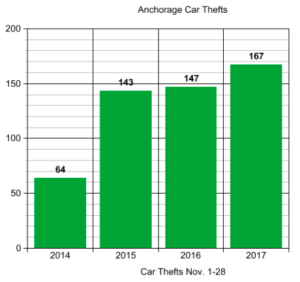
It’s not just anecdotal. Alaska has, in fact, become less safe, according to 2016 statistics released by the FBI this week.

At a Monday town hall meeting in Anchorage hosted by Rep. Charisse Millett, about 100 people came from all over the city — not just District 25 — to voice their concerns about the rise in crime. Some shouted, some screamed, some cried, and others held forth with specific criticisms and recommendations for several minutes until told by their fellow attendees to sit down.

Millett put no time limit on speakers, but they self-policed.

“It was the  most emotionally charged town hall we’ve seen in a long time. People just needed to be heard, and we were there to listen,” Millett said.

They were not emotional without reason. According to the FBI:

  • Property crime rose in Alaska 18.9 percent last year — the largest increase nationwide, according to the FBI report.
  • Auto theft in Alaska jumped 48.6 percent, the nation’s largest year-over-year change.
  • Violent crime in Alaska rose 10 percent. Robbery, aggravated assault, burglary, theft, and car theft also rose.
  • Sexual assault jumped by 16 percent in 2016.

Nationwide, property crime dropped 2 percent, violent crime rose 3.2 percent, auto theft rose 6.6 percent, and sexual assault rose just under 4 percent.

In addition to Millett, lawmakers in attendance at the Abbott Loop Elementary School town hall included Reps. Chris Birch, Andy Josephson, and Dan Saddler, Sen. Kevin Meyer and Anchorage mayoral candidate Rebecca Logan.
For some, it was a chance to voice their concerns face to face with lawmakers and law enforcement.

Many blamed SB 91 for the rise in crime, although defenders of the legislation said that crime was already going up under Gov. Bill Walker before he signed SB 91 into law.

Quote of the week: Gara on class warfare

4

“Politics shouldn’t be about class warfare and eyeing the next election. I’m proud of the many wealthier Alaskans who have said they’d like chip in. So today over 6,000 Alaska corporations and lawyers, realtors, banks and doctors are exempted from paying corporate or any other taxes.”

Rep. Les Gara, advocating for income taxes in an Alaska Dispatch News op-ed.

In other words, class warfare is bad. Long live class warfare.


When do taxpayers support pedophilia films?

3

With support from the Anchorage ACLU, the Anchorage Public Library and University of Alaska are celebrating “Banned Books Week” by showing a film adaptation of a “very controversial book.”

The book and film are so controversial that the social media event posted by the sponsors cannot bring itself to mention the name of the book or film on their social media event posting.

The promoters just say it’s about a middle-age man who becomes sexually involved with a young girl.

OK, we get that it’s Lolita, so why not just come clean? In the book, she’s 12. In the film, the producers attempt to make it marginally more pallatable by making her 14. In either, she’s not of the age of consent.

Perhaps the Anchorage Public Library is keeping it on the down low because even with today’s increasingly permissive standards, pedophilia is still very unlawful.

Spoiler alert: In Kubrick’s adaptation of the book Lolita, Dolores Haze (Lolita) is a prepubescent sexualized femme fatale, which makes it seem quite OK that Humbert Humbert finds her irresistible.

By any other name, this is rape of a child. And a bit of incest, since the man is her stepfather.

Anchorage Public Libraries, a space to bring books to enlighten the public, is evidently all-in on this salacious, soft porn film.

Related: Pedophilia is being made normal.

Alaska’s got gas, on that much Gov. Walker and AGDC’s Meyer agree

2

By CRAIG MEDRED
CRAIGMEDRED.NEWS

Alaska’s sputtering and stalling natural gas pipeline project appears to roaring forward again no matter what the media might be reporting.

Just weeks after Alaska Gov. Bill Walker told the Alaska Resource Development Council that he thought the $45 billion to $65 billion project “doubtful,” the governor’s natural-gas czar has suggested to the Chinese the project is on the way to the start of construction in 2019.

Xinhua, the official press agency for the People’s Republic of China, on Sunday reported that Keith Meyer, the president of the state-owned Alaska Gasline Development Corporation, “dismissed a recent local Alaskan newspaper report which quoted Governor Walker as saying that Alaska will not put more money into promoting the LNG project until firm commitments are made by customers.”

 Xinhua writers Yang Shilong and Zhou Xiaozheng went on to quote MeyerWalker’s half-million dollar LNG promoter – saying “the project is full steam ahead. The governor indicated we are expecting market agreements before the end of next year before asking for more money from the state. However, we fully expect to have customer commitments and also will be engaging strategic partners.

“The project will keep moving without question. Unfortunately, the Alaskan press misinterpreted the governor, which is quite common here in Alaska.”

Blame the media

Walker’s comments before the RDC were videotaped. His specific statements on the LNG project – which entails a pipeline from the North Slope to Cook Inlet and a plant on the Kenai Peninsula to convert the gas to a liquid for shipment to Pacific Rim nations – came in response to a question at the end of a presentation on the state economy.

At 25 minutes, 25 seconds into this videotape, Walker is asked “what’s the next steps in the LNG project,” given the high costs?

“I’ve long felt it must be a market-driven project,” the governor answered. “And it can’t be a state project. You can’t build it and they’ll come…it takes a market.”

He went on to say the markets have been “very, very positive,” though the state has no firm commitments for gas, and then added this:

“But do we continue on? I can’t say that here. Boy there’d have to be a really strong commitment.”

Walker then suggested the state should use the rest of the funding the Legislature allocated for gas pipeline planning, but said “I don’t allow myself to be optimistic anymore. I’m hopeful. Ah, and I am hopeful. But can we continue on after this funding? I’m doubtful.”

[Read more at CraigMedred.news]

[Read New China interview with Meyer and Walker]

Rebecca Logan files for Anchorage mayor

7

The president of the Alaska Support Industry Alliance has filed a letter of intent to run for Anchorage mayor in 2018, she announced this morning.

“I have spent the last 28 years living and working in Anchorage. I first ran for elected office in 2008 and was elected to the Chugach Electric Board and served as its chairman. For 10 years, I owned several restaurants in the Anchorage area and I have a strong history of community service,” Rebecca Logan wrote in a press release.

Her priorities will be:

  1. Reducing the alarming rate of crime that has so many residents living in fear.
  2. Focusing on delivering core services to citizens without increasing property taxes to the maximum amount allowed by law.
  3. Strengthening the private sector to boost the Anchorage economy and reduce unemployment.

“As I visit with my neighbors in Anchorage, it’s clear more needs to be done to address the shocking crime wave underway in our city.  It is unacceptable for people not to feel safe walking on our trails and sidewalks, and even worse that citizens feel no safer in their own homes.  As mayor, I will not only acknowledge the problem, but tackle it head-on,” she said.

She said her budget will focus on core services like public safety and road maintenance, and “I’ll ensure that taxpayers do not have to choose between snowplowing and an adequately staffed police department.”

“Lastly, I will not raise property taxes by almost 6  percent during an economic recession, and will work to strengthen the private sector, which is the only entity capable of lifting us out of the current economic slump.  More good-paying jobs in Anchorage will go a long way toward solving a lot of our problems, and my policies will reflect that strongly held belief.”

“I look forward to running a positive, issue-based campaign,” she said.