Thursday, December 25, 2025
Home Blog Page 1709

Insurance: Consumers brace to pay more, get less under Obamacare in Alaska

15032378_s

Obamacare’s next victim may be access to medical care in Alaska, particularly in rural areas and for all who are mandated to buy their insurance on the Affordable Care Act exchange.

This Friday, the Alaska Division of Insurance holds a listening session to gather information on the “80th percentile rule,” which is a consumer protection regulation that governs insurance reimbursements to out-of-network medical providers in Alaska.

This listening session only applies to one insurance company — Premera Blue Cross Blue Shield — because it is the last man standing in an Obamacare insurance market that collapsed in Alaska after President Obama signed the Affordable Care Act into law.

Premera wants the rule removed so that they can pay out-of-network providers at a loss instead of a market rate. This will give them the hammer to force those doctors into their network.

The Governor’s Office, through senior adviser Jim Whitaker, is pressuring for the change.

The problem with only looking at the private insurance market, as Premera does, is that it doesn’t account for veterans, Tri-care, Medicare, or Medicaid, or the impacts to these programs.

For better or worse, our health care system relies on cost-shifting from private payors to these government health care programs. If Premera can leverage doctors into its network, it reduces the ability for physicians to take on and subsidize government health care. Our veterans and seniors will find it even harder to get care.

Premera has to make money. Its biggest cost driver right now is the Obamacare law and the multiple mandates that go with it, which have made insurance even less affordable for people in Alaska not covered by Walker’s Medicaid expansion, or those who don’t qualify for the federal tax rebates.

Many Alaskans are now paying $1,500 a month or higher for basic, “bronze plan” insurance, that has deductibles as high as $6,000 to $10,000. And the rates will go up again this year.

HISTORY

In the late 1990s, insurance companies began reducing their reimbursement rates as a way of increasing their margins. This shifted the cost burden to Alaskans.

The Division of Insurance realized consumers were being hurt with huge medical bills. In 2004, the Division adopted a regulation requiring insurance companies to pay at the 80th percentile as the usual and customary rate.

For instance, if you go to a surgeon in Alaska who is out-of-network (and many are), and your bill is $10,000, but Premera has set the “usual and customary rate” at $2,000, you’ll be ponying up $8,400 from your own pocket. That may seem like an extreme example, but for a chemotherapy or radiation therapy center in a small community, the rates charged are typically much higher because there are so few patients.

Alaska’s specialty doctors and medical providers have very small patient loads across which to spread their costs. In Seattle, doctors have hundreds of thousands of patients. But in Alaska, a specialty physician doesn’t have a huge number of patients to help him/her spread out the costs. So they charge more.

Whether 80 percent is the right level is the debate at hand. But to change anything now in the insurance market would be risky. With the Republican Congress and with an incoming Republican president, Obamacare is facing repeal or, at the very least, overhaul.

For Alaska to make any changes to reimbursements in the marketplace at this time seems premature, considering that major federal changes are most certainly on the horizon.


Trump tweets China: Get a grip on N.K.

north-korea-nukes

KIM JONG-UN IS AN ALASKA-SIZED PROBLEM

President-elect Donald Trump, who will be sworn into office in 16 days, is moving the needle on major international issues in a way that no other president in modern history has done prior to taking office.

Trump is doing so 140 letters at a time. His tweets are driving diplomats and pundits to distraction. But his tactic of being a disruptive force to the status quo is promising for a world grown accustomed to the Obama Doctrine, which is hinted at in a tepidly received speech Obama gave in 2014 at West Point: “The United States will use military force, unilaterally if necessary, when our core interests demand it.” (Italics ours)

In actual practice, the Obama Doctrine can be summed up as empty threats, leading from behind, and drawing unserious imaginary “red lines” in the Syrian sand. Coming on the heels of such weak international leadership, the world is suddenly paying attention to art-of-the-deal Trump. Will his method of tweet-shaming result in better outcomes than Obama’s imaginary lines?

screen-shot-2017-01-04-at-1-53-01-pm

Let’s take a look at what Trump is saying about North Korea and China this week:

“North Korea just stated that it is in the final stages of developing a nuclear weapon capable of reaching parts of the U.S. It won’t happen!” Trump tweeted.

Not quite done, he continued in a follow-up message: “China has been taking out massive amounts of money & wealth from the U.S. in totally one-sided trade, but won’t help with North Korea. Nice!”

Critics say North Korea will be testing its intercontinental missiles quite soon, regardless: “I think North Korea will probably test the KN-08 (intercontinental ballistic missile) this year, no matter what Trump tweets,” wrote Jeffrey Lewis, director of the East Asia Nonproliferation Program in an email to CNN.

Lewis is an expert, and he has conventional wisdom on his side. But he’s no Donald Trump.

Actual parts of the KN-08 may have already been tested. Photo evidence is ample that North Korea is very close to having a finished product. At some point its rocket success rate, which is less than 15 percent, will improve.

Even if Trump’s blustery tweets can’t stop a missile, China is taking notice, and was forced to issue a response to the president-elect’s blistering remark. It likely galled the Chinese to have to respond to a tweet from Trump.

This much is clear: Trump, as an international figure, is going to be the Honeybadger President: He just doesn’t care about conventional wisdom. And he doesn’t care much about what others think is protocol.

Not only was Trump willing to take a call from the president of Taiwan shortly after winning the election, an act that shocked and offended the mainstream media, he’s now shaming the Chinese for their ineptitude with North Korea.

China, he’s correctly noting, enables North Korea’s ambitions, expanding through trade the nuclear hopes of unstable Kim Jong-un.

According to the Council on Foreign Relations, China is — as it has been for so long –North Korea’s BFF, its biggest trading partner, and supplier of most of its food, arms, and energy: “It has helped sustain Kim Jong-un’s regime, and has historically opposed harsh international sanctions on North Korea in the hope of avoiding regime collapse and a refugee influx across their 870-mile border,” the council says.

Here we are  in 2017 with the Chinese-created Frankenstein of Nations growing out of control and ever-less stable. At any time in the next four years, the Swiss-cheese-loving, wine-swilling, 32-year-old Kim will roll out his nuclear arsenal in a grand, public test, hopefully  not after consuming copious amounts of liquor.

His near-term objective? A nuclear-tipped missile that can reach the continental United States, thus giving him enormous bargaining power to prop up his regime.

Trump will have to deal with Kim, he’s signaling that he knows it, and he’s willing to do so. How he does will be at the time and place of his choosing.

But in the meantime, Alaska is wary of North Korea’s nuclear ambitions, as we are home to the one of the nation’s most important missile defense systems, and we’re also closest in proximity to North Korea.

As uncomfortable as it is to imagine, Alaska is both in the crosshairs and is the first line of defense against a nuclear-armed Kim Jong-un.

screen-shot-2017-01-04-at-11-38-04-am

ALASKA’S ROLE IN REBALANCING PACIFIC POWER

Alaska has an important role in protecting not just itself, but the entire continent.

Last month, U.S. Sen. Dan Sullivan spoke at the Reagan National Defense Forum, where he argued that it’s time for America to face the threat that North Korea has become:

“…[what] President-elect Trump is going to face in regard to North Korea is — it is a mess. I think it’s our responsibility to give the incoming administration options and time,” Sullivan said. What Sullivan left unsaid is it’s a mess because it’s been handled poorly by the current administration.

“Here’s the scenario I worry about: Right now, most Americans believe the North Korean nuclear issue is a regional issue: Japan. Korea. China. And at some point we are going to wake up and our public is going to wake up to the fact that the head of North Korea, who is not very stable and not very predictable, is probably going to have the capability to hit our country with an intercontinental ballistic missile with a nuclear warhead on top of it,” Sullivan said.

Sullivan went on to describe why Alaska remains front and center for a more robust missile defense system and why his work on the Armed Services Committee is important to Alaska.

In the National Defense Authorization Act of 2016, Sullivan inserted provisions to require the missile defense agency to perform testing every year, and to develop a long-range discrimination radar in Alaska at Fort Greely. The design review for the radar is scheduled for this month, with construction in Alaska to begin in 2019.

In 2016, he added these provisions to the NDAA:

Missile Defense:  Added $400 million above the Department of Defense’s $8.1 billion budget request for missile defense programs. Funding includes $1.28 billion for the Ground-Based Midcourse Defense portion of the Ballistic Missile Defense System, much of which is based at Fort Greely.

Missile Defense Sensors: Included $233.6 million for Missile Defense Sensors and $137.6 million for the Long Range Discriminating Radar, to be located at Clear Air Force Station.

F-35:  Included $5.3 billion to acquire 44 F-35As. Eielson Air Force Base will be the home of a F-35A squadron.

The Alaska delegation’s challenge will be to educate the president-elect about the real threat that North Korea already poses. “It won’t happen” is a great Twitter dig, and the transparency of sending that message so the whole world can see it in real time is not lost on us.

But snappy as it is, it doesn’t come close to addressing what is rapidly become a clear and present danger to the United States and the world. That is going to take military might, employed with courage and resolve, to back up the tweets, and thereby restore American credibility in Asia.

Swearing in day in DC for Murkowski, Young

screen-shot-2017-01-03-at-1-53-14-pm
Senator Lisa Murkowski is sworn in by Vice President Joe Biden this morning, as her husband, Verne Martell, holds the Holy Bible.

Alaska Sen. Lisa Murkowski was sworn in this morning in Washington, D.C. Rep. Don Young was also sworn in for his 23rd term, 45 year to begin in March.

Along with that comes changes in seniority. Murkowski is now 25th in seniority in the Senate, and is moving into Sen. Ted Stevens’ old office this month, which was occupied most recently by retired Sen. Harry Reid, a longtime foe of Alaska’s economy. Her new room assignment will be 522 in the Hart Building.

Sen. Dan Sullivan, who did not need to be sworn in this year, rises to 92nd or 93rd in seniority, depending on whether Sen. Jeff Sessions takes the job of U.S. Attorney General.

Murkowski retained assignments on these committees: Energy and Natural Resources Committee, Appropriations Committee, Indian Affairs,  and Health, Education, Labor and Pensions.

Sullivan retained his committees as well: Armed Services; Commerce, Science and Transportation; Environment and Public Works; and Veterans’ Affairs.

Committee chairs will be selected by a vote of the members and then ratified by the Senate Republican Conference.

screen-shot-2017-01-03-at-3-47-17-pm
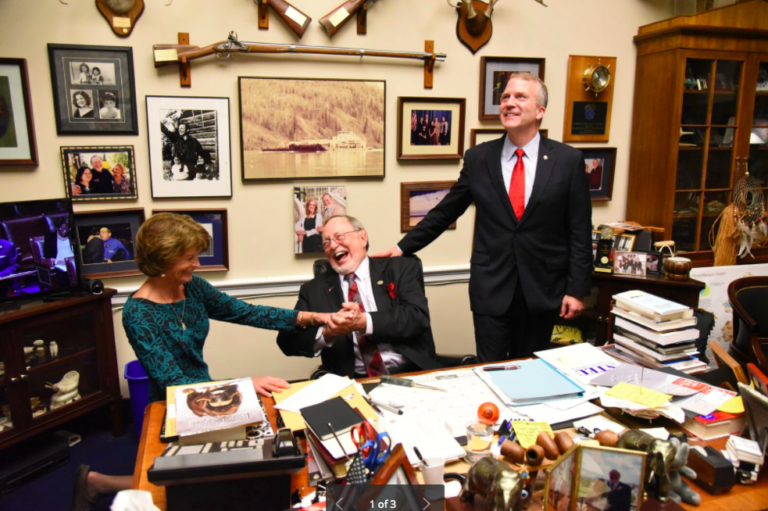
Alaska’s team: Senator Lisa Murkowski, Representative Don Young, and Senator Dan Sullivan today, in Young’s office, after the swearing-in ceremonies.

Young started the day strong by introducing 38 bills, some of which had languished in the 114th Congress, including reauthorizing the Magnuson Stevens Act, reforming the Antiquities Act, opening Arctic National Wildlife Refuge to limited resource development, and reducing burdensome federal regulations.

Young is the longest serving House Republican and 2nd longest serving overall member of the House.

House committees will be named later this month.

Events

January is shaping up to be a busy month for conservatives in Alaska. Here are some events on the horizon:

screen-shot-2017-01-01-at-9-09-55-pm

screen-shot-2017-01-01-at-9-11-29-pm

JAN. 5, 7 pm: District 7 Republicans, White Fields Church, 4800 Palmer Wasilla Highway. Guest presenter is Sen. Mike Dunleavy with his proposed state budget, how to balance it now, and control it in the future.

inaugural

JAN. 7: 6 pm, 58th Presidential Inaugural Gala, Alaska Petroleum Club. Contact Kristie Babcock, [email protected], for tickets.
JAN. 16: Martin Luther King Jr. Day, national holiday.

screen-shot-2017-01-03-at-8-08-44-am
JAN. 16: 5-7 pm, Juneau, House and Senate Republican fundraiser at The Hangar.

JAN. 17: First day of Alaska Legislature.

JAN. 23: House Finance starts budget hearings.

FEB. 16: Anchorage Republican Women’s Lincoln Day Dinner, Bridge Seafood Restaurant & Catering, 221 W. Ship Creek Ave, Anchorage.

screen-shot-2017-01-03-at-11-34-38-am
FEB. 17: Mat-Su Republican Women’s Lincoln Day Dinner.
FEB. 24: Capital City Republicans Lincoln Day Dinner at the Baranof Hotel. Speaker is national energy expert Jeremy Carl of the Hoover Institute. Ticket information forthcoming. Must Read Alaska will be there, with bells on.
FEB. 24-25: Juneau – Alaska Republicans’ State Central Committee quarterly meeting.
FEB. 25: Hunting Expo and Sportsman’s Banquet, Dena’ina Center. Tickets: http://www.aksafariclub.org/2013-banquet

CAPITAL CITY LINCOLN DAY DINNER: As they have since before Statehood, Juneau Republicans (a hardy bunch) host a great event in honor of the first Republican president. Watch for ticket information, coming soon.

screen-shot-2017-01-02-at-8-43-48-pm
Jeremy Carl

This year it’s on Feb. 24 and the speaker is Jeremy Carl, a research fellow at the Hoover Institute at Stanford University, where he specializes in U.S. politics and energy policy. He is also a regular contributor to the National Review and National Review Online.

Carl has served as a policy advisor to many state and national political figures and his recent policy work for a prominent Republican governor was highlighted by The Wall Street Journal and Time Magazine.

He was recently profiled as  “a rising star on the right” by the influential conservative Power Line Blog and was the author of what National Review’s Washington editor referred to as “The most interesting piece I’ve read this election cycle.”

His scholarly work at Hoover focuses on energy and environmental policy, with an emphasis on energy security, climate policy, energy innovation, and global fuel markets.  He directs Hoover’s Task Force on Energy Policy and is a member of the Arctic Security Initiative, both of which frequently address issues relevant to Alaskans.

Carl is the author or editor of several books, including Powering the Armed Forces (with former US Chief of Naval Operations, Admiral Gary Roughead) and his scholarly articles have appeared in numerous academic journals.

His political writing and commentary has been featured in the New York TimesWall Street JournalTime Magazine, Politico, The Economist, and many other leading newspapers and magazines. Carl received a BA with distinction from Yale University. He holds an MPA from the Kennedy School of Government at Harvard University and did further graduate work at Stanford University, where he was a Packard Foundation Fellow.

Here are just two of his recent articles we found of interest:
http://www.nationalreview.com/article/442365/donald-trump-won-midwest-states-new-red-wall

http://www.claremont.org/crb/article/the-church-of-environmentalism/

Bright, shiny objects: Rubenstein, Trump, minimum wage’s nickel

0

RUBENSTEIN MEETS WITH TRUMP

screen-shot-2016-12-29-at-9-37-44-pmAlice Rogoff, owner of the Alaska Dispatch News and wife of billionaire private equity investor David Rubenstein, famously served President Barack Obama caribou, moose, oysters, fresh-plucked Alaska greens,  and berries she picked, when he visited her Anchorage home in 2015.

Her husband, on the other hand, just met with President-elect Donald Trump on Wednesday.

Alice and David are, after all, the ultimate power couple.

Rubenstein, who lives in Bethesda, MD, while Alice lives in Alaska, is co-founder of The Carlyle Group. He flew his Gulfstream jet to Mar-a-Lago, Fla. to meet with Trump. He spends a lot of time on his jet — some 1,100 hours a year, it’s reported by The Washington Post.

The Carlyle Group manages $178 billion in investments. Rubenstein is also a known philanthropist, and has been close to the Obama Administration.  A lifelong Democrat who got his start working in the Carter Administration, he didn’t reveal what the meeting with Trump was about. Through Carlyle’s spokesperson Christopher Ullman, he only said it was private.

Perhaps Rubenstein prevailed upon Trump to undo the Obama Administration’s shutdown of the Arctic? It would be a shrewd move, since Carlyle has developed strong private equity interests here. His company also manages 5 percent of the Alaska Permanent Fund.

In May, Rubenstein made a case that Donald Trump had a strong chance of winning the electoral map.

“It’s going to be a hard-fought campaign and it’s not going to be decided until the very end,” he predicted.


MINIMUM WAGE GOES UP A NICKEL

Come Sunday, Alaska’s minimum wage will be $9.80 an hour. That’s one nickel more than it is today, or another 40 cents a day for many workers.

Nineteen states will see an increase in their minimum wages, including Washington and Massachusetts, both of which will bump to $11 an hour, the highest in the country.

California’s will be higher than Alaska’s by 20 cents.

Voters in Arizona, Maine, Colorado and Washington approved minimum wage hikes this past year. Alaska, Florida, Missouri, Montana, New Jersey, Ohio and South Dakota, will simply see automatic increases due to being indexed to inflation.

Look to the Democrat-run majority in the Alaska House to offer a bill that raises Alaska’s minimum wage even further. At its fall meeting, the Alaska Democratic Party State Executive Committee passed a resolution favoring $15 an hour.

A similar bill was sponsored by retiring Sen. Johnny Ellis during the past legislative session, but it died.


YEAR OF KINDNESS 

Juneau Police Department is launching a “Year of Kindness” initiative, starting with barbecues on Saturday, Dec. 31, 1-3 p.m., at Douglas Island’s Sandy Beach and Sunday, Jan. 1, noon – 2 p.m., at the Auke Village Recreation Area. It’s potluck and participants are encouraged to write down negative things on a piece of paper and then burn the paper in the bonfire. Perhaps Juneauites can write down the  number $4,200,000,000 and burn it, symbolic of the way the State’s operating budget is burning through Alaska’s savings accounts.

The kindness event is so newsworthy it made The Washington Post. 

Of course, the Alaska Legislature has not yet arrived for the season, and after that, all bets are off: It could be more like The Year of Living Dangerously.

Democrats announce budget subcommittee change

1

Democrats controlling the Alaska House of Representatives have announced they will have  standing committees and special committees reviewing the budgets of the various departments, rather than the usual subcommittees of the House Finance Committee.

In a press release, the new majority explained it this way:

House Majority Coalition to Implement New Budget Subcommittee Process

Expertise of Standing and Special Committee Members Will Be Utilized to Identify Budget Savings

Anchorage – When the 30th Alaska Legislature convenes next month, a new budget subcommittee process will be implemented by the House Finance Committee.  Previously, unique budget subcommittees were established to review the budget of each state agency.  In an effort to more efficiently use the time and expertise of lawmakers, the new House Majority Coalition has decided to use the current standing and special committees as budget subcommittees.  Each subcommittee will be chaired by a majority member from the House Finance Committee.

“A benefit to this new approach is that those legislators with subject matter expertise or interest who sit on a relevant committee can now work on both budgets and policy,” said incoming House Finance Committee Co-chair Paul Seaton (R-Homer).  “With this new structure, if legislation is required to make a budget change, the standing and special committee can start that process at the same time they examine the budget for the relevant department.”

The new approach to the budget subcommittee process will make more efficient use of members’ time during the 90-day legislative session.  It will also increase transparency by allowing the public and media to more closely follow the budget subcommittee process.  With this change, it’s anticipated that more budget subcommittee meetings will be held during the regular work day and can more easily be broadcast by 360 North and covered by the media.

“The members of the House Majority Coalition want to shift to a more holistic review of each department in order to find additional budget savings by identifying programs that can be combined, cut, or even eliminated without negatively impacting essential state services,” said Speaker-Elect Bryce Edgmon (D-Dillingham).  “Our members will be looking at each program to determine if it’s essential to the core mission of each agency.  In addressing the ongoing fiscal crisis, we will prioritize how and where we spend Alaska’s limited funds.”

The members of the House Majority Coalition are committed to passing a comprehensive fiscal plan this session and believe this common-sense proposal to streamline the budget subcommittee process will help achieve that goal.

The new budget subcommittee process will be implemented when the 30th Alaska Legislature convenes on January 17th in Juneau.  A list of budget subcommittees is attached.

For more information, please contact House Majority Coalition Press Secretary Mike Mason at (907) 444-0889.

The assignments on the departments are as follows:

screen-shot-2016-12-28-at-9-19-37-am


Bright, shiny objects: Juneau office shuffle, deadly Anchorage, intolerant Oahu

3
screen-shot-2016-12-28-at-9-34-46-am
Rep. Harriet Drummond, D-Anchorage, will serve on the House Natural Resources Committee, which will be led by Rep. Andy Josephson, D-Anchorage, and Rep. Geran Tarr, D-Anchorage in the House Democrat-led majority. 

JUNEAU OFFICE ASSIGNMENTS: Rep. Neal Foster, D-Nome, evidently doesn’t want one of the offices assigned to the House Finance Committee co-chairs. He’s decided to move into his late father’s office (Rep. Richard Foster) at the opposite end of the Capitol, one floor down from the Fifth Floor Finance corner, where all the budget action takes place.

Foster, who was appointed to represent the Nome area after his father died in office of a heart attack, was previously part of the bipartisan, Republican-dominated majority, but joined with the Democratic-led majority this fall, which earned him the plum spot leading Finance, where he has served for just one year.

Foster is known to show up late and leave early, work out twice a day and not do much heavy lifting in the Legislature. His role on Finance may be merely ceremonial, with Vice Chair Les Gara, an Anchorage Democrat, doing the real work on budget and legislation.

Richard Foster’s office was legendary in the Capitol for Friday parties with food, music, and camaraderie.

Word is that Gara is taking the office of Rep. Steve Thompson (R-Fairbanks), who is the current co-chair of Finance.

‘SAFE AND SECURE’ AND DEADLY ANCHORAGE

Mayor Ethan Berkowitz ran on the slogan “safe and secure.” But halfway through his mayoral term, he is reigning over the deadliest year in Anchorage history, with 34 murders and a lot of associated mayhem, much of it drug-related.

The last record was set in 1995 with 29 homicides.

In September, after a rash of unusual killings, Anchorage police warned citizens not to travel alone at night or in isolated places.

American cities generally saw a rise in homicides in 2016. Chicago has had more than 720 murders, a 56 percent jump over 2015, and was the site of more murders than New York and Los Angeles combined.

Anchorage makes the list of the top 25 most deadly cities in America, coming in at No. 22. But what makes Anchorage unusual on the list is its poverty rate, which is under 10 percent and the only city listed with a poverty rate in single digits.


‘NO NAZIS’ ALLOWED AT OAHU CAFE

Heading to Hawaii for a quick dip in the sun? Keep your politics to yourself if you voted for Trump because Hawaii went solidly for Clinton and some are taking the loss hard.

At least one restaurant is telling you they don’t want your business if you voted for Trump. Honolulu’s Cafe 8-1/2 posted a handmade sign that reads: “If you voted for Trump you cannot eat here! No Nazis.”

While the land of Aloha is not exactly throwing out the welcome mat for Republican travelers, if you do go, you might want to avoid Oahu anyway, as President Obama and his family are there until Jan. 3, which typically makes it difficult to navigate.


Should governor have assigned executive authority before surgery?

0
screen-shot-2016-12-27-at-8-54-28-am
Gov. Bill Walker on Nov. 4 announces he has been diagnosed with prostate cancer. His family surrounds him during the brief news conference.

CANCER SURGERY WAS FOUR HOURS

In mid-December, Gov. Bill Walker travelled out of Alaska for major surgery to remove cancer from his prostate. The surgery may have taken place on Dec. 15, but the specific date has not been made clear by his office; he was announced to be recovering from the surgery on Dec. 15.

Although Walker had made a dramatic announcement of his cancer six weeks earlier, with his entire family present, he kept all further information private.

The time and place of his surgery was not known, although he had indicated it would be not in Alaska.

Walker did not, from all indications, assign executive powers to Lt. Gov. Byron Mallott for the duration of what turned into a four-hour surgery.

In November, Walker said he expected the surgery would take three hours and that he would be back to work the next day or shortly thereafter.

In reality, he was not heard from for several days, although he may have been working from his hospital bed.

Walker was seen on a flight from Arizona to Alaska on Dec. 20. His press office has demurred on answering questions in recent days, stating he would not answer media inquiries as to whether a foreign government should have paid for his travel this fall and given him gifts due to his status of being in recovery.

SHOULD WALKER HAVE ASSIGNED AUTHORITY?

The Alaska Constitution does not require the governor to assign executive powers prior to a surgery or other incapacitation, so it’s a judgment call.

Other governors have faced similar decisions and come to different conclusions.

New York Gov. George Pataki, in 2006, faced emergency appendectomy surgery and quickly assigned authority to Mary O’Donohue, New York’s lieutenant governor, for the duration he was under anesthesia.

Oklahoma Gov. Mary Fallin in 2011 had a scheduled hip surgery and assigned executive powers to the lieutenant governor, Todd Lamb, for the time she was under anesthesia, which was anticipated to be three hours.

Indiana Gov. Mike Pence in 2015 assigned his duties to Lt. Gov.Sue Ellspermann for the duration of his hernia surgery, writing in advance that he would transmit a document after surgery stating when he would assume his duties and a “declaration that no inability exists.”

Idaho Gov. C.L. “Butch” Otter last year had his hip resurfaced and assigned acting governor status to Lt. Gov. Brad Little. Little received an official letter letting him know the time and place of his upcoming gubernatorial powers, but told Boise Public Radio that at times, it’s been a more spontaneous temporary transfer of powers:

“One time the Governor went to a rodeo in Oregon on a Sunday afternoon. [My] phone rang and he says, ‘I’m getting ready to cross the bridge, [so] you’re governor — I’ll be back in a little bit,'” Little described.

But Alaska Gov. Walker chose a different path. A records request to Alaska’s Attorney General for the decision-making process for whether he should turn over his executive authority during his surgery was denied on the basis of attorney-client privilege.

There was, the Attorney General’s office said, an email exchange between Walker and Attorney General Jahna Lindemuth, with a total of three pages, but the AG’s office decided it will not release them.

A four-hour surgery is not a minor procedure and complications can arise for a man of Walker’s age.

Other surgeries that take four hours include coronary artery bypass graft surgery, the most common heart surgery, which takes between three and six hours. A kidney transplant takes between two and three hours.

The question about turning over the reins of government to the man who has become his very close associate, Lt. Gov. Byron Mallott, comes down to a judgment call: Why did Gov. Walker not feel the need to provide the state with the assurance that, should an earthquake occur or another emergency arise, it was clear who was in charge?

The Alaska Constitution, Section 9, speaks vaguely to the role of the acting governor: “In case of the temporary absence of the governor from office, the lieutenant governor shall serve as acting governor.” There is no further indication of what “absence of the governor from office” means.

Alaska’s first governor, Bill Egan, became ill shortly after he assumed office in January, 1959. He was in a Seattle hospital until April of that year, and during that period Lt. Gov. Hugh Wade served as acting governor.

Must Read Alaska has made further public records requests to determine if any still undisclosed documents exist that the governor may have signed prior to traveling to Arizona for surgery.

With Alaska law remarkably vague regarding transfer of power in the event of the absence or temporary incapacitation of the Governor, perhaps in due course the Legislature will consider addressing the question by statute.


Inaugural events in January: Alaska, DC

0
screen-shot-2016-12-26-at-5-35-59-pm
The invitation to the Jan. 7 Inaugural Party in Anchorage.

SEQUENCE OF EVENTS STARTS JAN. 7 IN ANCHORAGE

Just 24 days remain until the 58th Presidential Inauguration, but the festivities start in Anchorage with the official Alaska Republican Inaugural Gala in just two weeks.

Jan. 7: The Anchorage party is billed as “The Power of Red,” at the Petroleum Club. It’s a fundraiser for the state party to kick off momentum for the next big election cycle in 2018, and is definitely black tie, but organizers are encouraging everyone to wear a bit of red.

Tickets are $200 per person, and it is likely the social event of the winter, but it’s limited to 100 people. Contact Josh Walton at 227-5785 to reserve your tickets.

The Alaska gala takes place prior to the official presidential inauguration so that legislators heading to Juneau and those heading to Washington, DC would have the opportunity to attend, said Dawn Linton-Warren, the head of the gala committee.

Ladies, it’s a chance to see if the sequins are still firmly attached to your gown and is one of the few occasions you’ll have to wear that spangled dress in Alaska in 2017.

JAN. 20: Word has it an event is being organized for Anchorage on the day of the inauguration, but details were not available this weekend.


img_4945
View of the Washington Monument and the Mall from the steps of the Lincoln Memorial earlier this month.

WASHINGTON, DC EVENTS

Jan. 19: A reception hosted by the Alaska delegation, from 3-5 pm in the House Transportation Committee room that Rep. Don Young secured. It’s an occasion for those who have requested tickets through any of the three delegation offices.

Jan. 19:  Donald Trump and Mike Pence will lay a wreath at Arlington National Cemetery. A welcome concert is planned at the Lincoln Memorial.

Jan. 19: An Alaska Inauguration Celebration, with honorary cohosts Sens. Lisa Murkowski and Dan Sullivan, at the Washington Plaza. Tickets are free and invitations are being sent to those on the list who have obtained tickets to the swearing-in ceremony (awarded by lottery by the Alaska delegation). Event sponsors will have tickets as well. Mike Robbins at Steelhead Productions was hired to handle the event, which will be an Alaska extravaganza with Native dancing and drumming, Hobo Jim, Alaska beers and seafood, and historic photos and artifacts on display. Contact: [email protected]. To get a room at the Plaza, use this link and get $400 off with the event discount code. Normal room rates appear to be close to $1,000 a night, with a four-night minimum.

Jan. 20: Parade and Swearing-in ceremony. Full schedule of events is at this link. The best place to see the parade? From the balcony of the Canadian Embassy, (501 Pennsylvania Avenue), if you can get yourself an invitation. Word has it that Sen. Sullivan’s Chief of Staff Joe Balash has one, but word also has it he is going to be busy that day.

Jan. 20: The Senate immediately convenes after Trump is sworn in to vote on cabinet appointments. The questions are: Which one will Democrats allow to be confirmed, which do they require a roll-call vote for, and which ones do they want to debate? Typically the incoming president will get at least his “big four” appointees: Justice, State, Defense and Treasury, but Democrats are said to be gearing up for a bruising fight. In 2009, six of Obama’s appointees were confirmed and the only one requiring a roll call vote was Hillary Clinton for State.


screen-shot-2016-12-26-at-6-43-59-pmJan. 20: Native Nations Inaugural Ball at the Native American Museum on the National Mall. The 7 pm event is in support of the National Native American Veterans Memorial. Tickets are $750 and can be found at this link. Contact Jerry Ward for more information: 907-887-3677.

Jan. 21: Best of the West Inaugural Ball. A combined event by the DC “societies” of Western states. Tickets are $100 and are available from the Alaska State Society. Many attendees from Alaska will be stopping in at this event, which is steps from the White House at the Old Ebbitt Grill Atrium.

HOW MANY ALASKANS HEADING TO DC?

Jerry Ward, who managed the Trump campaign in Alaska, says he thinks 1,000 to 2,000 Alaskans will head to the nation’s capital for the inaugural festivities. He arrived at that number by counting up the tickets the delegation had available by lottery, and those he knows are available from the Trump organization itself.