Sunday, December 21, 2025
Home Blog Page 1659

Heads and Tails: Saddler calls for a VPSO audit; Must Read getting a remodel

3

SADDLER CALLS FOR AUDIT OF VPSO PROGRAM

Rep. Dan Saddler has asked the Legislative Budget and Audit Committee for an audit of the Village Public Safety Officer program. Saddler said he he wants more information on why positions in the program are unfilled, and that housing for officers is taking up a lot of the funds. The program costs $14 million in discretionary general funds.

The program has seen a decrease in funding. The number of VPSOs has dropped from 92 in 2014 to 53 this year. It’s possible that there are other models that could provide better protection for a lower cost.

The number of grant administrators has not gone down proportionately with the drop in VPSOs. Of course.

HOMER REAFFIRMS WANTING RECALL STANDARDS

The Homer City Council says that yes, indeed, it will ask the Alaska Legislature to set standards for recalling city officials, after the community endured a brawling recall season in June of this year, with three members facing a special election.

The resolution asks the Alaska Legislature to “revisit the standard for recalling municipal officials.” Council member Tom Stroozas asked for reconsideration, but the vote on Sept. 11 went against him, 4-1.

WATCH FOR NEW MUST READ ALASKA FORMAT

Next week Must Read Alaska will look different, and hopefully improved.

Without promising exactly when we’ll roll out the new look, we just want readers to get their eyeballs ready for a more newsy approach. We’re putting the finishing touches on it and hope to transition over on Sunday night. The site may be down for several hours while we make the switch.

Thank you to all the supporters of Must Read Alaska who have donated and thus allowed us to start expanding. We are careful with your funds and endeavoring to live within our means, but still provide Alaskans with a good, alternative voice to the mainstream media.

Let them eat rabbit? Venezuelans heading for starvation

2

In 2009, Venezuela offered heating oil to Alaska villages that were struggling to pay for their winter fuel.

It was Venezuela’s way of shaming President George W. Bush, who then-President Hugo Chavez referred to as “the devil,” during a speech at the United Nations.

That year Sen. Bernie Sanders criticized income inequality and the American economy: “These days, the American dream is more apt to be realized in South America, in places such as Ecuador, Venezuela and Argentina, where incomes are actually more equal today than they are in the land of Horatio Alger.”

This is, of course, the Bernie Sanders who won the Alaska Democratic caucuses in 2016 by a landslide, with 81 percent of the vote to Hillary Clinton’s 19 percent. Alaska Democrats trend toward the Bernie end of the political spectrum.

Back in 2009, a number of villages in Alaska embraced th Venezuelan government’s offer. About 15,000 Alaska households received 100 gallons each of heating oil over two winters. They were villages like Noatak and Gambell, where people were locking their oil tanks against thieves.

SOCIALISM FAILS AGAIN

Today, Venezuelans want out. They are living in an apocalyptic nightmare, where crime is at war-like levels and people are starving, while the military gets fat. It’s every man, woman, and child for themselves.

The average Venezuelan has lost 19 pounds over the past year due to food shortages. Today, the socialist government is telling them to eat rabbits.

President Nicolas Maduro is preaching the “Rabbit Plan” to his starving people. Unveiling the plan on Wednesday, he acknowledged that most Venezuelans see rabbits as cute pets. But they need to see them as food, he said.

“For animal protein, which is such an important issue, a ‘rabbit plan’ has been approved because rabbits also breed like rabbits,” he said.

Freddy Bernal, the Venezuelan agriculture minister, found that after the government gave rabbits away in a demonstration program, people were putting bows on them and keeping them as pets, according to BBC news. They even allowed them to sleep in their beds with them.

“There is a cultural problem, because we have been taught that the rabbit is very nice. But seeing it from the point of view of the (economic) war, one rabbit arrives and in two months we have a rabbit of two and a half kilos,” Bernal said.

The ‘Rabbit Plan” might be a bad cultural fit, but it’s also a nutritional problem, if history is any indication.

RABBIT STARVATION

Accounts from early explorers in Alaska refer to patterns of starvation, when pioneers and trappers subsisted on rabbits, which are notoriously lean. Although the men would eat their fill of rabbit, they would waste away. Lt. Henry Allen in 1882 led an epic expedition up the Copper River Valley, and finding conditions harsh, the men subsisted on roots and rabbits in what sourdoughs called “hunger country,” described in the book Alaska’s History: The People, Land, and Events of the North Country.

The Arctic explorer Vilhjalmur Stefansson studied the diets of northern indigenous people and concluded that the ones who had blubber in their diets were the fortunate ones, “for they never suffer from fat-hunger. This trouble is worst, so far as North America is concerned, among those forest Indians who depend at times on rabbits, the leanest animal in the North, and who develop the extreme fat-hunger known as rabbit-starvation.

“Rabbit eaters, if they have no fat from another source—beaver, moose, fish—will develop diarrhea in about a week, with headache, lassitude and vague discomfort. If there are enough rabbits, the people eat till their stomachs are distended; but no matter how much they eat they feel unsatisfied.”

During the Greely Arctic Expedition 1881–1884, 19 of the 25 explorers died of “rabbit starvation,” not from eating rabbits but from cannibalizing the lean flesh of the already deceased members of the exploration party.

In Venezuela, much food grows easily, people spend hours picking up grains of rice or corn that fall from delivery trucks.

Unlike Chavez, who famously offered oil to Alaska Native villages, President Maduro is refusing humanitarian assistance to help his 30 million people avoid starvation.

Instead of embracing free market principles, Maduro has the Venezuelan military controlling the entire means of production — everything from food prices to distribution, taking kickbacks, and running a food racket in a country where food should be plentiful, but is nowhere to be found.

LESSONS FOR ALASKA

It’s a lesson for Alaska, now that Gov. Bill Walker has positioned the State to take over large oil and gas projects through policies that chase private companies out of the state.

Last year the governor wrote a warning letter to Exxon: “”Please do not take steps to thwart Alaska’s ability to monetize our gas.” The letter was obtained by the Alaska Dispatch News and was written as the state was taking over the AK-LNG project from the private sector.

Since then, the Walker Administration has refused to allow Exxon to start work on its expansion plan of development for Point Thomson, and threatened actions which some observers say may cause Exxon to give its leases back and reduce its work in the State.

Walker was ostensibly a Republican before he ran with a Democrat in the general election in 2014, but has embraced socialistic policies since taking office, both by moving aggressively against oil companies, expanding socialized medicine, and pushing for broad-based taxes to support his vision of a large government sector.

But at least he hasn’t suggested a Rabbit Plan for Alaska.

Democrat-linked data firm exposed Alaskans’ voter info

0

Records that contain extensive details about all Alaska registered voters were exposed to the public on the Internet, due to a database error at a Democrat-related Big Data firm.

Reported by Nat Herz in the Alaska Dispatch News, the database problem was also discussed in detail by Kromtech Security in a report released today. Some 593,328 Alaska voters had their information exposed.

That there are only 528,560 registered Alaska voters is a discrepancy that Must Read Alaska cannot explain. It appears that the remaining 70,000 individuals whose data was compromised were nonvoters.

The records included names, addresses, voting tendencies, birth dates, marital status, and family relationships. It also contained information to indicate whether the voter favored gun rights, was pro-choice, or other types of issues that drive voters to the polls.

Republican candidates have access to similar databases that are available from the Republican National Committee. These data products are part of the arsenal that candidates now use to gain an advantage.

It’s unclear if the massive data bank was captured by anyone. The company responsible, TargetSmart, says it wasn’t. But the company also didn’t know the data was exposed until it was told so by a third party company, Kromtech Security.

The information could have been harvested, because the files could be downloaded without using a login or password.

TargetSmart works extensively with NPG Van, a leading Democrat-focused software that supports the Big Data efforts of Democratic candidates. Campaigns use the data to target people with specialized messages that are tailored to meet their political viewpoints.

TargetSmart CEO Tom Bonier released this statement to Kromtech Security:

STATEMENT BY TARGETSMART

We’ve learned that Equals3, an AI software company based in Minnesota, appears to have failed to secure some of their data and some data they license from TargetSmart, and that a database of approximately 593,000 Alaska voters appears to have been inadvertently exposed, but not accessed by anyone other than the security researchers on our team and the team that identified the exposure.  None of the exposed TargetSmart data included any personally-identifiable non-public financial data. And to be clear, TargetSmart’s database and systems are secure and have not been breached.  TargetSmart imposes strict contractual obligations on its clients regarding how TargetSmart data must be stored and secured, and takes these obligations seriously.   

Equals3 has confirmed that the file was never accessed by anyone other than the security researcher who brought the exposure to our attention, and our team as they investigated the exposure. Equals3 assures us that although the data was left exposed for a time, it has since been taken offline and secured.  

We are thankful to the Kromtech security researchers for raising this issue with us.

Although TargetSmart released that statement to Kromtech, it did not post it on its own web site.

[Read: Another Day, Another Voter Database Exposed Online]


Ermalee Hickel, 1925-2017

1

Ermalee Hickel, former first lady of Alaska, died early in the afternoon of Sept. 14, 2017 at her home in Anchorage. She had just turned 92. Her family members were by her side when she passed.

Ermalee represented a generation of legacy political families in Alaska that dated back to territorial days. Gov. Walter Hickel died May 7, 2010.

Born Ermalee Strutz on September 11, 1925 in Anchorage, Ermalee’s father was a sergeant in the U.S. Army who had been stationed in Alaska.

The Strutz’ bought a home at the west end of the Park Strip in Anchorage, which was an air strip and sports field at the time. The family was associated with National Bank of Alaska, which became Wells Fargo.

Ermalee was the youngest of six. She was the editor of her school newspaper and was an usher at the  Empress Theatre, but also worked in the cannery at the Port of Anchorage and as a secretary at Elmendorf Air Force Base.

She met Wally Hickel after his first wife had died when his first son, Ted, was still a baby. He had heard about her and sought her out when he returned to Anchorage with young Ted.

Wally and Ermalee were married on Thanksgiving Day in 1945, in a Catholic church located where Holy Family Cathedral is today.

When Ermalee became Mrs. Hickel, she instantly became “Mother” to Wally’s son Ted, the family wrote.

“Five more Hickel sons arrived in the ensuing years, and Wally would call Ermalee ‘Mother’ for the rest of his life,” according to the family history. By 1952, Wally’s business, Hickel Construction, had built nearly two hundred homes in Anchorage.

Wally got into politics and was the spokesman for the Alaska Republican Party for over a decade. He unseated Gov. Bill Egan, a Democrat, in 1966.

Stories from her life are found at the family’s web page.

Current Chairman of the Alaska Republican Party Tuckerman Babcock remembers Mrs. Hickel from the time when he worked for Gov. Hickel. “She was always concerned about how people serving in public office conducted themselves,” he recalled.

“She was a very active, and very engaging first lady,” Babcock said.

Kristie Babcock, who is married to Tuckerman, worked for Gov. Hickel, and remembered when she gave birth to her first child on Dec. 2, 1994, two days before the Hickels left office. “They came to visit me at Bartlett. Ermalee was just a real person,” Kristie said. “And she loved a good sale at Nordstrom. She was a gracious hostess and would open the Governor’s House and do dinners for the staff.”

“We feel a great sense of loss at hearing of Ermalee Hickel’s passing. She was a most gracious Alaskan and wonderful former First Lady, and an inspiration to all of us who followed. Our thoughts and prayers are with the Hickel family and extended family.” – Sandy Parnell, former First Lady

Jean Overstreet of Juneau got to know Ermalee when she was in Juneau as First Lady, and later on the two became good friends and managed Wally Hickel’s office during his second run for governor.

“One of the nicest compliments I ever heard the governor make about her is that she could be at home at a white-tie banquet or be comfortable conversing with people on a dirt floor,” Overstreet said. “She was so generous with her time.”

The Hickels were also generous with their treasure. They started the Walter J. and Ermalee Hickel Alaska Foundation, a fund of the Alaska Community Foundation. They also funded the Hickel House at Providence Hospital, an affordable home-away-from-home for outpatients and their families.

The service has not been announced.

“As sad as we all are, I think my Aunt Erm is probably as giddy as a schoolgirl tonight. The last time I saw her, we were talking and she told me ‘ I’m ready to go be with dad. I tell God everyday, I’m ready to be with Wally.” – Bernadette Wilson

Judy Eledge, president of the Anchorage Republican Women’s Club, said Ermalee was a lifelong member who will be missed.

“I had the privilege of meeting this great lady when I served on the State Board of Education under Governor Hickel.  I remember her standing up in front of a group of educators and basically saying the problem with school today was the lack of God in them.  I still have a personal thank you note she wrote me for taking a stand and being the lone vote on the state board … I would see her occasionally when in the Captain Cook walking, always with a hat.  Ermalee Hickel was truly a great lady, something we all need to try to be,” Eledge said.

‘She’s gonna crash!’ video of floatplane bouncing on Campbell Lake

8

ROUGHCUT: Video of a Cessna 206 attempting to land on Campbell Lake on Saturday was captured by a nationally known film crew that happened to be in the area taking footage of floatplanes.

In the brief footage that is circulating among area aviation enthusiasts, the plane bounces, veers, and seems out of control before the pilot decides to do a go-round, and clears the water and trees in this brief video, whose narration includes lots of “Oh my gosh” and gasps from witnesses:

Campbell Lake flying

Must Read Alaska has not confirmed the name of the pilot, but the tail number on the plane lines up with that owned by former Alaska Dispatch News publisher Alice Rogoff through her company, Umailik LLC, which has the same address as her home on Campbell Lake. (The company is inactive, according to the state Department of Commerce’s data base.)

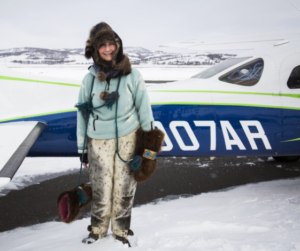
The Cessna’s tail number N907AR is a personalized number, indicating the 907 area code and A.R. for Alice Rogoff. These can be ordered specially from the FAA. The airplane was manufactured in 2014, according to the FAA, and it appears she purchased it new.

According to the website Trade-a-Plane.com, a plane of this quality, in airworthy condition, is worth as much as $400,000.

Close-up shot of the Cessna 206, tail number N907AR at Campbell Lake.

Rogoff is reported by Alaska aviators to be taking “dual lessons,” with a flight instructor on board to regain her seaplane certification, which she lost after a crash in 2016. One pilot looking at the footage said that the “go round” was the only good decision that appeared to be made by the pilot.

Alice Rogoff in Unalakleet with a Cessna with tail number partially visible in this undated photo.

Rogoff crashed a Cessna floatplane nearly a year and a half ago while attempted to land in Halibut Cove, Alaska.

The wealthy East Coast transplant, who purchased the Anchorage Daily News in 2014 and merged it with the Alaska Dispatch News that she had purchased years earlier, declared her newspaper empire bankrupt in August of this year.

She is still in litigation with her former business partner, Tony Hopfinger, who says she owes him $900,000. Many others are awaiting payment from her; the liens against against Rogoff are in the millions of dollars.

The Alaska Dispatch News changed hands this week after the sale was approved by a bankruptcy judge.

It is now owned by the Binkley Company of Fairbanks in a deal set to close today. The remainder of her assets are likely headed for a Chapter 7 bankruptcy, and creditors such as GCI and Arctic Partners have filed documents to try to “pierce the corporate veil” and get to her personal assets to recover the money she owes them.

[Read: Lawsuits, liens, and asset filings]

Mayhem City: Berkowitz backs away from ‘very safe city’ remark

5

“But if you’re not engaged in drug trafficking and not out after midnight, it’s a very safe city” – Mayor Ethan Berkowitz

And thus, the mayor of Anchorage set a suggested curfew for his citizens: Just don’t go out after midnight, he advised. It was not a comment taken out of context.

It was, however, just the kind of thing this mayor tends to say, like the time he was asked about North Korea’s aggression and he said he was more concerned about moose and bears than North Korean missiles.

Mayor Ethan Berkowitz is just flippant like that and his supporters cut him a lot of slack. This time, though, he hit a raw nerve. Even diehard Democrats don’t like being robbed, hijacked, or murdered.

Berkowitz took to Facebook today to walk back his statement that it’s a very safe city if you’re not out after midnight.

One woman’s response on Facebook was echoed throughout social media:

NOT acceptable! My city is NOT safe! I get up regularly through the day (and night) to check to see if my vehicles have been stolen. I can’t go shopping to multiple areas in town in one stop because you can’t leave packages in your car. We MUST do something to take our city back. I am willing to put in the work to make it happen – ideas?

The mayor was contrite, once the furor had grown to a roar:

“First, I did not express myself clearly and apologize for an insensitive comment,” Berkowitz said in his Facebook clarification.

“To clarify, whether noon or midnight, I and APD work all day every day to keep our city safe and secure. We have brought back and expanded foot patrol, emphasized community policing, and dedicated staff to communicating with residents and neighborhoods. We will continue to work hard to address crime in Anchorage, keeping all Anchorage residents safe at all hours of the day and night. We have grown Anchorage’s police force to over 400 officers, demonstrating our tireless commitment to keeping Anchorage safe,” he said.

Berkowitz made his first remark in the hours following a triple homicide at a business called The Bullion Brothers — murders which were evidently was committed during business hours.

The second remark — his clarification fell short for some. It wasn’t an apology, and it was really more about him and all he had done, than about the concerns of a worried citizenry.

The killings brought the murders in Anchorage to 28 this year. At this time last year, there had been 25 — and that was a record. In 2016, 34 murders were documented.

“What the Hell is going on here in Anchorage, so many post of stolen car and truck, 4 wheelers etc. We all need to watch out for this and fight back. Not let these criminals get away with the S**** ! So sorry, hope you get your truck back,” – a comment typical of those posted in Anchorage in the past few days.

Others talked about taking the law into their own hands, and on the Dave Stieren show, discussion centered on arming oneself and taking concealed weapons classes:

I bought bullets for my gun today. haven’t had it loaded in over 5 years as the only thing I’ve ever used it for was target practice. I’d hate to aim at a human but I don’t want to be the victim. – Anchorage resident posting on NextDoor, Campbell/Taku area

Others have already done so, sleeping with guns ready in neighborhoods not normally prone to break-ins. One South Anchorage resident posted this account on NextDoor:

Two nights ago someone was in my backyard, which is fully fenced with a six foot cedar fence. My husband was out the door, gun in hand but they hid from him in the dark. I hate that we even have to sleep with our guns loaded on the nightstands but I’m so darn sick and tired of this crap. I’m all for a neighborhood watch in my neighborhood and will participate to get my streets clean. – Anchorage resident posting on NextDoor, Campbell/Taku area

And over near the University, residents have set up security cameras and are posting the video on Facebook, prompting others to ask for recommendations:

This thread has convinced me I should get some security cameras ?Can my friendly, vigilant neighbors recommend some inexpensive, easy to install (wireless with a phone viewing app, perhaps?) options? I can contribute footage of happenings on [street name redacted] to our virtual patrols! – Posted on Facebook

And still others were recommending the importance of installing security devices on vehicles:

I just want to share what a HUGE difference it makes to install some sort of GPS tracking device in your vehicle. There’s several small, low profile options. Last week APD was able to catch car thieves red handed, spray paint still dripping off the hub caps within an hour of stealing the vehicle. Even then the thieves had the time to remove the rack, take all the tools out and start making alterations to the vehicle in an alleyway. In finding the truck, they also found two more stolen motorcycles and a truck that’d been stolen in late 2016. Please consider investing in a GPS!! – Facebook responder

We’re in an Anchorage not seen before, where violent crime and property crime is epidemic, day and night.

Berkowitz the candidate had a different take on crime back in 2015:

“I am honored to receive the support of Anchorage Police Officers,” he wrote on Facebook while running on a “safe, secure” platform. “As mayor I will bring back the drug, gang and theft units, implement community policing, and hire more officers to keep the city safe.”

The City of Mayhem is still waiting, two years later. And it’s only gotten worse.

Facebook’s Chris Hughes in Alaska, squired around by Begich’s Democrat operative

6

The cofounder of Facebook, Chris Hughes, will be in Alaska on Thursday. Jim Lottsfeldt, of Lottsfeldt Strategies and Midnight Sun AK political bog, is taking him around and introducing him to various Democrats in Anchorage, Lottsfeldt announced in his blog this morning.

Hughes is the second Facebook heavyweight to come to Alaska, after Mark Zuckerberg visited in midsummer to vacation and explore how the Alaska Permanent Fund provides what he is calling a “basic income” for Alaskans.

Zuckerberg and Hughes are both proponents of the basic income concept.

[Related: Facebook’s tax is far lower than the average taxpayer. Company moves funds out of U.S.]

On Friday, Hughes will be the featured speaker at the University of Alaska Anchorage at 9:30 a.m., in Rasmuson Hall. He’ll also be meeting with Lottsfeldt-picked rising leaders in Anchorage, whom Hughes will be speaking to about the Economic Security Project, also known as the basic income guarantee.

On Facebook yesterday, Hughes foreshadowed his visit by writing about how Hillary Clinton was looking at Alaska as a model for basic income:

“Hillary Clinton thinks she should have spent more time considering a basic income in America. An excerpt from the book out today:

“Before I ran for President, I read a book called With Liberty and Dividends for All: How to Save Our Middle Class When Jobs Don’t Pay Enough, by Peter Barnes, which explored the idea of creating a new fund that would use revenue from shared national resources to pay a dividend to every citizen, much like how the Alaska Permanent Fund distributes the state’s oil royalties every year. Shared national re“resources to pay a dividend to every citizen, much like how the Alaska Permanent Fund distributes the state’s oil royalties every year. Shared national resources include oil and gas extracted from public lands and the public airwaves used by broadcasters and mobile phone companies, but that gets you only so far. If you view the nation’s financial system as a shared resource, then you can start raising real money from things like a financial transactions tax. Same with the air we breathe and carbon pricing. Once you capitalize the fund, you can provide every American with a modest basic income every year. Besides cash in people’s pockets, it would also be a way of making every American feel more connected to our country and to one another—part of something bigger than ourselves.

I was fascinated by this idea, as was my husband, and we spent weeks working with our policy team to see if it could be viable enough to include in my campaign. We would call it “Alaska for America.” Unfortunately, we couldn’t make the numbers work. To provide a meaningful dividend each year to every citizen, you’d have to raise enormous sums of money, and that would either mean a lot of new taxes or cannibalizing other important programs. We decided it was exciting but not realistic, and left it on the shelf. That was the responsible decision. I wonder now whether we should have thrown caution to the wind and embraced “Alaska for America” as a long-term goal and figured out the details later.”


When Mark Zuckerberg visited Alaska, he wrote extensively about the Permanent Fund dividend as an example of basic income. Must Read Alaska covered his visit here.

Hughes purchased the left-of-center The New Republic magazine in 2012. The former editor wrote of the magazine wrote this about him in the Atlantic Monthly:

“Then, in 2012, Chris walked through the door. Chris wasn’t just a savior; he was a face of the zeitgeist. At Harvard, he had roomed with Mark Zuckerberg, and he had gone on to become one of the co-founders of Facebook. Chris gave our fusty old magazine a Millennial imprimatur, a bigger budget, and an insider’s knowledge of social media. We felt as if we carried the hopes of journalism, which was yearning for a dignified solution to all that ailed it. The effort was so grand as to be intoxicating. We blithely dismissed anyone who warned of how our little experiment might collapse onto itself—how instead of providing a model of a technologist rescuing journalism, we could become an object lesson in the dangers of journalism’s ever greater reliance on Silicon Valley.”

Others are not so laudatory. Hughes was featured in the Daily Beast in 2014, along with his partner, as America’s “worst gay power couple.” The article called them “entitled brats.”


Mallott says petition for salmon priority not constitutional

1

Backed by an 8-page opinion by the Alaska Department of Law, Lt. Gov. Byron Mallott turned down an initiative on Tuesday that would have prioritized salmon streams and tributaries over all other competing economic interests across Alaska.

The petition request had come from Stand for Salmon, chaired by Michael Wood of the Susitna River Coalition.

Attorneys in the Department of Law said the Stand for Salmon initiative was contrary to the Alaska Constitution, which prohibits initiatives that make an appropriation of state assets.

State assets, according to the State attorneys, include state resources such as anadromous waters, which means salt or fresh waters where fish spend portions of their lives. In Alaska, that’s salmon primarily, but also rainbow and cutthroat trout.

Stand for Salmon issued a press release on Tuesday that expressed surprise and dismay, and also took direct aim at the Walker Administration: “We were dismayed to hear today from the Walker Administration that they have denied our application for a ballot initiative that proposes an update to Alaska’s antiquated law governing development in salmon habitat. The Stand for Salmon ballot initiative would promote responsible resource development while creating clear standards for protection of Alaska wild salmon and ensure Alaskans have a voice in the management of our wild salmon resources.

“We are deeply disappointed that Governor Walker’s administration has chosen to play politics and cater to the short-term interests of outside, multinational mining companies instead of Alaskans and the salmon we depend on. Thousands of Alaskans support this update.

The decision to deny us our constitutional right as Alaskans to gather signatures and put this issue before voters is stunning, particularly from a governor who once promised to support fish first policies. Instead, Governor Walker and Lt. Governor Mallot [sic] have done next to nothing to uphold their promises to Alaskans who depend on salmon for jobs, culture, recreation and way of life. The merits of our application should have been based purely on the law. Yet, the relentless lobbying and pressuring from corporate representatives and lawyers seemed to carry more weight than the integrity of the public process.” – Stand for Salmon

“The Stand for Salmon campaign will continue evaluating all of our options moving forward. We, and thousands of Alaskans who are deeply invested in the future of our state, remain 100% committed to modernizing our outdated salmon habitat law. In a moment when our state is desperate for some long-term thinking and leadership, we are handed this disappointing decision that smacks of the status quo,” the organization wrote.

But the Department of Law’s decision said that the initiative would clearly limit the Alaska Legislature’s ability to decide how to allocate the waterways when there are competing uses. In addition, it would end the development of many mines, dams, roads, gaslines and/or pipelines.

The stern rebuke by Stand for Salmon may signal an end to the alliance between environmentalists and the Walker Administration. The decision was surely a topic of discussion in the Mark Begich camp. The former U.S. senator, a Democrat, is pondering jumping into the race for governor in 2018, ensuring a three-way race that would weaken Walker’s chances of re-election.

[Read: Initiative decision due today; what will lieutenant govenor decide?]

Breaking: Rep. Mike Chenault files letter of intent for governor

7

Rep. Mike Chenault, who has served in the House of Representatives since 2001 and was the body’s longest-serving Speaker, has filed a letter of intent to run for governor.

Chenault stepped down from the speakership after four terms in 2017, and the House reorganized under Democrat leadership with Bryce Edgmon.

Born in New Mexico, he moved to the Kenai Peninsula as a child, graduated from Kenai Central High School, and started a career in construction. He was president of the North Peninsula Chamber of Commerce.

He represents House District 29, which is the eastern Kenai Peninsula from Nikiski to Seward.

He told Must Read Alaska that filing his letter of intent would allow him to gauge support around the state for a candidacy.

“I am looking at all the options to see if the support is there to run for Governor in 2018,” said Chenault, in a statment released this afternoon. “I’m not satisfied with the direction of the current administration and where the state is headed. We need to resolve our fiscal issues, create a climate where businesses can thrive, and continue to develop an educational system that will enable our children to learn and be part of our future work force.”

Earlier today, former Sen. Charlie Huggins filed a letter of intent and Sen. Mike Dunleavy suspended his campaign for governor.

(Must Read Alaska is in travel status in Fairbanks and will update this story.)