Grace Jang, the governor’s Deputy Chief of Staff, will be flying to Juneau this week, Must Read Alaska has learned, in order to embed Walker’s political employees into the classified, nonpolitical positions open in State government.
With just six weeks to go until nearly all political appointees lose their jobs on Dec. 3, Jang will be helping Walker Administration political appointees stay on. It’s called burrowing.
They may have to accept less pay and less prestige, but a paycheck is a paycheck, and many of them will be covered by union contracts, if they can find a spot. The hiring freeze hasn’t been enforced since the day it was announced in 2016.
A classified position, however, has a process, with personnel rules, and most of those jobs take time to fill.
If Jang farms someone out to an agency in an exempt position, that usually only lasts for a while.
If Walker’s functionaries try to game the system and shove people into jobs for which they are not qualified, they may bump up against disgruntled personnel managers who report them.
But they have two extra weeks to try to help these workers keep jobs that they need to pay rent, feed their families, and make their car payments. There are 42 days left until the new administration takes over.
The maneuvering is fairly easy to detect in this day and age. Bruce Botelho, who provided transition services for the Walker Administration in 2014-2015, was able to eradicate nearly every exempt employee who had ever been near a Republican.
Not counting the support staff, about 25-35 people will need to find new work. Including the regional offices, the turnover could be as high as 60.
A staff meeting for the Governor’s Office is scheduled for Friday to discuss re-jobbing.
For those in Juneau, finding other employment is difficult because it’s a town with one major employer — the State of Alaska. But the exempt employees are spread across the state in Anchorage, Mat-Su, Fairbanks, and also in Washington, D.C.
If Mark Begich is elected, many of those workers may remain, although they may be shuffled to new jobs.
For example, Leslie Ridle, commissioner of the Department of Administration, is a close ally of Begich; she was his chief of staff when he was a senator.
Within hours of Gov. Walker announcing on Friday that he was not running for re-election, Ridle changed her Facebook profile picture to include a pitch for Begich, and likely she has been in conversation with him about a new role:
In addition, Must Read Alaska has learned that the Governor’s Office staff and exempt employees in departments will be traveling to rural Alaska extensively over the next two weeks and will use the travel time to campaign for Begich on or off state time.
Must Read Alaska will be pulling travel records to monitor how state dollars are being spent in the coming weeks.
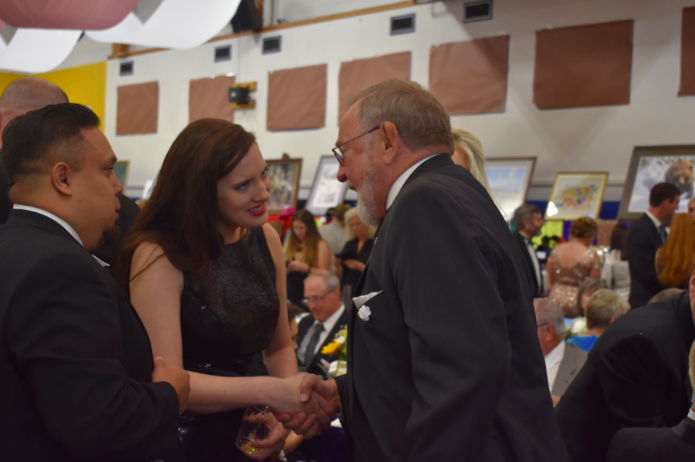
We asked Must Read Alaska newsletter readers to send us photos of them shaking hands with Congressman Don Young, who is known to have a firm handshake, even at his “Young” age of 85.
He’s always believed in a firm handshake and admonishes men to “Take your hands out of your pockets!” and shake hands with people.
Here are some of the photos that poured in this morning, followed by the one person who couldn’t seem to get the handshake quite right:
Normal, with bolo.
Normal with suspenders.
Normal with Standing Tall Guy, and Abraham Lincoln photobombing.Normal, starstruck.Normal, with rock star.
Normal, plus neckties.Normal, with little black dress.Normal, with shovel and MAGA hat, and Ann Young.Normal, with cool future leader.Normal, with dreamcatcher.
ALYSE GALVIN HAS AN ENTIRELY DIFFERENT REACTION TO DON YOUNG’S HANDSHAKE
The Democrats’ challenger to Don Young shook his hand after the AFN debate last week, and then yelled at him “That hurts! That hurts!” Her shout was picked up by the microphone, and she was irritable with Young, even while he apologized.
RUNNING AGAINST TRUMP HAS BEEN BEGICH’S PLAY SINCE AUGUST
Charles Wohlforth had it right in the Anchorage Daily News, and he should know. After all, he went to high school with Mark Begich.
On Sept. 13, Wohlforth wrote about how a discouraged Begich dug deep into his emotional reservoir and stayed in the campaign for governor, against all odds. He did so by returning to his far-left roots.
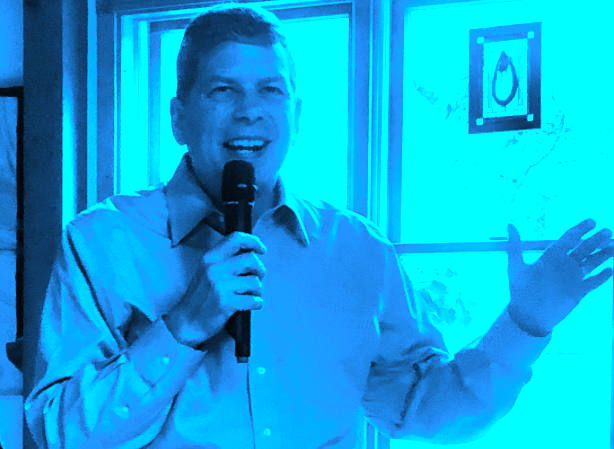
Begich was at a campaign fundraiser at the home of Sen. Berta Gardner, and he was losing his voice. But he was inspired by the women gathered there to hear him. Someone took a fuzzy phone video of him speaking candidly and from the heart.
Wohlforth tells the story:
“Begich, who had almost lost his voice, abandoned campaign talking points and spoke against President Trump and for living wages and child-care support,” Wohlforth wrote.
“The reaction to the video and his own emotions after his unfiltered comments convinced him to stay in the race and remade his campaign. Now Begich hopes to catch on as anti-Trump Democrats have in other parts of thecountry, using social media to activate disaffected voters and true believers.”
According to Wohlforth, Begich was somewhat demoralized in August. His campaign, launched on June 1, had not caught fire and he had not won the important union endorsements he had hoped for.
“Speaking to Alaska Women for Political Action, in Sen. Berta Gardner’s East Anchorage yard, he said, ‘Part of the job of a governor also is to speak out when a president is wrong, because it affects us all. You cannot be silent. You cannot sit there and hope it all works out.'”
And so he tacked hard left, and began running against President Trump, and against the business community. He went for the LGBT vote, and the Stand for Salmon environmentalists. Walker opposed Ballot Measure 1, so Begich would have to be for it.
“But now Begich is speaking a new language, one that hasn’t been heard much from mainstream statewide campaigns in Alaska: Attacking a Republican president, supporting Proposition 1 to protect salmon habitat, and emphasizing support for the working poor,” Wohlforth wrote, approvingly.
Donald Trump won Alaska by a mandate in 2016. Some 51.28 percent of the vote was for Trump, while Hillary Clinton received just 36.55 percent, a 15-point difference. Running against Trump is risky.
There was one thing Begich had no idea would happen back in August when he tacked to the “resist” vote: He had no idea that Gov. Bill Walker’s race would melt down just three weeks before the General Election.
Now that Begich is the nominee of the Democrats, and now that Walker has dropped his bid, Begich will attempt to drive his message back to the center in hopes that the centrists won’t remember what he said last summer.
It might be too late for that — the funds that have poured into the Mike Dunleavy campaign have given the Dunleavy team a shot in the arm so they’ll be ready for Begich’s trick shot over the bow — whatever it is and whenever it comes.
Meanwhile, the Alaska Democratic Party has little cash on hand to help the Begich effort. The Democrats are down to about $67,000, and have no time to raise the money they’d like to give to the Begich effort, as well as support all their other campaigns statewide. The ADP could probably muster $104,000 for Begich if they swept out all the cupboards and starved the state races of support they need.
BEGICH, THE TRUE PROGRESSIVE
Wohlforth, a left-leaning columnist who mainly sticks to the high ground, seemed giddy to see Begich abandon his faux centrist persona and become the person he really is: The anti-oil guy who has had four fundraisers in Alaska for fellow anti-oil senator Maria Cantwell.
Begich has revealed himself to be the anti-business candidate, badmouthing Walmart, Costco, and Lowes for not paying their workers what Begich thinks they should be paid.
“Begich is having fun. He is enjoying channeling the values of liberal Alaskans who usually have to compromise when they vote. Whether there are enough of them to win an election I don’t know, but I don’t think Begich will drop out now. He feels he is part of a movement,” Wohlforth wrote.
Liberal Democrats running in red states, but sticking to their progressive talking points, is a bold play. In Texas, Sen. Ted Cruz is fighting off a challenge from Democratic Rep. Beto O’Rourke, who raised more money in three months than any Senate candidate ever has. In Alaska, Alyse Galvin is a no-party candidate, but her talking points come straight from the Democrats.
In Alaska’s governor’s race, Dunleavy is still ahead by several points, although with Bill Walker out of the race, the calculation is refiguring.
Alaska hasn’t elected a Democrat as governor since 1998, and those were very unusual circumstances that included a write-in campaign from Robin Taylor and a scandal that developed around John Lindauer (he was using his wife’s money to fund his campaign and under campaign laws that was illegal).
BEGICH GOES FOR WALKER VOTES — BUT WILL THEY MOVE OVER?
Complicating matters for Begich is that he and Walker were fighting over the same votes, and with Walker’s name still on the ballot, they still are fighting over the same votes.
In fact, after Walker’s full-throated apology to the entire Native community last week, Alaskans might understand why many Natives will vote for Walker out of gratitude, or simply because he is was “done wrong” by Mark Begich.
That means significant Begich campaign resources will have to be spent just telling people not to vote for Walker, even though his name remains as a choice for voters.
Even Walker and his entire family will likely vote for Walker come Election Day, and so will some of the Walker loyalists who are mad at Begich for jumping in the race in the first place. Convincing them to come over to the candidate who destroyed Walker’s chances isn’t going to be that easy.
Walker will steal votes from Begich. Even a dead man can get votes when it’s that close to an election. On Oct. 16, 1972, the plane carrying Alaska Rep. Nick Begich disappeared, but he still won the election three weeks later, 56 percent to Don Young’s 44 percent.
And Dunleavy will certainly inherit a block of the centrists votes that Walker had. Some people will just never vote for a Begich.
Early voting started today, just three days after Walker dropped out of the race, and the lines are long. Voters are engaged and have made their decisions. This election is on now. People are not waiting until Nov. 6 — they’re ready to fill in the oval today, if the lines are any indication.
Remember the Politico story that identified campaign strategist John-Henry Heckendorn as the Democrats’ wunderkind of the north, turning the red state of Alaska purple without voters realizing what was happening?
Heckendorn, Rep. Jonathan Kreiss-Tomkins, and Forrest Dunbar recruited Democrat Zach Fansler to run against Rep. Bob Herron in Bethel, and Dean Westlake to run against Rep. Ben Nageak.
Two good family men were taken out by “Shades-of-Gray Fansler” and “Wandering-Hands Westlake.”
The political operatives for the Democrats recruited Justin Parish to run against moderate Republican Rep. Cathy Munoz in Juneau, because she was, they said, soft on crime; she asked for a judicial review of a constituent’s sentence.
It’s all coming back, isn’t it?
How to Turn a Red State Purple was a fawning story about pretend independents that fooled Alaska voters into thinking they were not Democrats, like Jason Grenn, District 22, who is featured prominently in the publication’s cover art:
Turns out, Heckendorn, Dunbar, and Kreiss-Tomkins brought a posse of playboys to power — randy men who then fell to earth spectacularly due to their misbehavior: Reps. Fansler, Dean Westlake, and Justin Parish.
Now, Bill Walker and Byron Mallott were taken down by … their own behavior, as it turns out, with Heckendorn steering the campaign. Mallott was caught in a sordid series of events that the Administration has chosen to cover up to protect the “victim.”
Heckendorn ran the Walker-Mallott campaign into the Twilight Zone after jumping into the Walker Administration for a year of State paycheck as Walker’s embedded campaign guy on the State dime.
If there’s a Midas touch, is there something the opposite, such as a “Kiss Your Campaign Goodbye” touch?
Now Walker running mate Lt. Gov. Byron Mallott, the Democrat candidate for governor four years ago who abandoned his party to join Walker on an independent ticket in order to oust incumbent Republican governor Sean Parnell, has resigned his office and severed his relationship with the incumbent governor.
Why?
Walker isn’t saying much. Mallott has left the stage.
The incident appears to center on inappropriate sexual overtures and inappropriate sexual comments, but no one in the governor’s office has explicitly said this. The entire incident has transpired behind something of a veil.
Mallott’s letter of resignation didn’t even say if there was a woman involved. Instead it referred to a placing “a person whom I respect and revere in a position of vulnerability.”
The vulnerability phrase would appear to indicate Mallot suggested that if the “person” didn’t cooperate, there would be consequences. There is no hint of what those might be, although Walker administration officials have said no state employees were involved so apparently the loss of a job or the loss of an opportunity for a job can be scratched from the list.
The mainstream media has reported little more on this story than the official statements coming out of Walker’s office, but there is plenty of talk in political circles and among old Mallott friends about what happened. The name of a Fairbanks woman involved in law enforcement has come up repeatedly.
For two days now, craigmedred.news has tried to reach her. She has been repeatedly queried about any possible involvement. She has not responded.
SHAPE-SHIFTING GOVERNOR WALKER BENDS ONE LAST TIME — INTO A DEMOCRAT
Last week was the strangest week in Alaska politics since the Department of Justice helped Mark Begich defeat U.S. Sen. Ted Stevens in 2008.
Last week was even weirder than early July, 2009, when Gov. Sarah Palin resigned.
Even the trick-or-treat ticket of Gov. Bill Walker and Byron Mallott, created by unions and Democrats after voters had already chosen their nominees during the 2014 primary election, isn’t as weird as this year’s gubernatorial careening path, which Walker-Mallott went down.
IN THE WAY-BACK MACHINE
Walker’s Chief of Staff Scott Kendall asked the Republican Party late in 2017 and again early in 2018 if Walker would be allowed to run for re-election as a Republican.
The party said, “It’s a free country, but we wouldn’t think it would be successful.” In fact, party Chairman Tuckerman Babcock said that the Republicans “might be hot, but certainly wouldn’t be warm to the idea.”
By February Walker decided to remain a no-party guy. He’d be “independent.”
Walker went to Washington, D.C. in February to get the Unite America money behind his no-party run. He already had the endorsement of the Centrist Project, because he was a “role model for our movement.”
But then, Walker dumped on the Centrists. In May, he announced he’d jump onto the Democrats’ ballot. The Democrats had changed their rules to allow him to do so, even without changing his party registration.
The Democrats’ primary looked like the most likely way to ensure a two-way gubernatorial race, Walker’s campaign manager John-Henry Heckendorn said. They feared Mark Begich would get on that ticket.
But it turns out that Mark Begich was more clever than Heckendorn and Walker combined.
Byron Mallott shakes the hand of Bill Walker in this Sealaska Corp. photo. The two received the endorsement of Sealaska, and $100,000 into their super-PAC, Unite Alaska for Walker-Mallott in September of 2018.
By June 1, Begich was having none of it, and filed for governor on the last day possible. He wasn’t going to let the Democrats put a shape-shifter like Walker at the top of the Democrats’ ticket again.
And when that happened, Walker decided not to complete the paperwork to join the Democrats’ ballot, but to become a petition candidate, and go straight to the General Election.
On Primary Election night, Aug. 21, Walker and Mallott walked into the Dena’ina Center with their signs victorious, even though they had not chosen to participate in the primary.
“We’ll see you on the November ballot,” they proclaimed. It was theater. They delivered their petition signatures with just as much theater.
The ballots were printed, with three tickets: Mike Dunleavy-Kevin Meyer are the Republicans, Mark Begich-Debra Call are the Democrats, and Bill Walker-Byron Mallott are the unknowns who got to the General via signatures gathered.
Both Walker and Begich began pounding on Dunleavy, criticizing him for not showing up in every debate they scheduled. Dunleavy stayed above the fray, but took a beating from them, even while absent from their near-daily cage fights.
As voters start voting on Monday, the ballots still say Walker-Mallott is a choice, but Walker has a new lieutenant governor — Valerie Davidson. Mallott has cleaned out his desk, sent home in shame.
Yet, Davidson could not campaign because she is not a registered candidate with the Division of Elections and Alaska Public Offices Commission.
She cannot raise money.
She cannot receive money from the Walker campaign for campaigning because she is covered by the Executive Ethics Act, as a state official. She can’t take gifts.
The situation was untenable for Walker. He was still running, after all, with Mallott.
The man whom Walker had identified as his best friend — 75-year-old Mallott — had been improper with a 16-year-old girl. There was no recovering from that. Walker was going to slip from second place to third place and likely the worst showing of a sitting governor in the history of the state.
So he did something he called “putting Alaskans first.” He characterized it as an act of courage: He quit the race.
In his swan song, Walker chose the most sympathetic audience of all — Alaska Federation of Natives annual convention. It was a convention for the ages, with a political spectacle never before seen by the attendees.
On Thursday, Walker made a sweeping official apology to all Alaska Natives for historical wrongs committed against them. The convention goers were happy with that. Very happy. Things were going well for them.
But that evening, few AFN conventioneers attended Walker’s informational reception at the Anchorage Hotel downtown, even though he had just made the biggest overture for Alaska Natives of his career — a full-throated “We’re sorry” on behalf of the State of Alaska. Those who did attend seemed to sense uncertainty in the air.
On Friday, Walker made a surprise appearance — his final announcement. He was suspending his campaign because there was no way to recover after his disastrous week. The three-way race was mathematically bad for him and getting worse.
In doing so, he went from being a lifelong Republican in 2014 to endorsing Democrat Mark Begich in 2018.
Begich, the most reviled Democrat out there for any red-blooded Republican, had just pulled off a coup. Walker, in an act of final defiance, was going to stick it to Republicans one more time.
All the endorsements Walker had were not enough to save him: AFL-CIO, National Education Association of Alaska, Alaska State Employees Association, Sealaska Corporation, Alaska State Firefighters Association, Alaska District Council of Laborers, Painters and Allied Trades International, and Calista Corporation.
All the personal endorsements Walker had were not enough: Aaron Plikat, Anchorage • Adam Wool, Fairbanks • AJ Sutton, Fairbanks • Albert Kookesh, Juneau • Amanda Mallott, Juneau • Andy Holleman, Anchorage • Andy Mack, Anchorage • Andy Mezirow, Homer • Anthony Mallott, Juneau • April Ferguson, Anchorage • Arlene Simpler, Kodiak • Barbara Blake, Juneau • Barbara Donatelli, Anchorage • Bill Tatsuda, Ketchikan • Bob Hubbard, Fairbanks • Brenda L. Tolman, Whittier • Bruce Botelho, Juneau • Buck Laukitis, Homer • Carl Marrs, Old Harbor • Carpenters Local 1234, Fairbanks • Chris Dimond, Juneau • Cindy Roberts, Anchorage • Claudia Anderson, Kodiak • Cordelia Kellie, Palmer • David Guttenberg, Fairbanks • David McCabe, Anchorage • Don Gray, Fairbanks • Donny Olson, Golovin • Dorli McWayne, Fairbanks • Earl Krygier, Anchorage • Emily Edenshaw, Juneau • Eric Jordan, Sitka • Gail Schubert, Bering Straits • Geron Bruce, Juneau • Gordon Glaser, Anchorage • Greg Razo, Anchorage • Greg Wakefield, Anchorage • Heather Flynn, Anchorage • Heidi Drygas, Juneau/Fairbanks • Ian Fisk, Juneau • Ira Perman, Anchorage • Jack Hebert, Fairbanks • Jaeleen Kookesh, Juneau • Jamie Kenworthy, Anchorage • Jan Carolyn Hardy, Anchorage • Janet McCabe, Anchorage • Jason Grenn, Anchorage • Jeanette Wakefield, Anchorage • Jodie Gatti, Ketchikan • Joe Nelson, Yakutat • Karl Kassel, Fairbanks • Kate Wool, Fairbanks • Kathryn Scribner, Juneau • Kati Ward, Anchorage • Kes Woodward, Fairbanks • Linda Behnken, Sitka • Lindy Jones, Juneau • Liz Medicine Crow, Anchorage • Malcolm Roberts, Anchorage • Marc Wheeler, Juneau • Margy K. Johnson, Anchorage • Mark Schneiter, Anchorage • Marlene Johnson, Hoonah • Marna Sanford, Fairbanks • Mary Hakala, Juneau • Mary Hilcoske, Anchorage • Mary Jo Robinson, Anchorage • Mary Schulz, Ketchikan • Matt Hunter, Sitka • Meera Kohler, Anchorage • Melissa Borton, Kodiak • Mike Gallagher, Anchorage • Mike Kenny, Anchorage • Mike Navarre, Kenai • Mim McConnell, Sitka • Minoo Minaei, Homer • Miriam Aarons, Anchorage • Myra Munson, Juneau • Nancy Barnes, Anchorage • Pat Branson, Kodiak • Paula DeLaiarro, Anchorage • Plumbers & Pipefitters Local 375, Fairbanks • Raina Thiele, Anchorage • Reid Magdanz, Kotzebue • Richard Peterson, Juneau • Robert Gottstein, Anchorage • Sarah McCabe, Anchorage • Scott Eickholt, Fairbanks • Sheri Buretta, Anchorage • Steve Hovenden, Fairbanks • Stosh Anderson, Kodiak • Tim Sharp, Fairbanks • Tom Panamaroff, Kodiak • Tom Schulz, Ketchikan • Tom Simpler, Kodiak • Tom Wescott, Eagle River • Vicki Otte, Anchorage • Willie Hensley, Anchorage • Debra Syvertson, Wasilla • Samuel Dunham, Anchorage • Craig Kasemodel, Anchorage
All the community leaders’ endorsements were not enough: Nels Anderson (Soldotna) • Richard Benneville (Nome) • Bruce Botelho (Juneau) • Pat Branson (Kodiak) • Harry Brower (Utqiaġvik) • Clint Cook (Craig) • Tony Christianson (Hydaburg) • Bert Cottle (Wasilla) • Vern Halter (Mat-Su) • Luke Hopkins (Fairbanks) • Matt Hunter (Sitka) • Mark Jensen (Petersburg) • Reggie Joule (Northwest Arctic) • Karl Kassel (Fairbanks) • Ruth Knight (Valdez) • Clay Koplin (Cordova) • David Landis (Ketchikan) • Georgianna Lincoln (Rampart) • Henry Mack (King Cove) • Will Mayo (Tanana) • Mike Navarre (Kenai) • Richard Peterson (Prince of Wales) • Pat Pletnikoff (Saint George) • Ralph Wolfe (Yakutat) • Bryan Zak (Homer) • Freddie Olin, Anchorage.
And all the money he raised was not enough: Walker raised nearly $580,000 in his campaign account, and Unite Alaska for Walker-Mallott, the super PAC, had raised over $1 million in early October, mostly from unions, but also from hundreds of Alaskans, mostly Democrats. In all, there was $1.6 million in the Walker-Mallott side of the battle, while Mark Begich barely broke $200,000.
At AFN on Friday, it was a self-pitying speech, and it was the most partisan speech possible. AFN leaders didn’t have time to reflect and make a sound decision about how much endorsement time they should give this sitting governor, but this was clearly history. He had just apologized and he was basking in the glow. They were caught flat-footed, and he took the liberty of giving full-throated praise to Mark Begich, and a stinging rebuke of his main opponent and the leading candidate, Mike Dunleavy.
This, even though it was Begich who muscled him out of the race, while Dunleavy was merely the teacher from rural Alaska with a conservative platform.
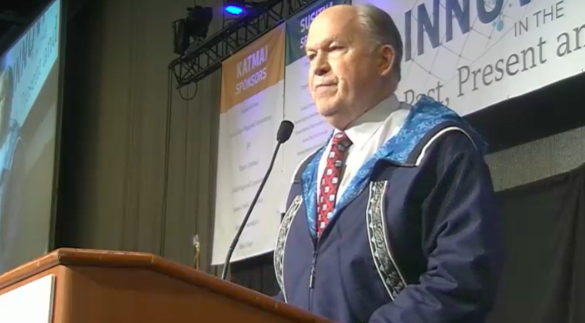
Gov. Walker and Lt. Gov. Valerie Davidson at AFN on Friday, while Walker announces he is suspending his campaign and throwing his endorsement to Mark Begich.
Walker choked his way through the written statement he had prepared Friday; the audience was clearly moved, emotionally in his corner. They sang for him, prayed for him (led by First Lady Donna Walker) and gave him gifts.
THE CAMPAIGNS SHIFT
Now, the battle is joined between Democrat Mark Begich and Republican Mike Dunleavy. There is no “Unity Ticket,” that the Democrats lauded in 2014. Unity tickets only happen once. There is only Republican and Democrat now.
Begich had the advantage because he knew what was coming. He had been negotiating with Walker for weeks. His machine is in place — half of his old senatorial staff is embedded in the Walker Administration. He knows what money is coming his way to fight for his message.
And what is the Begich message?
When he entered the race, he tacked far to the left. The unions lined up for Walker, so Begich had to go for the LGBTQ endorsement, which he did; and he had to endorse the Stand for Salmon ballot measure to get the environmentalists, which he did.
He came out strongly for Ballot Measure 1 only because Walker had stood against it. Now, he is changing his message: He meant that people should be allowed to vote. He will become the shape-shifter, now that Walker is gone.
Begich is the man who brought Sen. Maria Cantell to the state for fundraisers for her campaign. Cantwell has been one of the biggest opponents of opening up ANWR’s coastal plain for oil exploration, and who represents the interests of out-of-state commercial fishing entities.
Begich is the man who used the dirtiest campaign commercial in Alaska history to try to preserve his Senate seat after Dan Sullivan challenged him on the Republican side. Begich’s “Jerry Active” commercial went down as the worst campaign hit job of the 2014 races nationally, and he had to pull the ad because of the blow back.
Begich is the man who, it can be argued, was the deciding vote on Obamacare, and who still proudly claims that distinction.
A Begich governorship would mean many things for Alaska. He would be the first full-on Democrat since Tony Knowles, and he’d be far to the left of Knowles.
In a three-way campaign, Dunleavy was favored to win by what would be a landslide. But a two-way race has to be taken more seriously, when Begich is the opposition.
There is no more vicious knife than Mark Begich during a campaign knife fight.
With just 16 days until Nov. 6, this will be a battle royale between a non-establishment Republican who spent 19 years in the Arctic, rural Alaska, and a very-establishment Democrat from the suburbs of Anchorage, who has spent a lifetime in politics.
Who will be the next governor: A red-blooded Alaskan or a blue-blooded legacy Democrat?
Alaskans are in for a wild and wooly election on Nov. 6.
Even after years in this business, we are stunned to read that Gov. Bill Walker’s office actually is asking the news media to back off covering Lt. Gov. Byron Mallott’s rushed, secret resignation and the incident – whatever it was – that forced it.
In most parts of the nation, with real news media, that would be like waving a red flag in a bull’s face.
In a long Facebook post, reported by Must Read Alaska, Deputy Chief of Staff Grace Jang leaped to support Mallott. Jang was a broadcast journalist who covered Walker’s campaign and ended up his communication director.
Her inartful Facebook piece was designed to appear as a defense of Mallott’s victim(s), but was nothing more than a way to get the press to give Walker’s torpedoed re-election campaign a break.
“It’s been a tough week for my boss and our whole team,” Jang wrote. “We love, cherish and respect Byron. He made us laugh. He provided perspective. He advocated for voices not at the table. I miss seeing him in the office, hearing his stories and joking with him.”
I ran for re-election because I still believe that, more than anything else, Alaska deserves integrity, honesty, and courage.
Alaska First is, and cannot only be, a campaign slogan. When I said I ran for governor to do the job, not make the decisions to keep the job, I meant exactly what I said. Every decision I have made as your governor, I have made on the basis of what I believe is best for Alaska.
With that said, effective today, I am suspending my campaign for re-election as Governor. With more time, I am confident that Val and I could deliver a message and a campaign that could earn a victory in this election.
But there are only 18 days remaining before election day. Absentee ballots have already been mailed, and Alaskans are already voting. In the time remaining, I believe we cannot win a three-way race.
This week I have talked to many Alaskans to determine whether I or Mark Begich had a better chance of running a competitive race against Mike Dunleavy. The determination was made that, at this point, Begich has the better odds.
Alaskans deserve a competitive race. Alaskans deserve a choice other than Mike Dunleavy, whose record and campaign rhetoric indicate he will:
eliminate Medicaid Expansion that has provided healthcare access to 44,000 Alaskans, created jobs and brought $1 billion federal dollars into the Alaskan economy while decreasing State healthcare expenditures by $16 million, kept hospitals from closing, and saved lives;
defund the Alaska LNG Gasline project that has made historic progress, will create 12,000 high paying construction jobs, 88,000 direct and indirect jobs and deliver low cost energy to our homes and businesses;
undo the bipartisan approved sustainable fiscal plan that has resulted in fiscal stability, significantly reduced the deficit, improved our credit rating and preserved the PFD program into perpetuity;
cause our most vulnerable to suffer the brunt of the additional $1 billion in budget cuts he vows to make to education, rural Alaska and those receiving healthcare.
Moreover, my administration has worked tirelessly to improve the relationship between Tribes and State and restore respect for Alaska’s First Peoples in state government. Yesterday, I apologized on behalf of the State of Alaska for the wrongs committed against the Alaska Native people throughout our history, because I believed that was best for Alaska. My expectation is that this work critical to the healing of historical trauma and unifying all Alaskans will be undone in a Dunleavy administration.
On balance, it is my belief that despite my many differences with Mark Begich, his stance on the important issues I have listed above more closely align with my priorities for Alaska.
This is not the first difficult decision I have made this week, but it is one I know I must make. There simply are no words to express my deepest gratitude to the incomparable, dedicated team of outstanding Alaskans who have served in my administration and to the thousands of supporters, donors, volunteers and campaign staff who have been passionately committed to my re-election. And above all, I want to say thank you to my family and to Donna, my first lady for life.
As I said earlier this week, ultimately, it’s not how long my team and I serve, it’s how well we served the people and the state we love while the opportunity was ours. We have served with integrity, courage, devotion, and compassion, never asking ourselves whether a decision is politically correct but always asking if it is right for Alaska. I am proud of the work we have done in the most challenging fiscal crisis in state history and it is the honor of my life to have served as the governor of this great state.
Thank you, God bless you all, and may God continue to bless Alaska.
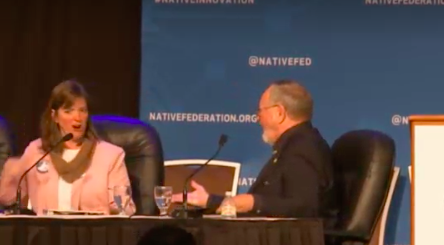
Alyse Galvin stalked off the stage after scolding Don Young for shaking her hand “too hard” subsequent to their debate at Alaska Federation of Natives.
“You hurt me! You hurt me!” she barked at him, well within range of the microphone, and then she hastily exited the stage without thanking the moderators.
“Ow,” she said, as she left the stage. Young had apologized, but she did not accept it. This was not one of her better performances.
To the viewer, the hand shake appeared to be normal, and Young is, after all, a strong 85 years old. Young appeared surprised at her dramatic exit, but he then got up from his chair and thanked the moderators before exiting the stage himself.
Galvin started out her debate performance by channeling her inner Sen. Elizabeth Warren: She adopted an accent reminiscent of Native Alaskans. Ethan Berkowitz also did this oddity of speech in 2010, and his strange new accent was remarked upon at the time as he ran for governor.
Galvin culturally appropriated the speaking pattern, slowly forming her words in a noticeable fashion, one that was not her usual style of speech.
“First. I. Would. Like. To. Acknowledge. That. We. Are. On. Dena’ina. Land. Today. And. Every. Day,” she started.
It was her best Native accent.
At times, she appeared on the verge of tears, with deeply flushed cheeks and quavering voice, while at other times, she forgot to speak in her idea of a Native accent, and lapsed into her normal Midwestern intonation.
Don Young was Don Young: Plain spoken, always making the case for why he is still the best congressman for Alaska.
Galvin suffered from some of the questions because she clearly was unaware that Rep. Young had sponsored a lot of the legislation that she says she supports — Indian Child Welfare Act, and the 8A program, which she was unable to articulate to the audience.
In fact, as Young pointed out, about 60 percent of the bills he works on are for Alaska Native interests. “Because I listen, because I work, and because I’m dedicated,” he said.
Alyse Galvin yells at Congressman Don Young after he attempted to shake her hand after the debate at Alaska Federation of Native.
But in spite of the emotional perfomance and the bizarre ending, she received a lot of applause from the same group that clapped hard later for Mark Begich, in his debate with Mike Dunleavy. It appeared to be an organized effort.