Tuesday, December 16, 2025
Home Blog Page 1553

Candidate accused by State of food stamp fraud

BEKAH HALAT CAMPAIGN IN PERIL AS DOCUMENTS SURFACE?

Bekah Halat, a first-time candidate running against Rep. Chris Birch for Senate Seat M (South Anchorage hillside), and her husband have been accused by the State of Alaska of food stamp fraud.

The State’s complaint is on two counts: The first is a Class C felony for theft of $750 to $24,999. The second is a Class A misdemeanor for misrepresenting the family’s income, according to court documents sent to Must Read Alaska. A search of online cases at CourtView confirmed the charges.

Halat’s husband, Jarek, is named in the complaint with the same charges. Their arraignment is Aug. 24, three days after the Primary election. That’s when they’ll plead guilty or not guilty.

Noteworthy in the State of Alaska’s complaint is that Bekah Halat “is running in the Republican primary.”

Why the State Department of Law finds it important to identify the party affiliation of the accused raises the question of this having been an accelerated interest to the state, or even a witch hunt.

But the accusation draws startling conclusions that bring her continued candidacy into doubt. She will, regardless, appear on the Aug. 21 ballot for the seat that is being vacated by Sen. Kevin Meyer, who is a candidate for lieutenant governor.

Bekah Halat has not returned messages to explain whether it’s a mix up, or whether she is the subject of false accusations by the State. She has not yet said if she is going to suspend her candidacy and focus on repairing her personal situation.

But it’s clear she has known about the pending legal action against her, since she has been interviewed by investigators in July.

The entire complaint is linked here:

Halat Class C Felony Charge

At the same time she was being interviewed by State of Alaska fraud investigators, a story and photo spread about her appeared in the Anchorage Press ,declaring her a new kind of Republican, not the “old white guy” type.

According to the State’s accusation, the Halats applied for the SNAP (food stamp) program in 2017. They had to go through an income certification process to determine if they were low income enough to qualify.

The maximum resource/asset limit for a family of four to qualify is $2,250, after Division of Public Assistance’s allowable deductions. The Halats’ were approved on March 2, 2017 and received $622 per month in food stamps for the household in 2017.

Their food stamp eligibility was based on having no income at all, and the State complaint says they would need to inform the division when Jarek’s unemployment benefits started. Jarek signed a document stating he understood, under penalty of perjury. It is not clear that Bekah signed the document. Applicants must sign a document stating they understand that if they provide misleading or false information, they could be criminally prosecuted.

For 2017, they received $7,374 in food stamps.

The couple had to be recertified in January, 2018. By then, Jarek was making $836 in unemployment insurance benefits and Bekah was working 15 hours a week, earning $20 an hour.

They were approved on Feb. 1, 2018. During the approval process, Jarek mentioned he was no longer working for Uber and Lyft as a driver. The State is saying that is the first time he had mentioned to the Division of Public Assistance that he had any income.

In 2018, the two received $2,296 in food stamps, from April through June, according to the State’s accusation.

Bekah Halat filed to run for Senate on May 31, 2018, announcing her candidacy on Facebook, launching a web site and quickly printing signs and t-shirts. Her signature issue was to repeal the “soft on crime” bill, Senate Bill 91. By then, her family had been awarded food stamps for over a year.

On June 20, 2018, an anonymous caller to the Fraud Control Division of the State’s Division of Public Assistance reported that Bekah had filed for office, was on assistance, and yet appeared to have sufficient income, and that the couple was committing welfare fraud.

The State opened an investigation immediately and did a deep dive into the Halats’ finances and bank accounts. The investigator examined her business licenses with the State and Jarek’s income stream.

Further, once the investigator reviewed Bekah’s campaign page, he noted that she had a campaign bank account at Alaska USA Federal Credit Union, but on the Halats’ SNAP application, they only listed one at Wells Fargo. The investigator found that they had four Wells Fargo bank accounts, and upon looking into matters at Alaska USA, he discovered the couple had other bank accounts, and they also had some small certificates of deposits.
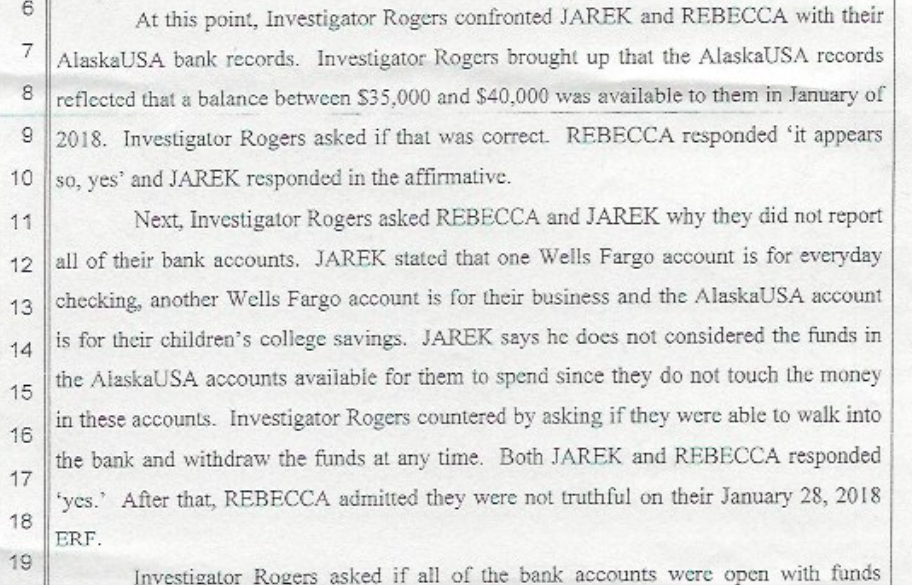
The State is claiming that during the entire time the family was on SNAP benefits, they were ineligible, due to being above the income threshold.

Must Read Alaska reached out to Bekah Halat but did not receive a return call.

Halat’s file at the Division of Elections shows she has lived in Anchorage since 2005. She has a B.A. in political science from the University of Alaska Anchorage, with a theater minor. She owns Bekah’s Dance Expressions, Super Beans and founded a nonprofit called Empowered Arts Alaska. She works at Business Boutique Training Center as the events and office coordinator, business trainer, and is a professional singer and songwriter, according to her file.

The State’s action is complaint, and comes with a felony charge, but it doesn’t represent guilt. Cases such as this are often pleaded down to lesser charges, but cases like this are also not usually laced with political intrigue.

Alaska Airlines plane stolen, crashed by suicidal man

1

MAN WAS FROM WASILLA

Hundreds of Alaskans were stuck in the Seattle-Tacoma International Airport on Friday night after the airspace around Seattle was shut down entirely for hours.

A Horizon Air Q400 had been stolen by a man who was later identified as a suicidal -29-year-old, who had taken off in the 76-seater turbo-prop that later crashed the plane on Ketron Island, west of Tacoma.

“I’ve never seen so many planes in one place,” said Jeremy Price, Alaska director for Americans for Prosperity, who was trying to get back to Anchorage after a business trip to New Orleans.

Price’s incoming jet circled for a long time, he said, until it got low on fuel and was landed at Sea-Tac. The pilot had announced the problem to passengers and said the jet might have to land at Boeing Field.

Two F-15s were scrambled out of Portland and were alongside the rogue plane within minutes to keep the plane away from populated areas.

By then, the plane was being piloted in stunt maneuvers such as a barrel roll, before the pilot said he would “call it a night,” and flew it into the ground. The F-15s were trying to steer it out over water.

The unauthorized pilot, identified as Richard “Beebo” Russell, was a ground service employee of Alaska Airlines, which explained his access to the plane. He is reported to have used a pushback tug to move the jet into position before he boarded and took off. No one else was on board. Pierce County Sheriff’s Department said that the FBI has taken over the investigation.

Anchorage former mayoral candidate Rebecca Logan’s daughter was also among the dozens of Alaskans who had just landed in Seattle; the Alaska Airlines jet she was on was stuck on the tarmac for an hour, Logan said.

“She texted me that they landed and asked me if Seattle is the place where there’s always a delay on the tarmac. And then she texted ‘OMG someone stole a plane.’ That’s when we turned on the news,” said Logan, who is president of the Alaska Support Industry Alliance.

Russell, in conversation with air traffic control, said “I’ve got a lot of people that care about me. It’s going to disappoint them to hear that I did this. I would like to apologize to each and every one of them. Just a broken guy, got a few screws loose I guess. Never really knew it, until now.”

Russell also said he was looking for a “moment of serenity,” and asked officials if the plane could do a back flip.

He also said, in jest, that he didn’t need help with landing the plane as he had played video games. And then he wondered aloud if Alaska Airlines would hire him as a pilot if he successfully landed the aircraft. Russell was married and left behind his wife and child.

His family, who calls him by his nickname “Beebo,” released a statement today:

Russell graduated from Wasilla High School in 2008, according to the Anchorage Daily News. He was a football player, wrestler, and thrower in high school and placed fifth in the discus throw in 2008 at the state track and field championships.

He attended  Valley City State University in Valley City, N.D., where he played football for a season.

Ketron Island is 221 acres and has a population of 17.

The video by John Waldron of the plane before it crashed can be found here:

https://www.facebook.com/search/top/?q=John%20Waldron

ANCHORAGE SMALL PLANE STOLEN, CRASHED IN TO BUILDING IN 2015

In December of 2015, a Cessna 172 was stolen from the Civil Air Patrol and was crashed into two buildings in downtown Anchorage, also believed to be a suicide. It was piloted by a licensed pilot and first lieutenant with CAP, but the man was not authorized to fly the plane at that time.

The pilot’s wife worked in one of the buildings struck by the plane, the Brady Building. She was not in the building at the time. The other building that was struck, the Carr-Gottstein Building, caught fire and sustained substantial damage.

Dunleavy campaign headquarters has open house today

0

Rainy day putting a damper on your plans?

Alaskans for Dunleavy holds an open house at its Anchorage headquarters Saturday this afternoon, 1-3 pm at 400 Northern Lights Blvd. Candidate for governor Mike Dunleavy will attend and yard signs and bumper stickers are available.

The campaign headquarters is one block away from another Dunleavy group of enthusiasts, named Dunleavy for Alaska. That group is headed by Terre Gales and is separate from the campaign, although is running an independent and robust operation to increase the name-recognition of the former state senator who is now the leading candidate for governor, according to polls from all of the candidates.

That office will also be open today, and people can stop by for their own version of Dunleavy signs, bumper stickers and pins. The campaigns are not allowed to coordinate their efforts and the candidate will not be in attendance there.

PRIMARY VOTING HAS STARTED

The Alaska Primary Election season has started, with early voting now available during weekdays.

Locations for early voting in person are here.

Out of town? You can receive a ballot through the mail if you apply by today, Aug. 11.

Instructions for mail-in voting are here.

Due to the threat of cyber attacks, such as the attempt on Alaska’s voting system in 2016, you won’t be able to submit an electronic ballot, although you can receive one by email. You will need to fax or mail it in.

Other dates to know:

  • Aug. 18: Regional offices open 10 am-4 pm for early and absentee in-person and special needs voting.
  • Aug. 19: Regional offices open 12 pm -4 pm for early and absentee in-person and special needs voting.
  • Aug. 20, 5 pm: Deadline to receive electronic transmission absentee ballot. applications from voters requesting an electronic transmission ballot
  • Aug. 21: Election Day.
  • Aug. 21: Absentee electronic transmission ballots being returned by-fax must be received by 8 pm.
  • Aug. 21: Absentee ballots being returned by-mail must be postmarked on or before Election Day.

As Alaska fire season winds down, Alaska crews head to help Idaho

0

ALASKA VILLAGE MEN NOW BATTLE FIRES ACROSS THE GREAT NORTHWEST

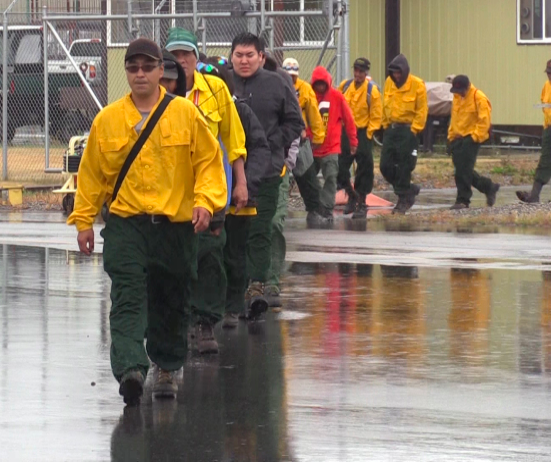
Dozens of men from Fairbanks and Interior villages boarded planes this week for Spokane, Washington, where they were transported by bus to Idaho and elsewhere to fight wildfires.

Four Type 2 Emergency Firefighter crews said farewell to Alaska’s wet skies as the 49th State’s  fire season winds down, with few incidences for the crews to work on in what was a quiet season.

Alaska Division of Forestry’s Fairbanks #2 Crew Boss Ken Richards said the crew is happy to be heading south to get to work.

“I’m excited,” Richards said. “Whatever we can do to help in the Lower 48 we’ll do. That’s what we’re here for.”

While the situation in the Lower 48 has resources stretched thin, Alaska has downgraded to a “preparedness level one,” the lowest. Firefighters demobilized from the three remaining staffed fires in Alaska on Tuesday. Meanwhile, the four emergency firefighter crews will bring fresh energy to the more than 28,000 firefighters already working on wildfires across the west. A second jet load with four more Type 2 EFF crews flew south on Friday.

The rural crews were flown in to BLM AFS facilities on Fort Wainwright Saturday and equipped with things like Nomex, fire shelters and packs for a 14-day assignment.

They are the Kobuk Valley #2 crew from Selawik, Ambler, Noorvik and Buckland; the K River Crew from Hughes and Allakaket; and the Yukon Koyukuk Crew with firefighters from Huslia, Nulato, Galena and Koyukuk. They’ll get their hand tools and chain saws once they get to Idaho. Then they’ll more than likely head out to a fire in the Northern Rockies Area which includes Montana, North Dakota, northern Idaho and a small portion of South Dakota.

Those who headed out Friday included men from the Division of Forestry Fairbanks #1 and Delta crews, BLM Alaska Fire Service’s Yukon Flats and Kusilvak Crew. The Yukon Flats Crew is made up of firefighters from Fort Yukon, Venetie and Arctic Village. The Kusilvak Crew, which is named after a mountain about 30 miles from Mountain Village, is made up of firefighters from Marshall, Mountain Village and Pilot Station.

Read the rest of the story and check out the dramatic photography at akfireinfo.com, a web site of the Bureau of Land Management.

Look up your voter information at Division of Elections

0

FIND OUT NOW, BEFORE YOU TRY TO VOTE

If you’re not sure that the Division of Elections has you listed in your proper voting district, there’s one way to find out quickly.

Go to the State’s voter database and type in your name, and either the last four digits of your Social Security number or your date of birth, and you can find out where the Division of Elections thinks you live.

What the State has on file may not be where you actually live.

After the State of Alaska enacted a voter initiative to automatically register to vote all applicants for an Alaska Permanent Fund dividend, the State proceeded to import the information from the Permanent Fund database into the Division of Elections database and unintentionally moved many Alaskans out of their districts.

[Read: Election Division has move hundreds of voters to new districts]

[Read: It’s not hundreds, it’s thousands of voter files changed.]


Dunleavy, Treadwell face off at Anchorage Republican debate

2

SPIRITED EXCHANGE KEPT AUDIENCE RIVETED

Beyond differing styles of the candidates, gubernatorial hopefuls Mike Dunleavy and Mead Treadwell agreed on much during their latest debate on Thursday evening in Anchorage.

They both agreed that SB 91 needs to be repealed and that crime is one of their top priorities. They somewhat agreed on how the Permanent Fund dividend should be calculated (Dunleavy favors original formula, Treadwell goes with POMV, Dunleavy favors putting it in the Alaska Constitution, Treadwell does not).

They agreed on the “3 percent for Native Corporations out of the oil that will come from the Arctic National Wildlife Refuge,” honoring the agreements made with Alaska Natives during ANILCA, which Treadwell explained in solid detail, showcasing his deep knowledge of the subject.

However, they did not agree with Treadwell’s statements that Dunleavy wasn’t the best candidate for the job.

The two took a couple of indirect shots at each other during the Anchorage Republican Women’s Club’s “Visions for Victory” debate in the conference room of Davis Constructors.

How each responded under pressure revealed how prepared they were for the criticism that will come after the Aug. 21 Primary Election: Treadwell gesticulated and was frustrated by the time limits set by the moderator; Dunleavy was composed, nonchalant, and left no opening for future attacks from Treadwell, who has attacked him in campaign materials and radio spots.

But Treadwell also said he had supported Dunleavy for Senate, and was proud of doing so.

Treadwell, when it was time to ask his own pointed questions of his opponent, asked Dunleavy to explain a complicated high-stakes financial deal that Dunleavy’s Texas brother had been a part of, which Treadwell said raised electrical rates in California, and the other parts of the question were to ask Dunleavy if he agreed with his brother, and what Dunleavy do would do to lower electrical rates in Alaska. Dunleavy had 60 seconds to answer that.

Dunleavy lobbed back a rhetorical missile, saying this was the Treadwell voters had come to expect, and he (Dunleavy) would not go after Treadwell’s family in this debate.

Later, when it was his turn to ask a question, he asked Treadwell to repeat Reagan’s 11th Commandment, which Treadwell did, paraphrasing it satisfactorily. It is this: “Thou shalt not speak ill of any fellow Republican.”

Dunleavy was driving home the point about negative campaigning. He asked him to repeat it again.

Dunleavy asked Treadwell to explain why, when he was lieutenant governor, he allowed the hybrid ticket of Bill Walker and Byron Mallott to go forward to the general election, even though the Democrat voters had duly elected Mallott as their nominee. Treadwell would have 60 seconds to answer that.

Treadwell answered that he felt Walker and Mallott deserved due process and that he was leaning on three other instances in Alaska history when making his decision. He said he consulted with the attorney general for three hours, and he expected some external entity representing Republicans to sue over it, but a lawsuit never materialized.

The crowd of about 70 seemed to enjoy the exchange, which drew camera crews from the Anchorage Daily News, KTVA and KTUU, although most media left before the gubernatorial segment began.

Moderated by Bernadette Wilson, the evening also included major candidates for lieutenant governor, who agreed on nearly everything (“save the PFD” and “repeal SB 91”).

During the lieutenant governor segment, the four candidates avoided attacking each other and at times it was somewhat of a love-fest, with each simply touting his or her own experience, not criticizing the others.

Sen. Kevin Meyer spoke directly to the multiple problems identified in the Division of Elections, including the issuing of double ballots to Democrats in Shungnak (allowing them to vote one Republican ballot and one Democrat ballot during the primary), lost ballots, and now, the overwriting of addresses in the Election Division’s database with addresses provided by the Permanent Fund Division, which has moved many Alaskans into the wrong voting districts.

[Read: Division of Elections has moved hundreds of voters to new districts]

Sharon Jackson rebutted a question posed about whether the state should try to get a higher voter turnout, at the expense of getting an informed turnout. Jackson wanted to make it clear that she feels it’s not up to the state to determine who is intelligent.

Retired Col. Edie Grunwald pointed to her experience in the Alaska National Guard, and former Rep. Lynn Gattis drew upon her lifelong experience in rural Alaska, and her time in the Legislature, and how that gives her a perspective none of the others has.

The candidate-to-candidate questions between the lieutenant governor hopefuls were purely softball, reflecting the camaraderie that has developed between them on the campaign trail.

Thank you, Mayor Koelsch

2

AFTER TRAGEDY STRUCK, HE WAS THE RIGHT PERSON AT THE RIGHT TIME

By WIN GRUENING
SENIOR CONTRIBUTOR

For most of us who have never held an elected position, it’s difficult to appreciate the extraordinary demands made on public servants and their families.  Amazingly, such people are willing to sacrifice their family life – even their careers – usually with relatively little financial compensation.

Luckily for Juneau, Ken Koelsch was willing to do just that when he announced for mayor in January 2016. It was no ordinary election – in fact, an off-cycle special election, because of the untimely death of the recently elected mayor after only two months in office.

As it turns out, he was the right person, at the right time.  Some might say, the perfect person.

After a career in education and law enforcement and having been previously elected twice to the Assembly (and serving as deputy mayor), Ken Koelsch was well-qualified to step up to the job.

WIN GRUENING

His message of stronger public safety, fiscal prudence, responsible economic development, and “uniting generations to move Juneau forward” were the hallmarks of his campaign.

His election results speak for themselves. With one of the highest local election turnouts in recent history, Koelsch swept 9 of 13 Juneau precincts and garnered almost 60 percent of the votes.

He immediately began working with the Assembly and the community.

As a highly visible and effective advocate for Juneau, Koelsch regularly walked the halls of the Capitol speaking with legislators and staff members about how Juneau could better serve them as Alaska’s capital city.

He kept regular office hours, making himself accessible to the general public. Along with his wife, Marian, he attended countless community events.  The mayor welcomed scores of dignitaries and visitors to Juneau and, with his engaging and comfortable personal style, always found a way to make them feel special.

Koelsch hasn’t been afraid of controversy and believes that tough decisions are part of being a leader. He has been especially forceful in his advocacy for making our streets safer, growing the economy, and exercising fiscal restraint.

Soon after taking office, to address concerns of local downtown property owners, he led the Assembly to pass an “anti-trespassing” ordinance – making the downtown area safer and cleaner for shop owners, locals and visitors.

At the same time, he supported the construction of a Housing First facility that provided permanent housing for the chronically homeless.  He supported additional camping areas and a warming shelter as well.

The mayor continued to champion the Lynn Canal Highway project believing it is critical to the survival of the ferry system.  It would also spur economic development, lower transportation costs, and demonstrate to the rest of the state Juneau desired improved access to the capital city.

Recognizing the contribution the mining industry makes to Juneau’s economy, Koelsch supported changes to the borough mining ordinance to help attract additional mining projects to Juneau.

With the realization that Juneau’s population and employment were shrinking and would not see appreciable positive change until new economic development became a reality, he advocated caution when considering large scale, expensive public projects.

Hence, his skepticism of the $32 million New JACC arts and cultural center.  Koelsch favored discussion of a more affordable, modest facility – one that would provide a larger venue for events but not saddle the city with additional subsidies or raise property taxes – further negatively impacting Juneau’s already high housing costs.  Likewise, he objected to spending up to $2.8 million per year on a new community pre-K program when a smaller investment to help expand daycare facilities made more sense.

The choice Mayor Koelsch made not to run for re-election wasn’t easy.  Yet, his promise to “unite generations” echoed loud and clear in his announcement when he said, “My commitment to this community will never cease — and yet it’s time to turn the reins of leadership over to the next generation.”

Juneau will have a difficult choice to make in selecting a new mayor.  Two of the three announced candidates are from the next generation.  But all three candidates have different ideas on how to lead our community and the direction it should take.

As a former teacher, Mayor Koelsch understood the value of a lesson plan and creating a path for others to follow.

Win Gruening retired as the senior vice president in charge of business banking for Key Bank in 2012. He was born and raised in Juneau and graduated from the U.S. Air Force Academy in 1970. He is active in community affairs as a 30-plus year member of Juneau Downtown Rotary Club and has been involved in various local and statewide organizations.


Election Division has moved hundreds of voters to new districts

STATE FLUBS PERMANENT FUND AUTOMATIC VOTER REGISTRATION

When the Permanent Fund Dividend automatic voter registration went into effect this year, it came with unintended consequences: Several hundred, and probably thousands, of Alaska voters were reregistered to new voting districts by mistake.

The reason is, for some at least, is because they used a different address for their Permanent Fund application, the deadline of which was March 30.

Aaron Weaver, a candidate for House District 15, pictured above, found out in time — perhaps.

Weaver, who is running against Rep. Gabrielle LeDoux in the Republican primary, discovered that the Division of Elections had assigned him to District 20. He only found out when he received a card from the Division of Elections, but he didn’t get the card within the 30-day period required to change his address back to his home address in East Anchorage.

Weaver, who is a photographer and videographer, uses his downtown business address for most business transactions and had used it for his Permanent Fund Dividend application.

At first, Weaver thought it was perhaps a nefarious action on the part of the opposition to disqualify him from being a candidate. But then he talked to the people at the Division of Elections, and he reported to Must Read Alaska that  they told him it’s a mess — it’s happening to possibly thousands of people who have either been registered into the wrong district or have been wrongly registered to vote.

For instance, felons who have not had their voting rights restored, but who applied for a PFD, have been registered to vote by the Division of Elections, against the conditions of their release. This could get them in big trouble, according to a source inside the Division of Elections who needs to remain anonymous.

But for a candidate to be removed from his own district? That was shocking to Weaver.

“I was definitely not the first voter affected by this mixup,” Weaver said. “But apparently I’m the first candidate affected.”

Weaver said he was told to go online and re-register and then vote in his district, but he’s not convinced the problem is solved in his case or in the cases of an unknown number of voters.

The situation developed because the Permanent Fund application information is overwriting that on file with the Division of Elections, according to sources in Division of Elections.

Voters might see a card from the Elections Division, and it may have the wrong information on it, but they might not have looked at the card, and now it’s too late to correct it in time for the primary election.

That’s not all. There’s still Election Day, Aug. 21.

Voters who now are early voting at, for example, the Gambell Street office, are able to deal with Elections officials who have access to the information from all 40 districts.

But voters who cast ballots on Election Day might find they walk into polling places, where temporary employees only have access to limited voter files in that district. They’ll be voting a questioned ballot, and they’ll have to contact the Division of Elections to correct the information on file.

No one at this point knows how many voters are affected by the unfortunate overwrite of information. But according to Weaver, the Division of Elections employees he talked to said it is a widespread problem.

“As a candidate, I was really sick to my stomach about this, thinking I’d have to either withdraw from the race or figure out how to get them to fix it,” he said. “And I’m worried about it happening to my fellow Alaskans.”

CAMPAIGNS WILL BE AFFECTED

Not only are voters impacted by the overwrite of the information, campaigns that depend on correct voter addresses from the Division of Elections could be sending mail to the wrong voters.

At this point, candidates who use databases that are synchronized with information from the Division of Elections, will want to pull back and review their work. In a primary race where 200 votes make a difference, having the wrong addresses may change outcomes for get-out-the-vote efforts.

Campaigns will also not know which of the Division of Election updates have correct information, but should figure that anything after the Permanent Fund dividend filing date of March 30 is going to be riddled with errors.

Breaking: Court says salmon initiative may go forward, in part

The Alaska Supreme Court today allowed most of the Stand for Salmon ballot initiative go to forward. It severed some of its language on constitutional grounds, but left in place a pending danger for all developers in the state.

The decision was not unexpected but oil, mining, forestry, and construction companies are analyzing it now, as the outcome of the November election will have an impact on the economy in Alaska.

The initiative puts stricter controls on all development in Alaska if it is anywhere in a watershed or drainage of anadromous fish like salmon or rainbow trout. That is most everywhere that is unfrozen.

It creates a condition that will allow lengthy litigation to rule the process in everything from building a dock, a home, or a business.

Lt. Gov. Byron Mallott decided that the ballot initiative proposed by Stand for Salmon would violate Article XI Section 7 of the Alaska constitution because it removed the State’s constitutional right to allocate resources.

The initiative sponsors challenged that decision and the Alaska Superior Court approved the initiative.

The Walker Administration’s lawyers in the Department of Law actually assisted Stand for Salmon in writing ballot language that would pass muster. But later, the Governor’s Office appealed the Superior Court decision, and this morning the Supreme Court said that portions of the initiative in fact do encroach on the discretion over resources — discretion which is given to the Alaska Department of Fish and Game by the Legislature, ” that the initiative as written therefore effects an unconstitutional appropriation,” the Supreme Court decision states.

Basically, the judges say that the language that ties the hands of the commissioner of Fish and Game, forcing him or her to  deny a permit under certain conditions, is an inappropriate incursion into the Legislature’s authority.

“But we conclude that the problematic sections may be severed from the remainder of the initiative. Accordingly, we reverse the judgment of the superior court and remand for the superior court to direct the Lieutenant Governor to sever the offending provisions but place the remainder of the initiative on the ballot,” the ruling says.

The initiative will, it appears, move ahead to the November ballot, and the battle will continue between those who wish to have a diverse economy and those who wish to stall resource development in Alaska.

Must Read Alaska’s Suzanne Downing is still reading the decision, which was released at 11:30 am. Expected are statements from the Governor’s Office, and the Stand for Alaska group, both which oppose the Stand for Salmon initiative.

The entire decision can be found here:

STAND FOR SALMON DECISION

This story will be updated.