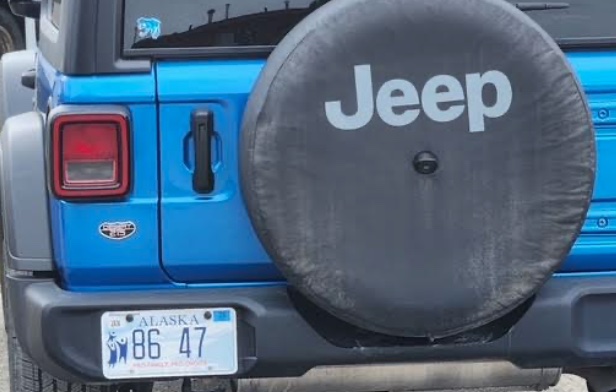
A newly issued Alaska license plate bearing the characters “86 47” is drawing a strong response from members of the public who believe it is a coded reference advocating violence against the president of the United States.
The plate, which was approved by the Alaska Division of Motor Vehicles in May, 2025, was seen in Soldotna over the weekend. The number “86” is widely understood slang for “eliminate,” “destroy,” or “kill,” while “47” is commonly associated with the 47th president: Donald Trump. It is a number that has been used by anti-Trump protesters across the country.
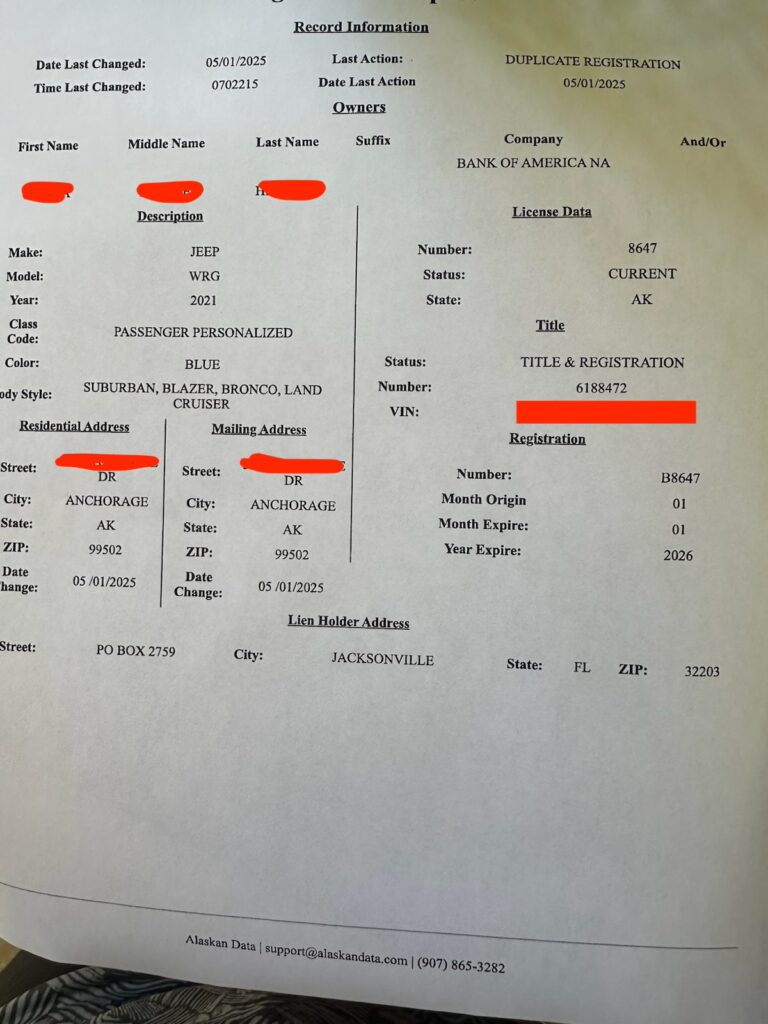
A source has sent MRAK the documentation showing this vehicle is owned by an employee of the Anchorage Daily News. We believe this information to be accurate but have redacted the name, address, and VIN as we await another form of verification:
The sighting comes just weeks after another Alaska license plate made waves online for bearing the sequence “8T64T7,” which is easily interpreted as a stylized version of the same message.
In both instances, Alaskans have contacted the Alaska Department of Administration and Division of Motor Vehicles with concerns that the plates violate agency policy or even state law regarding threats or incitement.
The controversy has renewed questions about how the DMV screens personalized plate requests.
In 2021, following public backlash over plates reading “FUHRER” and “3REICH,” the Department of Administration issued a report stating that the DMV would strengthen its review process. The policy changes were to prohibit messages that demeaned ethnic, religious, or racial groups, or that included vulgar, violent, or criminal language.
It is unclear what review process was in place when the “86 47” plate was approved in May of 2025.
A group calling itself Alaskans for Fair Courts is suing Gov. Mike Dunleavy over one of his recent appointments to the Alaska Judicial Council.
The group claims that because the appointee is a retired attorney, he’s ineligible to serve as a non-attorney member of the Council.
The group’s lawsuit hinges on a narrow and novel reading of the Alaska Constitution, which says members shall be appointed “without regard to political affiliation,” but makes no mention of retired lawyers.
That argument is flimsy on its face. But if Alaskans for Fair Courts is truly concerned with upholding the integrity of the Judicial Council, they might want to turn their scrutiny to someone a bit closer to their ideological home: Fairbanks attorney Savannah Fletcher.
Fletcher was appointed to the Judicial Council by the Alaska Bar Association, a move that received little media attention. Unlike the governor’s appointments, which face immediate public and political scrutiny, the Bar Association’s picks tend to slip under the radar. She was reappointed in April — by the Bar Association.
And in this case, that’s a problem.
Fletcher’s résumé reads like a blueprint for progressive political activism. She works on behalf of the Northern Justice Project, a hyperpartisan law firm that engages in “law fare” and operates at the far edge of the political spectrum, closely tied to the Alaska Democratic Party. She also served on the Fairbanks North Star Borough Assembly, where she rose to become presiding officer before her failed attempt at state office. Her tenure wasn’t without controversy.
Earlier this year, a nonpartisan ethics committee found that Fletcher had violated the Borough’s ethics code — not once, but three times — while serving on the Assembly. The findings were serious enough to warrant a formal censure by her fellow Assembly members. In government service, a censure is no small matter. It signifies a breach of public trust, conduct unbecoming of someone in a leadership role. But her professional code of conduct as an attorney is also a matter of concern.
Fletcher was the only attorney on the Assembly at the time. She had both the legal training and the ethical obligations of her profession.
But when she ran unauthorized political radio ads and then misled her colleagues about it, she crossed the line. Rather than acknowledge the misstep, she hired a lawyer to defend her in what should have been a straightforward matter of admitting she erred, and offering resumption to resolve the matter. The effort to deny her responsibility failed, and she was censured during a public hearing.
To be clear: Attorneys are held to high standards for a reason. They are officers of the court. The Alaska Bar Association routinely disciplines lawyers who violate public trust or act unethically.
Yet in Fletcher’s case, the Alaska Bar looked the other way, and then rewarded her with a seat on the Judicial Council, the very body responsible for helping choose Alaska’s judges.
It gets worse. Fletcher’s biography proudly notes that she once clerked for Alaska Supreme Court Justice Susan Carney. That’s notable because Justice Carney now serves as Chief Justice, and holds the tie-breaking vote on the very same Judicial Council.
So let’s summarize: A politically connected progressive attorney, formally censured for ethics violations, gets quietly appointed to a powerful body with input into who becomes a judge in Alaska and she has a personal tie to the Council’s tie-breaking vote.
If Alaskans for Fair Courts were genuinely concerned about political influence or the integrity of the process, this is where their lawsuit would begin. Instead, they’re focused on parsing words in the Constitution to disqualify a governor’s appointee based on a status (retired attorney) that the document doesn’t even mention.
Their silence on Fletcher is telling. So is the presence of Bruce Botelho as their co-chair. Botelho, a former Democratic Attorney General, remains one of the most influential political operatives in Juneau. His fingerprints are all over the city’s Democratic machine—from the mayor’s office to the left-leaning “Juneau Independent” news site. The board of Alaskans for Fair Courts also includes heavy-hitting Democrats and politicos such as AFL-CIO president Joelle Hall, who is rumored to be considering a run for governor.
Among the officers of Alaskans for Fair Courts is attorney Tom Amodio, who, as a private attorney, works for the Alaska Democratic Party. In 2024, Amodio asked the court to force Democrat Eric Hafner off of the ballot. Hafner, a Democrat and a felon, was going to take votes from Mary Peltola, the sitting congressional representative. The court ruled against Amodio, who routinely files lawsuits on behalf of the Democratic Party against the Division of Elections.
When Alaskans for Fair Courts calls for fairness, what they really mean is control. This group is an undeclared arm of the Democratic Party.
If we want truly fair courts, then the standard must apply to everyone, regardless of party. That means examining all appointees to the Judicial Council, not just the ones made by a Republican governor.
Integrity isn’t partisan. And neither should be our courts.
Suzanne Downing is the founder of Must Read Alaska and serves as editor.
The City and Borough of Juneau issued a public notice warning residents of rising flood risk as Suicide Basin, perched on one side of the Mendenhall Glacier, is approaching levels associated with previous glacial outburst floods.
According to the latest monitoring data, the water level in Suicide Basin has climbed to 1,290 feet, just 44 feet shy of the level that triggered last year’s record-breaking flood on Aug. 6, 2024. Over the past week alone, water levels have risen more than 17 feet, averaging a rapid increase of 2.5 feet per day. If that estimate is true, by Wednesday, the water-ice level will have reached nearly 1,300 feet.
City officials said that if a release occurred today, floodwaters could inundate low-lying areas such as View Drive, potentially reaching homes and making roads impassable. No flood alert has been issued yet, but authorities are maintaining a watch, with a likelihood of another possibly catastrophic flood event in mid-August. This would be during the time when the Alaska Legislature is scheduled to be in special session in Juneau, further adding to Juneau tensions.
In preparation, CBJ and Tlingit & Haida are partnering to host sandbag distribution events at the Dimond Park Field House to help residents protect their properties. The next event is scheduled for Saturday, July 26, from 11 am to 3 pm, with additional events planned later in the month.
A Hesco barrier project is under way along the riverbanks in the areas most prone to flooding, although the Assembly decided not to move forward with the proposed Phase 1B barrier installation until the appropriate funding discussions, community conversations and bank armoring could be completed.
Since 2011, Suicide Basin has regularly unleashed outburst floods, sending torrents of water and debris downstream into Mendenhall Lake and the Mendenhall River. The frequency of these annual floods has increased and the 2024 summer flood season was the most damaging on record, and the latest data suggests the basin is on track to reach similar capacity again this summer.
The US Geological Survey operates two cameras providing four images daily, along with active laser sensors tracking water levels. Officials say that occasional fluctuations in laser data can occur due to large iceberg movements within the sensor’s range.
The latest on-site assessment by the University of Alaska Southeast, conducted on July 14, confirms the rapid water accumulation. By comparison, the basin stood at 1,334 feet at this time last year and 1,370 feet two years ago.
City officials said inflow rates remain highly dependent on weather, with warmer temperatures and rain accelerating the basin filling process. Based on current projections, the basin could reach full capacity, around 1,371 feet, by mid-August, increasing the risk of a sudden release.
When Alaska Attorney General Treg Taylor pursued felony indictments against Ketchikan Police Chief Jeff Walls, his office withheld the most credible piece of evidence clearing the chief’s name — a memo from a seasoned Alaska State Trooper investigator.
My column last week about “How Attorney General Taylor ran a decorated police chief out of Ketchikan” generated a lot of comments on Must Read Alaska and on various social media platforms nationwide.
The majority of those posting comments easily grasped the seriousness of the prosecutorial misconduct committed in gaining three separate grand jury indictments of former Ketchikan Police Chief Jeff Walls. However, apparently the quotes by former DPS Commissioner Dick Burton, Superior Court Judge Katherine Lybrand, and the Ketchikan City Manager weren’t enough for some.
There’s an old saying, “you can lead a horse to water, but you can’t make them drink.”
Perhaps the number of doubters will decline after reading the concluding paragraph of the memo written by retired Lt. Jeff Hall of the Alaska State Troopers, following his investigation into Walls’ case:
“This case should never have been brought forward. Every person has a right to protect himself and others from aggression. Law enforcement officers have the right to use force in this manner to detain criminal suspects. The chief showed great restraint in dealing with a large, aggressive, intoxicated man, and was ill-served by the trooper and the prosecutor.”
Lt. Hall was the major crimes investigation sergeant for “A” Detachment, based in Ketchikan from 1992 to 1995. His investigation and opinion should have carried significant weight with AG Taylor.
But it didn’t carry any. In fact, Taylor withheld Lt. Hall’s memo from the two subsequent grand juries who indicted Walls. So much for the pursuit of truth by our prosecutors.
I recently spoke with Lt. Hall. “Chief got screwed” were among his first words to me. Toward the end of our call he gave me permission to quote him.
Lt. Hall’s memo is dated Aug. 31, 2023. He emailed it that same day to Major Anthony April, Deputy Director of the Alaska State Troopers. The next day April forwarded the email with a “High Importance” tag to Captain Mike Zweifel, Commander of “A” Detachment and Colonel Maurice Hughes, Director of the Alaska State Troopers.
Exactly where Lt. Hall’s report went from Captain Zweifel and Colonel Hughes hasn’t yet been confirmed, but one thing is certain – the Attorney General’s Office knew about the memo at least two weeks before Taylor made his second attempt to indict Chief Walls, who was now back on the job after the first indictment had been dismissed.
On Sept. 5, 2023, Walls’ defense attorney sent the memo to Taylor’s Office of Special Prosecution and also filed a Notice of Expert Witness pertaining to Lt. Hall. The notice clearly stated, “Lt. Hall is freely available for interview by OSP by appointment with the undersigned attorney”.
The notice was a matter of public record in Ketchikan and stated that Lt. Hall “will testify, most significantly, that the use of force alleged in this case was reasonable and appropriate under the circumstances.” Undeterred, Taylor sought the second grand jury indictment in Juneau two weeks later on Sept. 21, 2023.
Was this notice one of the factors that influenced Taylor to seek the second indictment in Juneau rather than Ketchikan? Was Taylor concerned that knowledge of the contents of this notice would become more easily known to the Ketchikan grand jury, dooming his attempt to put Walls in jail?
Had the Attorney General allowed the 2nd and 3rd grand juries to review Lt. Hall’s memo, here’s what they would have read:
“This opinion is the result of reviewing available information regarding the incident at Salmon Falls, Ketchikan, Alaska, 9/10/22, involving Ketchikan Chief of Police Jeffrey Walls and Mr. Wildes, a visitor from Washington State. It is written based on my years as a trooper, my experience, training, and education, and having been the major crimes investigation sergeant for “A” Detachment, based in Ketchikan from 1992 to 1995.”
“On the evening of 10 Sept., Chief Walls and his wife, Sharon, entered the Salmon Falls resort restaurant. They had made a reservation for dinner, but their table was not ready, so they sat at the bar. A short time, later, a “highly intoxicated” Mr. Wildes commented “watch this” to his two companions. Mr. Wildes then rapidly approached the chief from his right rear and drove his shoulder into the chief, knocking him almost 180 degrees on his stool. Chief Walls asked him why he did it, did he know him, and Wildes replied “I thought it’d be funny” then offered to buy the chief and his wife drinks – they declined.”
“Approximately an hour later, after their food had arrived, Mr. Wildes again assaulted the chief and his wife. Wildes, who weighs over 200 pounds, used his body to strike both the chief and his wife, driving them both onto the bar, injuring Sharon Walls’ right arm and breast. Wildes continued walking towards the door, and Chief Walls followed him with the intent of detaining him for the two assaults. Wildes’ hands were not visible, so the chief pushed him from the back, causing Wildes to fall to the floor. Wildes immediately began to get up, turned, and his head came up under the chief’s armpit. The chief attempted a headlock, then was grabbed from the rear, around his neck, by the bar manager, who separated the two. A bystander said, “we’ve got him,” referring to Wildes. At some point, Wildes received abrasions to his head.”
“At no time did Chief Walls use any excessive force. He did not strike, kick or use any type of “chokehold”. Had he used a proper LVNR, which would have been entirely appropriate, Wildes would have suffered no injury. I have submitted 20-30 men and 1 woman using the LVNR, and none suffered injury. Wildes was bleeding from a head cut and had blood on his hands, but the chief did not have any blood on him. Wildes himself stated that no chokehold was used.”
“The ‘investigation’ conducted by Trooper Larry Dur’an was a travesty –- he ignored almost all basic investigation techniques. He did not enter the building until an hour after he arrived; failed to separate witness; allowed witnesses to talk among themselves; he refused to interview the bartender: did not interview the spouses of both KPD officers; he handcuffed, un-handcuffed, then re-handcuffed Wildes; repeatedly asked witnesses if they saw the chief use a “chokehold”; suggested that witnesses change their statements, etc.”
The next and final paragraph of Hall’s memo was cited at the beginning of this article, but it is so important it merits repeating:
“This case should never have been brought forward. Every person has a right to protect himself and others from aggression. Law enforcement officers have the right to use force in this manner to detain criminal suspects. The chief showed great restraint in dealing with a large, aggressive, intoxicated man, and was ill-served by the trooper and the prosecutor.”
Former DPS Commissioner Dick Burton saw things the same way as Lt. Hall. In his “something stinky” email Burton continued to write his former colleagues: “reading the attached news report I have no sympathy for the drunk; assault another man’s wife and you can not expect anything less than a violent physical reaction.”
Taylor’s exclusion of Lt. Hall’s memo is the “smoking gun” evidence why Alaska prosecutors can’t currently be trusted with serving as advisors to grand juries in criminal indictments or in investigations. Emergency intervention by the federal government to protect citizens’ due process rights under the US Constitution is needed immediately.
It is likely that many of the current personnel under the Attorney General will need to be replaced, and the current system refined, so that more meaningful checks and balances can be implemented. But that will require our Legislature to take meaningful action, which could be a long time coming. Reform is also needed within the Alaska Supreme Court which has no right to restrict grand jury reports following their investigations.
Despite the misleading constructions of fact and law given by prosecutors to the Ketchikan and Juneau grand juries, I can’t imagine them indicting Chief Walls had they been allowed to read Lt. Hall’s memo and invited him in to testify. His memo offered valuable insight into the truth of the Salmon Falls Incident and the use of force guidelines that were so critical in the case.
Chief Walls’ case reminds me of what Pastor Bob Barton of Hoonah, a key witness in the Thomas Jack, Jr., case said in an affidavit about the actions of Juneau prosecutor Angela Kemp 15 years ago. Barton, who was awarded the Air Medal signed by former US President Lyndon B. Johnson stated:
“I recall being stunned upon learning that Thomas was convicted of multiple counts of sexual assault of T.T. in the Juneau courtroom. I returned to Alaska from Texas to be present in court and testify on Thomas’ behalf at his sentencing hearing in the fall of 2010. I recall that when Assistant District Attorney Angie Kemp figured out who I was, she stopped asking me questions and that didn’t sit well with me. In my view, prosecutors are obligated to follow the truth regardless of the result it leads to.” (emphasis added)
Over two years ago I gave Deputy Attorney General John Skidmore a copy of Barton’s affidavit and tried to pin down a time for a meeting he had previously agreed to have with me. Skidmore later told me he had changed his mind and wouldn’t meet with me because my claims weren’t credible. Incidentally, Skidmore and Kemp were involved in formulating the new rules out of Taylor’s office that restrict grand jury access to Alaska citizens requesting investigations.
If truth was the guide of our prosecutors, Chief Walls would still be in Ketchikan taking deadly fentanyl off its streets. Instead, Alaska prosecutors abused Truth to try to put Walls in jail alongside Jack.
Through his indictment of Chief Walls, exactly what message was Attorney General Treg Taylor trying to send to law enforcement officers across Alaska? That its OK for drunks to intentionally assault you or your wife? Or that if you respond to any crime in what you and your fellow officers believe is a lawful use of force, you risk felony assault charges?
Or could the message have been that if you are successful in taking deadly drugs off the street, his office will find a way to get rid of you.
This last question deserves special attention Sources I have spoken to say that Ketchikan has a reputation for being infested with vast quantities of deadly drugs. Indeed, after Chief Walls’ arrival fentanyl seizures increased 525% in his first year.
However, instead of recognizing Walls as a hero, Taylor got him indicted on two felonies and went after him relentlessly over the next two years.
Burton had this to say about the Ketchikan troopers in an email several months later: “Ketchikan is not known for doing things right anyway. I used to think they were on our side, but I think the inmates have taken over.”
Have the inmates taken over the Attorney Generals’ office as well? When one considers they ignored Hall’s memo and then kept it from the grand jury, the answer to that question is likely a “yes”.
Important questions remain: Was the Salmon Falls incident a set-up, intended to provoke a more violent reaction from Walls? If so, who was all in on it?
According to Walls, some of KPD’s drug seizures during his tenure occurred on boats that had come over from the airport on Gravina Island, which is part of the Troopers’ domain. Walls also noticed a lack of US Customs officials on his official visits to Gravina Island.
Is the Ketchikan airport a central hub of the fentanyl drug distribution network throughout Southeast? Is the deadly drug offloaded in Vancouver on container ships from China or Russia? Are containers then trucked to the Prince Rupert vicinity where the drugs are then loaded onto small planes that land in Ketchikan an hour or two later?
These are all legitimate questions. Alaskans need a grand jury to investigate and discern the truth. But the Attorney General has rigged that process too.
You were right Commissioner Burton. Things are really stinky here in Alaska.
David Ignell was born and raised in Juneau where he currently resides. He formerly practiced law in California state and federal courts and was a volunteer analyst for the California Innocence Project. He is currently a forensic journalist and recently wrote a book on the Alaska Grand Jury.
The National Education Association, the nation’s largest labor union, recently adopted resolutions that call into question its political neutrality, and thus its bias with regard to overseeing education, according to leaked documents.
In a series of tweets, education activist Corey A. DeAngelis posted images of a document that he said outlined the NEA’s goals for the immediate future. Notably, one plank pledges to “defended democracy against Trump’s embrace of fascism by using the term fascism in NEA materials to correctly characterize Donald Trump’s program and actions.”
The NEA has an outsized influence on public schools across the country. Founded in 1857, NEA started as a professional trade association that would later merge with other associations representing education and public employees. It was eventually granted federal union status by Congress and today represents three million members nationwide.
Recent efforts within Alaska by Gov. Mike Dunleavy to provide for alternatives to taxpayer-funded schools have been hotly contested, resulting in a veto-override, and are the topic of an upcoming legislative session. The NEA-backed initiative to re-introduce a “Defined Benefit” package is likewise controversial. The NEA forms one of the strongest and most well-funded lobbies in Juneau.
In recent times, the NEA adopted a more adversarial approach to advocacy, calling for strikes against the people as leverage for increased funding, and directly engaging in political campaigns. Today, the group regularly faces accusations that it prioritizes its interests ahead of the people it is fundamentally intended to serve. Namely, students.
The documents obtained by DeAngelis appear to support that criticism. For example, one resolution that was adopted states: “NEA declares its support for and participation in the mass democratic movement against Trump’s authoritarianism and violations of humans rights.” It then affirms that it supports the “No Kings” movement.
Each item on the document is followed by a section called “cost implications,” which details the additional funding that would be required to bring it to fruition. That is worth mentioning, given the exodus of dues-paying members that the union has suffered in recent years.
Between 2009 and 2024, the NEA lost some 400,000 members. According to an analysis by Illinois Policy, just nine percent of its spending went toward representing teachers during this period, with the bulk being spent on “politics, administration and other union leader priorities.” Meanwhile, its officers and employees enjoy six-figure salaries, spending millions on travel and food for “unspecified purposes.”
According to DeAngelis, the NEA decided to keep its newly adopted resolutions private this year, raising further questions about transparency.
Not long after news of the convention’s agenda became public, Rep. Josh Brechen, an Oklahoma Republican, announced that he was working with other lawmakers to terminate the NEA’s special status. He is joined in that effort by GOP Rep. Mark Harris and Sen. Marsha Blackburn, who introduced the National Education Association Charter Repeal Act, which would revoke the union’s congressional charter.
“Congress established the NEA in 1906 to support America’s teachers and strengthen our schools, but it has abandoned that mission in favor of a radical agenda,” Harris said in a statement.
“From branding President Trump a fascist to embracing divisive gender ideology and walking away from efforts to fight antisemitism, the NEA has become nothing more than a partisan advocacy group. Since the NEA is clearly not prioritizing students, parents or even teachers, it’s time to remove Congress’ seal of approval from this rogue organization.”
In her own statement, Blackburn said that “teachers’ unions have shown they’ll put their political agenda ahead of students’ needs.”
“The National Education Association has made it crystal clear it’s a partisan organization, and it shouldn’t be rewarded with a federal charter that platforms woke gender ideology, antisemitism, and left-wing propaganda. Our students deserve better.”
The NEA-Alaska affiliate did not respond to a request for comment for this report.
Alaska State Sen. Forrest Dunbar, currently deployed to Poland on active duty with the Alaska Army National Guard, is drawing scrutiny for a politically charged letter issued to constituents while serving in uniform — a move that may violate military conduct standards and federal law.
In a letter circulated on social media under his official Alaska State Legislature letterhead, Dunbar confirmed that he would return to the state for the August special session and vote to override Gov. Mike Dunleavy’s partial veto of a massive increase to education funding that was passed by a deeply split legislature.
“I will be voting yes to override,” Dunbar wrote, citing what he called “catastrophic cuts” to school budgets.
However, the message may have crossed a line drawn by multiple federal regulations prohibiting active-duty service members from engaging in partisan political activity.
Dunbar’s statement appears to run afoul of Department of Defense Directive 1344.10, which strictly limits active-duty military personnel from making partisan political statements or taking public positions on pending legislation.
The directive bars service members from participating in political activity that may imply military endorsement or blur the lines between official military capacity and political advocacy.
While Dunbar said he sought an “Exception to Policy” to take leave and pay for his own return to Alaska for the vote, the statement itself was issued while he remains mobilized, and it was made using his official legislative platform. That fact alone may violate the principle that political commentary must be done in a purely personal capacity and without use of official titles or platforms.
Under Article 88 of the Uniform Code of Military Justice, commissioned officers are prohibited from using contemptuous or disrespectful language against senior government officials. Dunbar’s letter stops short of overt disrespect, but his partisan and inaccurate framing of the governor’s action while on active duty adds to the case that can be made that he is engaging in partisan political activity.
In addition to the legal and ethical concerns, Dunbar’s letter also contains a misleading characterization of the governor’s action. Gov. Mike Dunleavy vetoed only a portion of an increase to education funding, not cutting funding. Dunleavy only cut out some of the additional funds that were awarded to Education. Calling it a “catastrophic cut” oversimplifies and exaggerates the scope of the veto, which makes Dunbar’s statement highly political, rather than factual information for his constituents.
Then there’s the Hatch Act. Although it primarily applies to civilian federal employees, the same types of restrictions extend to members of the armed forces.
The combination: Military status, state office, and partisan advocacy, is a messy mix that his higher-ups at the Pentagon may find interesting, at the very least.
Violations of DoD Directive 1344.10 or UCMJ provisions can result in administrative or disciplinary action, ranging from a formal reprimand to more serious consequences, depending on the severity and whether the statement is judged to harm good order and discipline.
As of this writing, no official investigation into Dunbar’s conduct has been announced. However, the incident is likely to be elevated to Department of Defense leadership by those who take umbrage with his use of his uniform for political business.
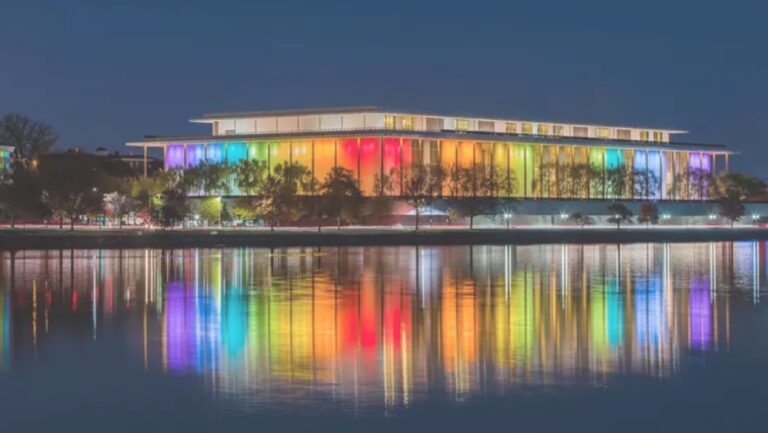
A House panel voted Tuesday to rename a cultural landmark after First Lady Melania Trump.
The House Appropriations Committee approved an amendment to the fiscal 2026 Interior-Environment spending bill that would redesignate the Kennedy Center’s Opera House as the “First Lady Melania Trump Opera House.” The amendment, introduced by Rep. Mike Simpson of Idaho, passed on a party-line vote of 33-25.
The proposal still requires approval from the full House and Senate before it can become law. As of Tuesday, House leadership had not set a timeline for bringing the bill to the floor for a vote. August recess starts July 24, and the House won’t reconvene until Sept. 2.
Supporters of the renaming effort described it as a recognition of Melania Trump’s contributions to the arts and culture during her tenure as First Lady. Mrs. Trump championed American heritage and oversaw major White House restoration projects, making this designation a fitting tribute, Simpson said during the committee markup.
Democrats swiftly criticized the move as politically motivated. Rep. Chellie Pingree (D-Maine), the ranking member on the subcommittee, called the amendment “divisive” and questioned the wisdom of using a government funding bill to rename a cultural institution. It’s not a priority for the American people, Pingree said.
The Kennedy Center Opera House, named in honor of President John F. Kennedy, a Democrat, has borne its current name since the performing arts complex opened in 1971.
The United States Olympic and Paralympic Committee announced a change to its Athlete Safety Policy on Monday, formally barring transgenders (men who live as women) from competing in women’s categories at both Olympic and Paralympic events. The policy shift brings the USOPC into compliance with President Donald Trump’s Executive Order 14201, titled “Keeping Men Out of Women’s Sports,” signed Feb. 5.
The revised guidelines state that eligibility for women’s sports will now be determined strictly by biological sex, although the guidelines refer to this as “sex assigned at birth.” As a result, transgenders who are biological males will be directed to compete in men’s or open categories, effectively ending access to women’s divisions for any athlete not born female.
The USOPC policy does not explicitly reference transgender athletes. Instead, it adopts the terminology and framework set out in the presidential executive order, which focuses on safeguarding what it describes as the integrity of women’s sports.
This update reverses USOPC policy, which at last as in April 2025 had deferred decisions on gender eligibility to individual international federations and national governing bodies. Under the new directive, all NGBs are now required to adopt uniform policies based on biological sex. The change applies across all levels of competition, from grassroots programs to elite international events, and will directly increase the chances for women athletes competing for the 2028 Los Angeles Games.
With this latest action, the United States becomes one of the first major Olympic nations to codify such restrictions across all sporting disciplines in response to national policy.
The National Transportation Safety Board has concluded its investigation into the 2023 plane crash that killed Eugene “Buzzy” Peltola Jr., husband of former US Rep. Mary Peltola, placing the blame squarely on pilot error.
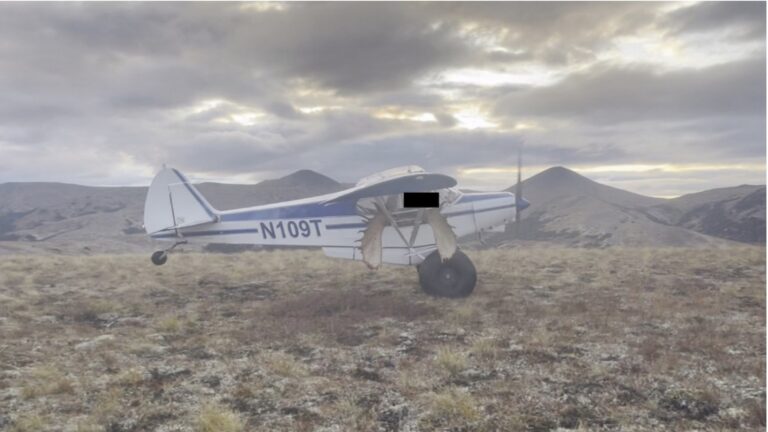
According to the NTSB’s final report, Peltola’s decision to fly his overloaded aircraft in dangerous wind conditions with unapproved external cargo was the primary cause of the fatal accident on Sept. 12, 2023. The NTSB cited his choice to exceed the plane’s certified weight limits and to fly with moose antlers improperly lashed to the wing strut as key factors leading to a loss of control.
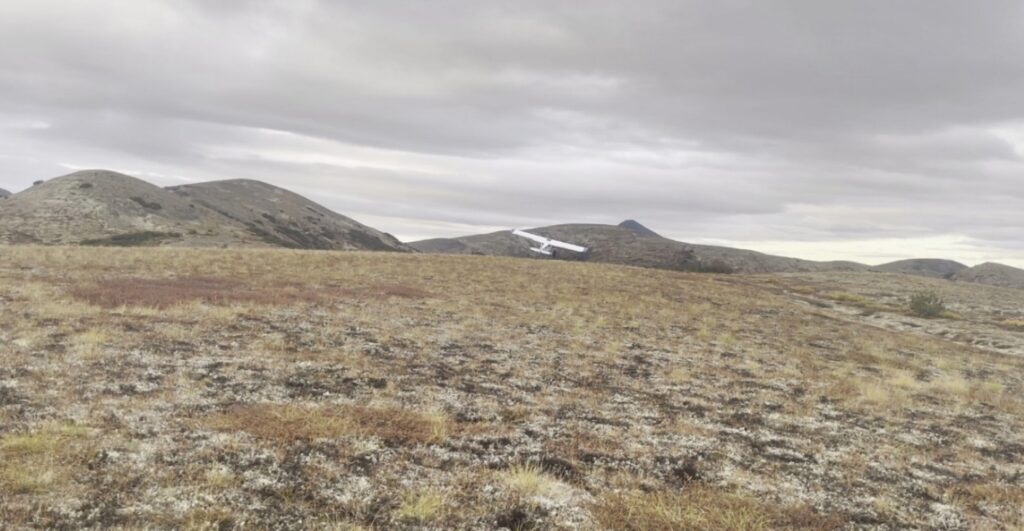
The plane rolled immediately upon takeoff. Hunter video screenshot.
Peltola was ferrying moose meat and antlers from a remote hunting camp about 80 miles northwest of Holy Cross after a group of hunters harvested a moose. After successfully transporting the first load of meat earlier that day, Peltola returned for a second trip, this time with the plane loaded 117 pounds over its certified maximum takeoff weight. The aircraft was so overloaded that even after burning fuel en route, it would have landed nearly 180 pounds over its maximum landing weight.
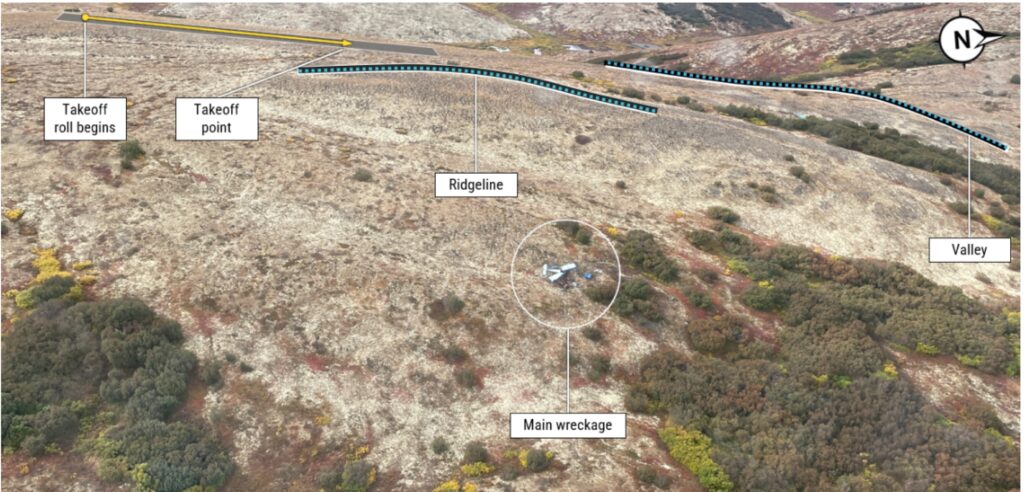
The runway, located at the crest of a hill, presented additional challenges. Terrain rapidly dropped away to the north before rising sharply within three-quarters of a mile. At the time of the crash, shifting north winds likely provided initial lift but caused turbulence and downdrafts as the heavily burdened plane turned south over the valley, contributing to the crash just beyond the hunters’ view.
Screenshot
The NTSB ruled out mechanical failure, noting the engine was running at full power during the accident. The plane’s airframe, originally manufactured nearly 70 years prior, had been heavily modified over the years. Despite being equipped with numerous FAA-approved alterations, the true flight performance characteristics were unknown, especially when flown over its weight limit.
The report also documented that while carrying antlers externally is common in Alaska, it requires FAA approval—documentation that was absent for this aircraft. Though Peltola suffered from cardiovascular disease, investigators found no evidence that his health contributed to the accident.
The crash occurred around 8:47 p.m., and despite surviving the impact, Peltola succumbed to his injuries within hours due to the severity of the crash and the remoteness of the site. Air National Guard rescuers arrived several hours later, but the cockpit had sustained catastrophic damage, compromising any chance of survival even with safety restraints.
Just four days earlier, Rep. Mary Peltola filed a wrongful death lawsuit on July 18 in Bethel Superior Court. The lawsuit names guide Bruce Werba and his companies—Alaska Pike Safaris, Wilderness Adventures LLC, and Neitz Aviation—as defendants. Peltola alleges that unsafe working conditions, excessive duty hours, overloading, and improper external cargo contributed to her husband’s death.
Peltola would have been notified by the NTSB last week that the report would be released soon; it is standard procedure for the agency to notify next of kin in advance.
The complaint also claims that Peltola was an employee of the companies and was operating the aircraft under a purchase agreement, having made payments on the plane before his death. The lawsuit alleges the defendants failed to provide workers’ compensation insurance and have withheld funds owed to Peltola’s estate.
With the two-year deadline for filing a wrongful death suit approaching, Rep. Peltola seeks damages of more than $100,000 and has requested a jury trial. As of July 22, no court date has been set. The probate case surrounding Peltola’s estate remains open, complicated by ongoing family disputes and unresolved financial claims.