By Zack Gottshall
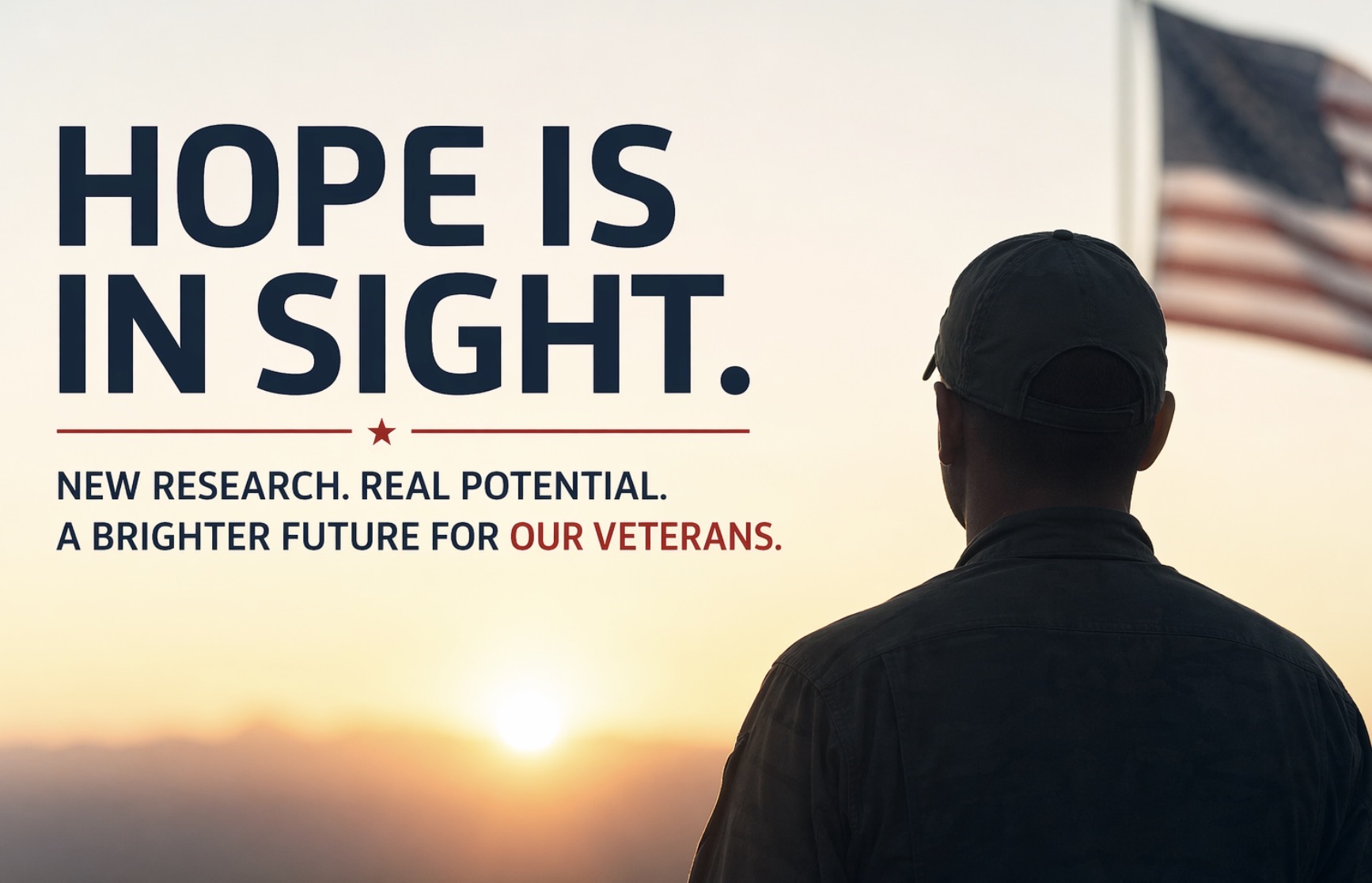
For tens of thousands of veterans, surviving combat was only the first battle.
Coming home did not mean returning to the life they left. It meant learning to function inside a mind that combat had permanently altered— one that replays what the body survived, that cannot quiet itself at night, that resists every conventional treatment the system has offered.
Twenty three veterans die by suicide every single day in this country. Not in combat. At home. After the deployment ended. After the medals were awarded. After everyone moved on.
Most of those deaths are connected to post-traumatic stress disorder, traumatic brain injury, and post-concussive disorders— the signature wounds of the post-9/11 wars. Wounds that do not show on an x-ray. Wounds that pharmaceuticals and therapy protocols have helped manage for some but have failed to adequately treat for far too many.
For that group— the treatment-resistant, the ones who have exhausted what the VA and civilian medicine could offer— the status quo is not a policy failure in the abstract. It is a death sentence in the specific.

On April 18, 2026, President Trump signed an executive order directing federal agencies to accelerate research, development, and regulatory review of treatments for serious mental illness. Veterans are explicitly named as a priority population. The order expands clinical trial access, improves data-sharing across agencies, and creates a Right to Try pathway for eligible patients. It also directs at least $50 million toward a federal-state partnership to advance these treatments, including psychedelics like ibogaine, through a legitimate, supervised scientific process.
Ibogaine is not new to veterans. It is new to the federal government.
For years, veterans have been traveling to clinics in Mexico at their own expense, outside the American medical system, beyond the reach of the VA because they had run out of options at home. Some went out of desperation. Many went because other veterans told them it worked.
The science is beginning to confirm what those veterans already knew.
Stanford University School of Medicine studied 30 Special Operations veterans, nearly all presenting with clinically severe psychiatric symptoms and significant functional impairment, who received ibogaine-assisted therapy at a medically supervised clinic in Mexico. One month after treatment, the results were striking: average reductions of 88% in PTSD symptoms, 87% in depression, and 81% in anxiety. Disability scores on the WHO assessment scale dropped from 30.2 (indicating mild to moderate impairment) to 5.1, indicating no disability.
These were not patients with mild symptoms who responded to a nudge. These were Special Operations veterans— elite, high-functioning individuals whose careers demanded peak performance— who had been functionally disabled by the cumulative trauma of combat. The improvements were rapid, sustained, and accompanied by measurable gains in cognitive function: concentration, memory, executive processing, and impulse control. Follow-up neuroimaging published in Nature Mental Health in 2025 documented changes in brain activity consistent with neuroplasticity— a biological fingerprint, not just self-reported relief.
This was an observational study, not a large-scale randomized controlled trial. Ibogaine carries real cardiac risks, particularly outside supervised clinical settings. Those facts matter and must be stated plainly.
But they are arguments for rigorous clinical infrastructure, not for continued inaction.
The executive order creates exactly that infrastructure. It does not legalize ibogaine. It does not short-circuit safety. It directs the FDA to fast-track review of breakthrough-designated treatments, establishes supervised access pathways, and funds the kind of serious, peer-reviewed investigation this therapy has never been able to get inside the United States.
For veterans, this is not a political story. It is not a psychedelics story. It is a what-do-we-owe-the-people-we-sent-to-war story.
We sent them into environments that changed their brains. We told them to perform at the edge of human capacity under sustained mortal threat. We brought them home and handed them a prescription and a therapy referral and called it care. For many, that was enough. For far too many, it was not.
Twenty three veterans a day is not a statistic that should be acceptable to any American, regardless of politics. It is a failure that has persisted across administrations, across decades, across every generation of post-war veterans we have asked to quietly absorb what combat cost them.
If ibogaine, rigorously studied and properly administered, can give even a significant fraction of treatment-resistant veterans their lives back— their cognition, their sleep, their relationships, their sense of a future worth living— then the obligation to pursue that answer is not optional. It is the minimum we owe them.
They held up their end. It is long past time we held up ours.
Zack Gottshall is a retired U.S. Army Intelligence Officer, a Commissioner on the Alaska State Commission for Human Rights, Vice President of the Taku/Campbell Community Council, and a small business owner in Anchorage, Alaska.