
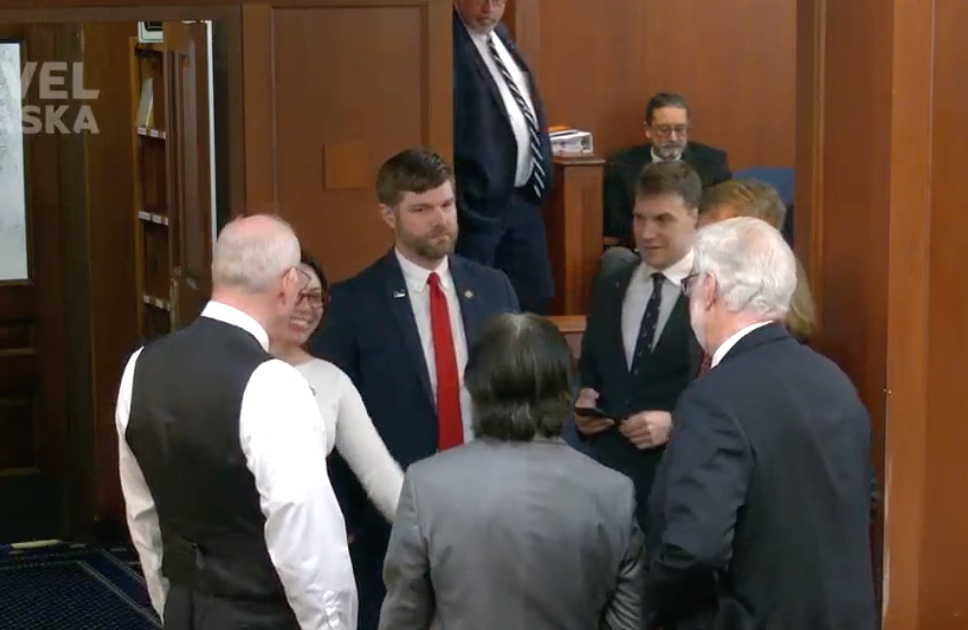
No sooner had the Senate passed House Bill 57, which suddenly added $184 million to school districts in Alaska, than the Senate asked the House to send the bill back. Someone spotted a provision in it, added by Sen. Rob Yundt of Wasilla, which was clearly unconstitutional.
Yundt had worked with Democrats Sen. Loki Tobin and Sen. Bill Wielechowski to pass an amendment that would provide some $23 million in reading grants. That amount used to be a rounding error in the state budget, but these days it’s a lot of money.
The way the amendment is worded makes the reading grants dependent upon passage of Senate Bill 113, by Sen. Wielechowski, which taxes businesses that are conducting internet sales in Alaska. Apparently, Yundt had made a deal with the Democrats to support that tax, and his amendment dedicated some of that expected revenue to the reading grants. That bill has passed the Senate but not yet passed the House.
That addition of dedicated funds made the bill unconstitutional.
During the “sausage-making” process that all bills and amendments go through, the constitutionality aspect was overlooked by the lawyers who work in Legislative Legal. Someone pointed it out to the Senate Majority after the vote had already been taken on Monday.
House Bill 57 has had a twisted life. It started out as a simple bill by Anchorage Democrat Rep. Zack Fields that would get school districts to ban the use of cell phones by students during school hours.
But then it became the mule for what is now about $200 million in more spending for education, and a hefty increase to the Base Student Allocation formula. Once the Senate got ahold of the bill, it became tarted up with all kinds of wants and desires, with no fiscal notes. Yundt fell into the trap and Democrats did him no favors.
During floor remarks on Monday, Sen. Yundt effusively praised the Democrats for helping him get his amendment passed. He noted that he is not an education expert, but more of someone who makes deals and looks for the “soft spots.”
“This is what teamwork looks like,” Yundt said, after thanking the Democrats for their cooperation.
The bill is now been bounced back to the Senate Rules Committee and will return to the floor on Wednesday for repair.
The fix may be that the word “shall” can be changed to “may,” in Yundt’s amendment, but if that happens it means there is no real funding source for the $23 million he wants, and that makes it unpalatable to many in a year where funds are scarce. The fiscal support for the amendment has all but collapsed.
Meanwhile, there’s another aspect to the bill that has constitutional questions and makes it vulnerable for a lawsuit on down the road.
HB 57 has a provision that mandates the Department of Labor and Workforce Development track Alaska high school graduates for 20 years to see what happens to them in their lives. There are no specific parameters to the tracking, which may involve their careers or may involve other things, such as personal data; it’s just a general tracking provision in law that keeps tabs on Alaskans until they turn 38 years old. Critics say this is a severe violation of the Alaska Constitution’s privacy provision.


