TEMPORARY CLOSURE OF BROOKS RIVER VIOLATES STURGEON RULING?
The National Park Service is proposing to close a section of the Brooks River in Katmai National Park and Preserve to motorboats.
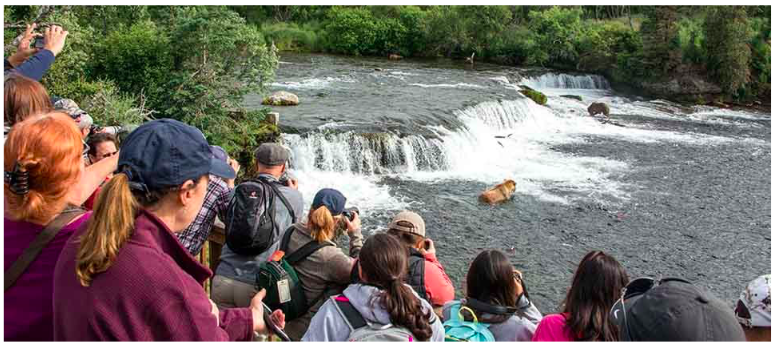
The federal agency that manages Katmai National Park and Preserve says that motorboat use upriver of a new bridge the Park Service has constructed would disturb brown bears who concentrate at Brooks Falls to feed on salmon.
The motorboats would interfere with the visitor experience at Katmai, the Park Service says. And motorboats would endanger “cultural resources along the river by exposing them to erosive boat wakes.”
At first blush, it seems reasonable to keep visitors from traveling to Brooks Falls by skiff because tourists fly into the area to view bears, not skiffs.
But the Supreme Court ruled a month ago that the Park Service has no jurisdiction over navigable waters inside national preserves, and that ruling changes everything. If a motorboat can navigate the water, then it’s state water.

In the Sturgeon vs. Frost, National Park Service case, Alaska hunter John Sturgeon was taking his boat up the Nation River in the Yukon-Charley National Preserve when Park Service officers ordered him out. That case went to the Supreme Court, which agreed that the navigable rivers in Alaska are under the jurisdiction of the State of Alaska. The decision was unanimous: Alaska’s navigable waters are different because of the Alaska National Interest Lands Conservation Act, or ANILCA.
Evidently the Park Service hasn’t gotten the Supreme Court memo.
The area in question less than a month after the Supreme Court decision is a popular tourist destination and is part of a chain of lakes and waterways upstream from Naknek.
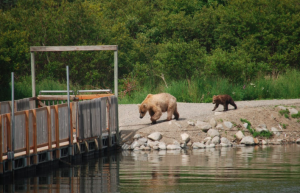
In many parts in that region, bears feed in the rivers and streams, and they are unperturbed by boats that come and go. They don’t run, they don’t even pay attention to boats. They are busy, oblivious fisher bears.
In this particular river, no boats are ever present. But with the new bridge, which replaces an old floating bridge, it raises the possibility that people may someday choose to bring in a hovercraft or outboard.
“Katmai’s landscape contains vast multi–lake watersheds with hundreds of miles of wild, untamed rivers and streams. It’s an outdoor laboratory for studying the effects of volcanism, climate change, and other large-scale landscape processes. This is also place with a 9,000 year record of human adaptation to environmental and ecological change,” the Park Service has posted on the website dedicated to this park. Things to do, the Park Service says, include bear watching, sport fishing, boating, backcountry hiking and camping in an area that is largely wilderness, with less than six miles of designated and maintained hiking trails.
So why the pre-emptive closure of a half-mile of river by the National Park Service? It could be the camel’s nose under the tent, a case of attempting to re-establish some of the jurisdiction the Park Service just lost in the Supreme Court. A precedent-setter, if you will.
A public meeting is scheduled for Wednesday, April 24, 2019 at 6 pm at the National Park Service headquarters in King Salmon to discuss taking away Alaskans’ rights to use the river upstream of the new bridge from June 1 through Oct. 1.