
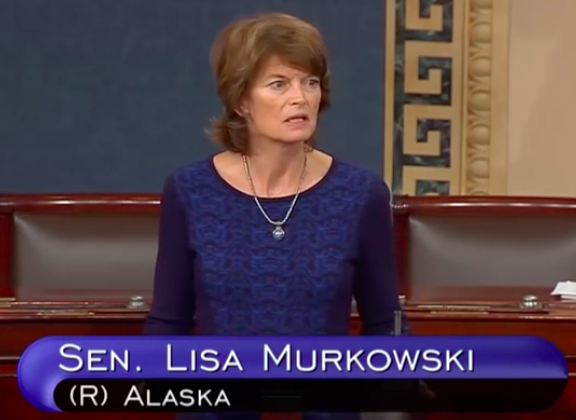
Sen. Lisa Murkowski of Alaska and 11 other Senate Republicans have committed to voting for a same-sex marriage bill in the Senate, guaranteeing its passage this week or next. Sen. Dan Sullivan was among those voting in favor of the bill. Both Murkowski and Sullivan are Catholics; the Catholic Church explicitly denies its blessing for marriages between two people of the same sex.
Sens. Mitt Romney of Utah and Roy Blunt of Missouri also said they would vote for the bill that moved forward 62-37, with 12 Republicans joining all the Democrats in the Senate. The bill only needed 10 Republicans to move.
The Respect for Marriage Act, with lead sponsors Sen. Tammy Baldwin, D-Wisc., and Sen. Susan Collins, R-Maine, went through negotiations that purport to protect religious liberties, and a final vote is expected on the Senate floor on the amended version.
“We can ease the fear that millions of same-sex and interracial couples have that their freedoms and their rights could be stripped away,” Baldwin said, equating same-sex marriage with interracial marriage. “We are guaranteeing same-sex and and interracial couples, regardless of where they live, that their marriage is legal.”
The bill was introduced and passed the House in lightning speed in July on a vote of 267 to 157, with 47 Republicans and all Democrats supporting it. There was no vote from Alaska, as the state’s congressman, Don Young, had died and the state was without representation. Based on past history, Young would have likely voted against then bill; Congresswoman Mary Peltola, who has since taken the spot, would likely have voted for it. There were no public hearings on the bill.
The passage of the Respect for Marriage Act concerns those for whom adoption and fostering of children is a stumbling block. It also affords weak-to-no protections for faith-based non-profits, religious schools, religious business owners, and civil servants.
“The so-called Respect for Marriage Act is a misnamed bill designed to enshrine same-sex marriage in federal law,” wrote Greg Baylor, chief legal counsel at Alliance Defending Freedom.
“As soon as the U.S. Supreme Court overturned Roe v. Wade in June, activists went to work mischaracterizing the ruling. Many used the decision—and particularly Justice Clarence Thomas’s concurrence—to claim that the Court could revisit other rulings, including the one in Obergefell v. Hodges, which created a constitutional ‘right’ to same-sex marriage. Using this feigned outrage as a cover, these activists pushed for a federal law called the Respect for Marriage Act,” wrote the attorney.
“Let’s be clear: the Respect for Marriage Act is unnecessary and could have a disastrous effect on religious freedom,” Baylor said.
Read more about Alliance Defending Freedom’s position here.
Sen. Dan Sullivan’s office issued a statement:
“This vote was unnecessary. The Supreme Court has already ruled on this issue—under Obergefell v. Hodges same-sex marriage is already the law of the land in each state—and our time and energies should be focused on addressing the very real and immediate concerns of the vast majority of Americans, including runaway inflation and looming energy shortages,” he said.
“However, given that the Majority Leader insisted on bringing this vote to the floor, I listened to Alaskans and used the opportunity to work relentlessly to include in the bill considerable advances in much stronger religious liberty protections for millions of Americans that previously were not in federal law and were not in the Obergefell decision,” Sullivan said.
The protections include:
• Directing courts that nothing in the bill diminishes current statutory religious liberties or conscience protections, including the important protections in the Religious Freedom Restoration Act.
• Protecting the rights of a broad array of religious organizations, including educational institutions, and their employees from being required to host, accommodate, or in any way participate in same-sex wedding ceremonies;
• Protecting these same religious organizations from being sued for not participating in same-sex wedding ceremonies; and
• Preventing the federal government from discriminating or retaliating against religious organizations that hold a traditional view of marriage by taking away any benefit, right, or status—including tax-exempt status, grants, loans, or educational accreditation, among others.
“While I’ve long held that marriage should be an issue left up to the states, the Supreme Court nationalized the issue in Obergefell. I said then that I would respect the Court’s decision, but would also continue to fight for and respect and defend the religious liberty of all Americans. This bill makes important advances in doing that. Finally, in the very unlikely event that Obergefell is overturned in the future, this bill would still respect state laws, like Alaska’s constitutional provision on traditional marriage, and it would only require states to provide full faith and credit recognition to all lawful marriages from other states,” Sullivan said.
The bill does not protect people like Colorado cake baker Jack Phillips, who has been sued repeatedly for conscientiously refusing to decorate a cake for a same-sex wedding celebration.
The Respect for Marriage Act is also opposed by the Religious Freedom Institute, which issued a statement that the bill would, “deal a devastating blow to religious freedom in America, even if it included proposed amendments [which the current bill now does] that purport to protect religious freedom, but in fact do not. It represents a dangerous authoritarian turn by Congress and the administration that would extend the power of government well beyond its constitutional role and harm the fundamental freedoms of all Americans.”
The Institute said that the bill attempts to dismantle and remake an institution that existed long before the state, that is, marriage and the family produced by marriage. Even in its amended form, it does not protect religious liberty of dissenters.”
The premise of the Respect for Marriage Act, is that any “opposition to same-sex ‘marriage’ is akin to racism. That claim is not only false but profoundly disingenuous. The vast majority of Americans, including those who are religious, do not oppose interracial marriage. There is no real or perceived threat to marriage based on race in any state in America.”
The Respect for Marriage Act would repeal the Defense of Marriage Act, signed into law by President Bill Clinton in 1996. DOMA, as that law is known, affirmed, for federal purposes, that marriage is the union of one man and one woman, and allowed states to refuse to recognize “same-sex marriages” granted under the laws of other states, the institute said. The Supreme Court overturned it in 2013 in United States v. Windsor. Later, in Obergefell v. Hodges, the Supreme Court required all states to license and recognize same-sex marriage.
Rep. Chip Roy (R-Texas) sent a letter to his Republican senators on Wednesday, urging a no vote. He wrote:
“Dear Senate Republican Colleagues,
Under the guise of compromise, and the cultural winds of today, you are slated to soon vote on the so-called “Respect for Marriage Act.” Supporting this bill would be a mistake, as passing this bill would codify, in federal law, a false belief on marriage and villainize millions of Americans for their religious beliefs. This, all because Democrats felt political pressure mounting, and Justice Clarence Thomas lives rent free in their heads.
The Baldwin-Collins-Tillis Amendment will threaten the charity status of faith-based adoption and foster-care agencies — while painting a target on them for future frivolous litigation — and fan the flames of attacks on religious liberty. As drafted, this amendment does not provide sufficient protections for faith-based non-profits, religious schools, religious business owners, and civil servants or close the polygamy loophole.
In July, the House Freedom Caucus took an official position urging you, our Senate colleagues, to oppose this unnecessary and harmful legislation.1 Not only should this bill be opposed on its merits, but Speaker Pelosi rushed this legislation through the House without hearings, markups, and the proper time to review before Members were asked to vote on the floor. Indeed, this bill passed the Democrat led House of Representatives with 157 “Nay” votes and should not become law.
The law cannot be neutral on marriage. It can either affirm truth or portray distortions. The foundational truth will always remain, and no act of Congress can change that. Those who see and know the truth have a moral duty to stand firm in its defense and to defend the crucial institution of marriage.
Doing so against the grain of cultural and political forces to cower and compromise takes courage; the question is how many Republicans will display it this week.“
Many Republicans believe it is unnecessary to vote on something already decided in favor of same-sex marriage by the U.S. Supreme Court.


