The news about BP exiting Alaska came as no surprise to industry participants in the state; it had been rumored for months, with increasing buzz in recent weeks after Petroleum News advanced the news. But there was still a lot of folks on pins and needles, waiting for the big reveal.
[Read: BP sale rumors surface again, with credibility]
Having one of the world’s largest oil companies decide to leave Alaska is breathtaking. The company has openly said it was going to divest some $10 billion in business; Alaska was first to go.
That’s right, Alaska was the first to go.
If, as Sen. Bill Wielechowski and his oil tax hike initiative effort would have us believe, companies are making money hand over fist in Alaska, why would BP abandon the state?
It’s the business model, in part, according to Must Read Alaska’s knowledge experts. BP is a behemoth company that doesn’t do aging oil fields. Hilcorp does.

But Alaska has other issues: A high cost of doing business and an ever-changing tax structure from a government that just can’t decide when enough is enough in taxes. The large companies like BP need to plan 10 years out, and Alaska’s oil tax structure is so unstable they are not able to make those plans with any degree of confidence.
Lawmakers like Wielechowski insist taxes have nothing to do with it, but that Alaska just isn’t a good fit for BP anymore. He’s half right.
As a side note, the cost to the State treasury could be in the tens of millions, because unlike BP, which is a C Corporation, Hilcorp Alaska is a limited liability corporation, which does not pay a corporate income tax. Increased production could make up for the loss in corporate income tax, unless tax conditions change again, as Wielechowski would have them.
HILCORP ALASKA
Hilcorp is the kind of company that likes to drain every drop out of an aging oil field. Recently, BP conducted 3D seismic imagery of Prudhoe, getting fidelity that’s never been seen before. Hilcorp is the kind of company that will drill those pools and sidetracks and create a lot of economic activity on the Slope. Many oil industry people say this transaction is a very good thing for the Alaska economy.
Since arriving in Alaska in 2012, Hilcorp has pretty much taken over Cook Inlet gas, to the worry of some who wonder it the company will gouge the Kenai and Southcentral for the gas that runs homes and businesses.
Then Hilcorp acquired some of BP’s fields on the North Slope in 2014, shed a couple of hundred jobs, and, with five years of experience is now the dog that caught the truck. How it will adapt to the increase pressure of being one of Alaska’s “majors” is going to be part of its unfolding story.
Hilcorp Alaska paying $5.6 billion for BP’s assets in Alaska makes it one of the big players now.
NONPROFITS AND PRIVATE SECTOR WORRIES
Already, the nonprofit cartel has sent up the alarm that without BP’s philanthropic largesse, a gaping hole exists for nonprofits and Hilcorp isn’t like BP in the giving arena. BP has given to the nonprofits by the millions — $4 million last year alone.
That, too, was forecast by the leaders in the nonprofit world many years ago. In 2015, the former executive director of the Foraker Group warned that the nonprofit sector was still too reliant on the Rasmuson Foundation and major corporations.
“Appreciate the money that you’re getting from any industry, but understand that industry giving is market driven,” Dennis McMillian cautioned at the time. In Alaska, corporate philanthropy is three times the national average, while foundation funding is twice the national average.
The number of nonprofit organizations operating in Alaska has grown from 6,000 in 2007 to 7,904 in June of 2019. It’s an expanding industry that has grown 31 percent in 12 years in Alaska.
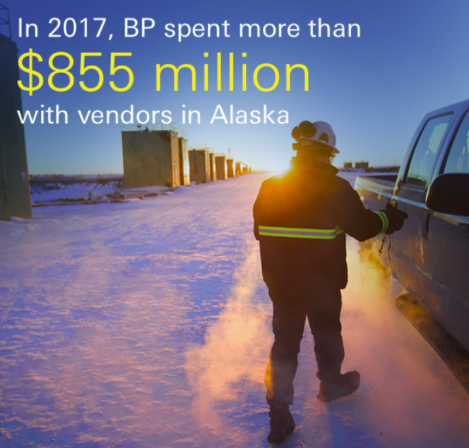
Between 2013-2018, BP has given $26 million to those nonprofits, while in 2017, it spent $855 million on Alaska vendors.
But while nonprofits have gained much from BP’s investment in them, few of them were there for the oil companies during the battle over Senate Bill 21, when tax advocates tried to jack up the taxes on production. In general, the nonprofits have been grateful recipients of the corporate funds, but not exactly besties with the oil sector.