
Following the Division of Elections’ review of the thousands of signatures submitted by Repeal Now, Lieutenant Governor Nancy Dahlstrom officially approved the petition to repeal ranked-choice voting (RCV) today, December 31. Alaskans will get to vote in the 2026 election to either keep or repeal RCV.
The Division of Elections verified 42,837 signatures (exceeding the required minimum of 34,098 signatures) and verified that the petition contained signatures from all 40 house districts.
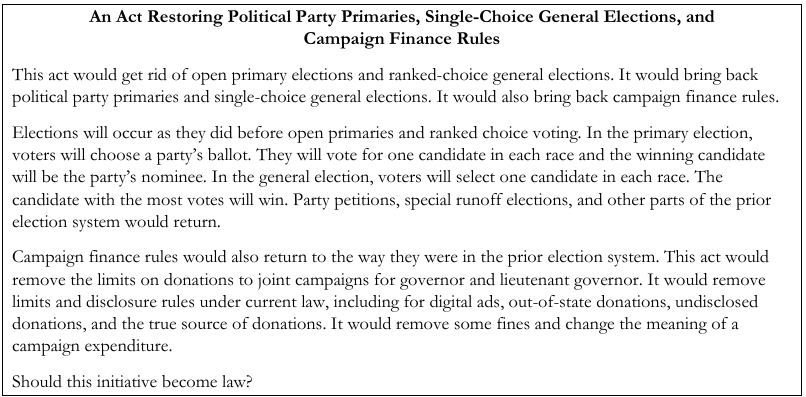
The proposition will appear on the 2026 general election ballot as follows:
More About RCV and the Repeal Now Effort
Alaska is only one of two states that operates rank-choice voting for state-wide elections. Maine was the first to implement the new voting mechanism in 2018. Alaska followed suit in 2020. 12 additional states plus the District of Columbia have authorized the use of RCV for specific types of elections, but not for statewide elections.
Repeal Now volunteer Wyatt Young Nelson writes in an earlier column published by Must Read Alaska: “An example of what damage rank choice voting can do is the city of Minneapolis… The election required 33 rounds of vote counting and redistribution, which took weeks before a winner—Betsy Hodges—was declared. Even then, she was elected without receiving a majority of the vote. … Ballots were discarded due to errors, and others were “exhausted”—meaning votes were thrown out after several rounds because no remaining candidates were ranked. Voters found themselves forced to rank people they didn’t know, support, or agree with politically. Since then, Minneapolis has consistently had some of the lowest voter turnout rates in its municipal elections.” Nelson argues, “We’ve seen similar problems here in Alaska since adopting RCV.”
Voter turnout is a huge problem in Alaska with the highest voter turnout in the 2025 local elections only 45% of eligible voters (with many local elections seeing even lower voter turnout). Only 44.38% of Alaskan voters spoke up in the 2022 statewide election, and a slight majority (55.8%) of all registered Alaskan voters voiced their will in the 2024 national election. The unintended consequence of the majority’s refusal to vote is a democratic sanctioning of rule by the minority.
Governor Dunleavy has also published his opinion on RCV. He writes: “I won under the traditional voting method in 2018 and again under ranked-choice voting in 2022. So, my position on this issue is not about political gain or loss. It is about trust, clarity, and confidence in our electoral process. Ranked-choice voting was pitched as a reform to solve a problem that, frankly, didn’t exist in Alaska. We were told it would reduce partisanship, promote consensus candidates, and make elections more fair. In reality, what we got was a system that confused voters, made outcomes less transparent, and created deep concerns about how votes are tabulated and who ultimately decides an election.”
Alaskans attempted to repeal RCV in 2024 but lost by only 664 votes out of 340,110 total votes. On November 3, 2026, Alaskans get a chance to either reaffirm support for RCV or take down what many Alaskans consider a convoluted election sham.


