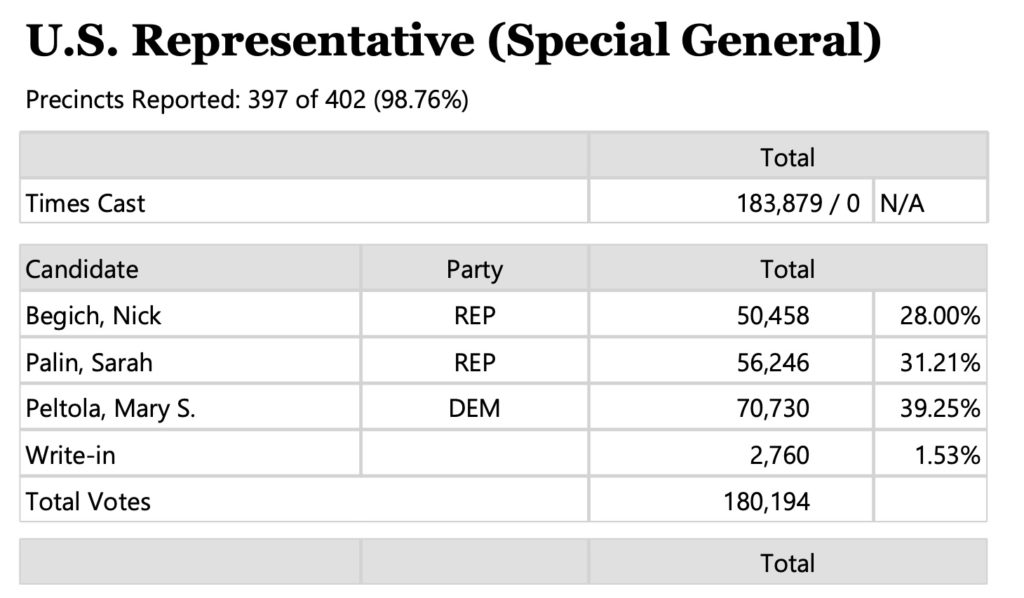
Another tranche of special general election ballots has been counted, raising temporary congressional candidate Mary Peltola to 70,730 total votes, or 39.25%. This puts her 8 points ahead of Sarah Palin, who has 56,246 votes, or 31.21%.
Peltola, a generic Democrat with a D rating from the NRA, came out of nowhere in this race, rocketing from 10% of the vote in June’s special primary to 39.25% on Aug. 16. And she, the Bethel Yup’ik grandmother with few campaign dollars, is beating the most famous person in Alaska history, who appears to be capped at 31% of the vote. While voters have had an opportunity to mark a ballot for Palin three times this year, she has not been able to move the needle more than four points from the June 11 special primary, when she garnered 27% of the vote.
Nick Begich, who was at 19% for the special primary, has moved the needle to 28%, shrinking the difference between him and Palin from 8% down to 3%. But he remains in third place, where he will be the first to be eliminated in ranked choice counting on Aug. 31.
To win outright with the ballots counted so far, a candidate would have to have 90,098 votes. That ballot universe will shrink when any voter who only picked Begich, and chose no other candidate for second place, sees his ballot exhausted.
For Palin to win at this point in the ranked choice scenario, she would have to close the 8% gap between herself and Peltola, and then get another 11% for a total of more than 19% increase from where she sits now to reach the 50+1 goal.
Palin needs roughly 28,124 more votes to win. Those votes would likely come mostly from Begich voters who marked her second. Based on polling, however, 70% of Begich voters have a negative opinion of Palin.
Peltola, however, needs as few as 19,368 of those second Begich votes to win if every ballot counted so far stays in play (this is unlikely, since the ballot universe shrinks when a ballot has no second choice).
Polls show that between 20-30% of the voters in the special general bullet voted, which means they only voted for one candidate. That indicates the number of Begich ballots that will be exhausted will be 20-30%.
This rough (and dynamic) calculation is based on the current 180,194 people voting; a few more ballots will dribble in over the next few days, but it appears that the ratios are not changing much at this point.
Turnout has been heavy for this election, second only to the 2014 primary, when there were 193,400 votes — a 38% turnout. This year has the second-highest turnout in recent memory, even though it’s only at 30.7% due to the fact that so many people have been automatically registered to vote through the Permanent Fund dividend application automatic registration process, which drives up the voter numbers and drives down the percentage of actual interested voters.
Five precincts are still missing; they are in the rural districts and there’s no word as to where those votes are and whether there is a chain of custody established for them.
The final vote count is on Aug. 31, when all the ballots must have been received by Division of Elections. Then, the Division will eliminate Begich from the calculation and take all the second votes from those ballots and distribute them to what voters had indicated: Palin, Peltola, or nobody. The winning candidate is the one who reaches 50+1 of the ballots that have a second choice.
The Division of Elections will announce more ballot counts on Friday in the afternoon.