
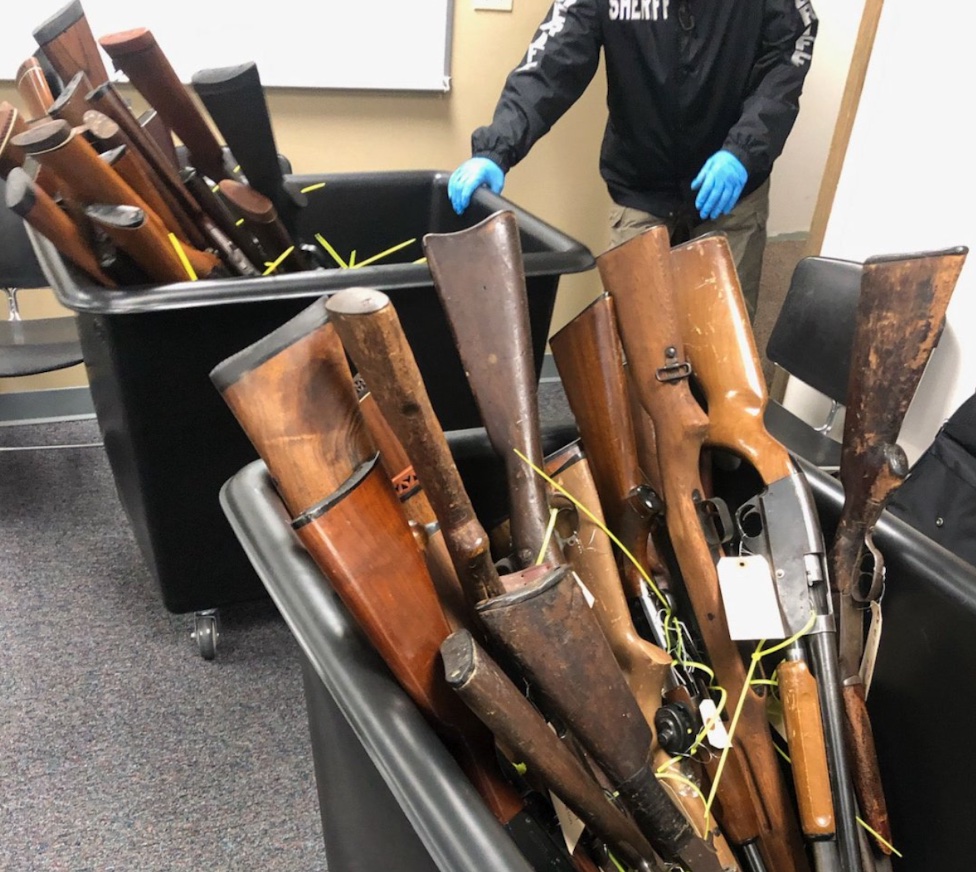
The King County Sheriff’s Office accepted 287 firearms and about 10,000 rounds of ammunition on Saturday, and gave out $36,000 in gift cards to residents turning in these items during the county’s gun buyback event held in Burien.
The event had a budget of $100,000, including up to $40,000 in gift cards.
All of the firearms will be destroyed, including the seven antique guns turned in, the King County Sheriff’s Office said. A number of the long-barrel firearms appeared to be old, with wooden stocks that showed a lot of wear and tear. They may have been inherited hunting rifles and shotguns but didn’t appear to have been maintained by their owners.
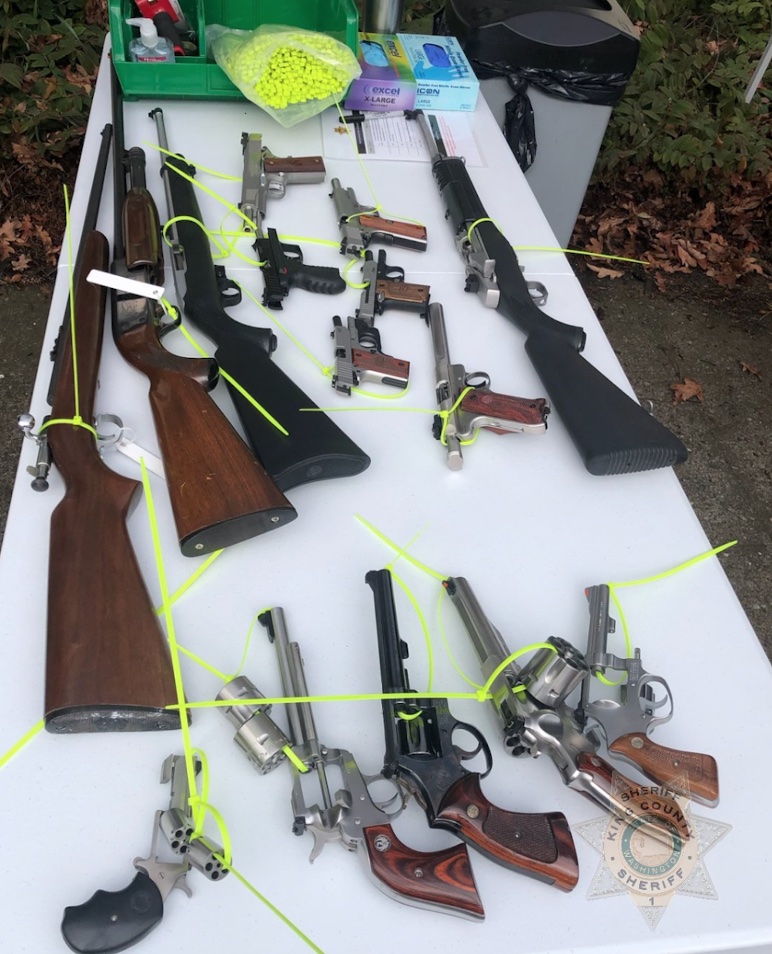
The firearms turned in were:
- 11 AR-15/AK-47
- 68 Pistols
- 46 Revolvers
- 70 Shotguns
- 75 Rifles (excluding AR-15)
- 8 Muzzle loading
- 7 Antiques
- 2 Other
The guns will be destroyed at a facility in Spokane, the sheriff’s office said.
Federal Way, a city within King County, had a gun buyback day in February. Police accepted hundreds of guns and gave out $25,000 in gift cards, but ran out of them a half hour before the end of the event.

The city of Seattle and King County both held gun buyback programs years ago. In 2013, 716 firearms were turned in to King County. Seattle Police took in 1,172 firearms in 1992.
The aim of the program is to reduce gun violence. According to the Seattle Times Seattle reported a 19% increase in verified criminal shootings and shots-fired citywide compared to 2021. In 2022, Seattle had 39 fatal shootings, 157 nonfatal shootings, and 543 verified shots-fired reports, compared to 32 fatal shootings, 142 nonfatal shootings, and 446 shots fired reports in 2021. These figures do not include suicides, confirmed self-inflicted shootings, or officer involved shootings. Seattle’s population is 733,919, according to the 2020 Census.
In King County there were 83 fatal shootings, 357 nonfatal shootings, and 1,654 verified shots-fired reports in 2022. King County has a population of 2.269 million.
While the programs take resources from taxpayers that could be used to put more officers on the street, there’s little evidence that they work to reduce gun violence is debatable.
“It’s a waste of resources if the entities that are sponsoring believe that it’s going to have a positive effect on reducing crime,” said Keith Taylor, an adjunct professor at John Jay College of Criminal Justice, which is part of the City University of New York system. “But if the purpose is to provide a means for individuals to get rid of weapons from their households that they don’t want to have anymore, it absolutely is a good option.” He was interviewed by the Pew Charitable Trust on the matter of the efficacy of gun buy-backs reducing crime.
“Taylor, a former assistant commissioner at the New York Police Department, said if people wanted to get rid of unwanted guns, they don’t have to wait for a buyback event; most police departments will allow people to turn in firearms without a reward. But that doesn’t appeal to people who may use their firearms for crimes and a means of earning a living, he said,” the nonprofit reported.
A paper published in the National Bureau of Economic Research said the effect of buybacks on crime is so little it’s not even measurable.
“Gun buyback programs (GBPs), which use public funds to purchase civilians’ privately-owned firearms, aim to reduce gun violence. However, next to nothing is known about their effects on firearm-related crime or deaths. Using data from the National Incident Based Reporting System, we find no evidence that GBPs reduce gun crime. Given our estimated null findings, with 95 percent confidence, we can rule out decreases in firearm-related crime of greater than 1.1 percent during the year following a buyback. Using data from the National Vital Statistics System, we also find no evidence that GBPs reduce suicides or homicides where a firearm was involved. These results call into question the efficacy of city gun buyback programs in their current form,” the researchers found. That study can be seen at this link.


