
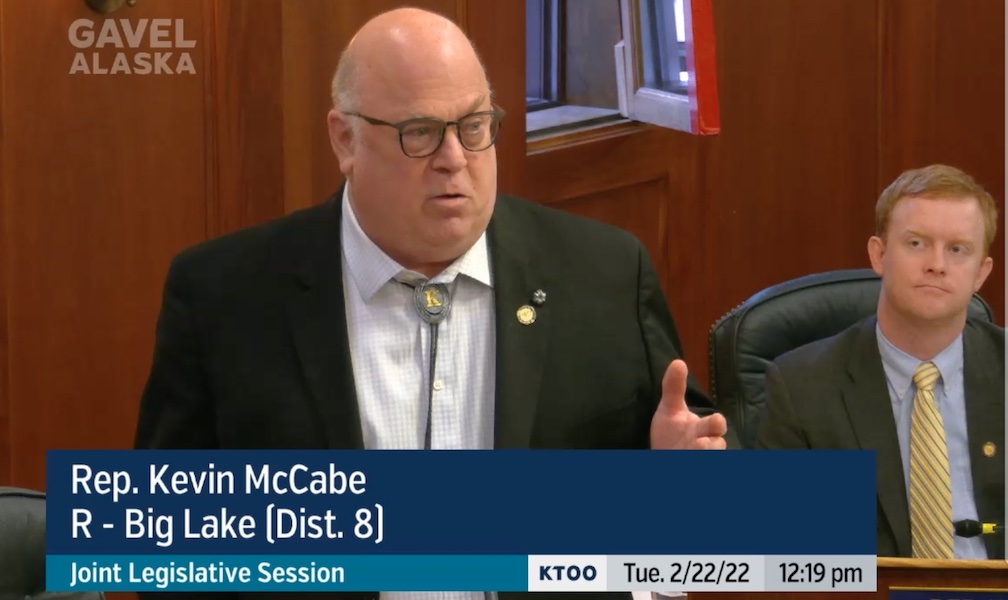
By REP. KEVIN MCCABE
Primum non nocere, originally a medical maxim, translates to “first, do no harm.” This principle of ethics is the medical establishment’s guiding belief in virtually every country and is the hallmark for ethical medical practice, requiring healthcare providers to weigh risks and benefits carefully.
Whether prescribing medications, performing procedures, or making treatment decisions, the imperative to avoid harm guides every step. In the legislature the same ethical decision making must apply.
If we do apply the same principle to the Alaska State Legislature, it highlights our duty to preserve and protect the well-being of all Alaskans. As we navigate complex budgetary landscapes, this well-known maxim should shape our responsible care for the future of Alaska.
While it is essential to weigh the future risks our current budget decisions create, we must not forget the programmed funding increases that already plague our budget. This includes the $7 plus billion-dollar pension liability (from the previous defined benefits program) that remains unfunded, and the current education foundation formula spend.

Healthcare professionals are also cautioned to consider the potential harm any intervention from them might cause. When faced with a choice, it may be better to refrain from action if the risk of harm outweighs an uncertain benefit. This same principle must underly every decision, bill, and monetary choice the legislature makes. We must consider what any legislative decisions will cost Alaska in the next decade or century.
Just as physicians prioritize patient safety, legislators must prioritize the wellbeing and future welfare of their citizens when crafting legislation. Much like doctors tailor treatments to individual patients’ needs, legislators create laws and policies, through debate and deliberation, that directly impact Alaskans current welfare as well as the future health of Alaska itself.
Likewise, do no harm thinking should inform the various groups that are advocating for huge, programmed spending increases. With our current dependency on oil revenues, where is the money going to come from now, as well as in the future?
How is this spending going to affect our children and our grandchildren? Is there a quantifiable and measurable return on investment? Or just an uncertain benefit with a murky fiscal note? And if the benefit is uncertain, would we be better to refrain from passing a bill or spending the money?
Two bills currently in play that highlight what should be our process are SB 140 (the so called “BAG” bill which contains the possibility of a significant BSA increase); and SB 88, the Defined Benefits bill.
SB 140 currently has an increase of $300 in the Base Student Allocation. This is not education funding as everyone seems to want to call it. It is school district funding. It goes to fund the business end of the school districts and will not necessarily filter quickly to the classroom in any great quantities.
In some districts, such as the MatSu borough school district, increased funding does translate into current increased outcomes for our children. But does such an increase also create possible future harm to Alaska? At a price point of $27 Million for every $100 dollar increase to the BSA, a $300 increase will add $81 million dollars to every single budget going forward – a programmed increase to an already huge $2.7 Billion dollar education budget.
Can future Alaska — our children and grandchildren — afford that? The return on investment might be obvious. But in our current budget crisis, what other program, that might contribute to the health and wellbeing of Alaska gets cut to afford this increase now, and how do we afford it in the future? What will future legislatures be unable to pay for because we have increased the BSA to this level.
Likewise, SB 88 has a very cloudy outlook, with possible huge financial implications for future Alaskans. With the current generation workforce attitudes against working for a single agency or company for their entire lifetime, the benefits SB 88 are intended to provide seem unlikely. In short, it has no decent return on investment for Alaska. The potential damage to Alaska, however, could be huge. It is a risk we should not take.
As with any legislative action, whether bills or budgets, honest open dialogue is important from all sides. The sales pitches and social media memes, particularly from the groups pushing for a huge BSA increase and defined benefits, have been anything but truthful.
Their emotional rhetoric is designed to trigger and activate certain segments of Alaskans without really providing any factual data. It is also specifically designed to pit Alaskans against their elected representatives, without any dialogue or discussion, by ascribing untrue motives and actions to a legislature that, by and large, is trying to do no harm.
Rep. Kevin McCabe represents District 30 Big Lake (formerly known as District 8), and is a 747 captain.



