
A pair of vaccine mandates for truckers in and out of Canada and the U.S. may worsen the supply chain problems in Alaska.
While much of Alaska’s consumer goods come to the state via barges and shipping containers at the Port of Alaska, there are still goods being trucked up the Alaska Highway, entering the state at the Tok border crossing. There is no one organization that knows just what is coming through near Tok, Alaska and how the lack of drivers will impact Alaska families and businesses.
The Biden Administration’s vaccine mandate for cross-border truckers went into effect on Saturday. Canada enacted new trucker vaccine Covid regulations that went into effect on Jan. 15.
The vaccine mandates represent a stare-down between President Joe Biden and Prime Minister Justin Trudeau. Canada’s mandate was in reaction to the U.S. mandate, which was announced first, but went into effect a few days after Canada’s.
In protest, some truckers have created blockades at U.S.-Canada border crossings, making already long waits into bottlenecks for everyone trying to traverse the border. Right now, a trucker convoy is crossing Canada toward the capital of Ottawa to stage a major protest.
According to the Department of Homeland Security, non-U.S. citizens seeking to enter the United States via land ports of entry at the U.S.-Mexico and U.S.-Canada borders must be fully vaccinated for Covid-19 and provide proof of vaccination. No booster is required by the DHS.
The rules from the Biden Administration apply to all non-citizens, even those traveling in essential capacities, which includes truckers moving critical medical goods to combat the pandemic.
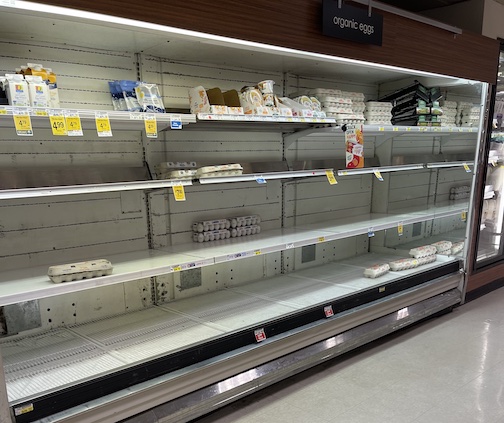
Trucking and logistics groups have said this new set of rules will negatively impact supply chains already in crisis, according to Heavy Duty Trucking, a trade group.
What comes to Alaska via highway in the winter? A lot of construction equipment, including oil and gas machinery, comes up the highway, as well as all the household goods that belong to military families being reassigned to Alaska, and other household moves. Anything too big to move in a Conex or cargo container comes up the highway.
It’s estimated that 40 percent of the U.S. trucking workforce is now unable to traverse the U.S.-Canada border. The same holds true for the U.S.-Mexico border, where produce, medicine, and manufactured goods are sourced for much of the U.S.
U.S. auto part imports from Canada were $14 billion last year, while its auto part imports from Mexico were $51.6 billion, according to the Auto Care Association, as reported by NBC News.
The American Trucking Association joined the lawsuit against the Biden Administration over the vaccine mandates and issued a statement after the U.S. Supreme Court put a stay on the Biden vaccine-or-test mandate:
“Today, ATA has won a tremendous victory on behalf of the trucking industry and workers and employers everywhere. Today’s ruling by the Supreme Court validates our claim that OSHA far overstepped its authority in issuing an emergency temporary standard that would interfere with individuals’ private health care decisions,” ATA said in its statement.
“Trucking has been on the front lines throughout the pandemic – delivering PPE, medical supplies, food, clothing, fuel, and even the vaccines themselves. Thanks to this ruling, our industry will continue to deliver critical goods, as our nation recovers from the pandemic and we move our economy forward,” the organization said on Jan. 13.
But the lawsuit didn’t touch the Department of Homeland Security’s cross-border vaccine mandate.
Last week on Fox News, American Trucking Associations President and CEO Chris Spear said that the trucking industry is “on the edge of a cliff.:
“I think a year of policies that have led us there generally stem from rewarding people not to return to work,” he said. Spears added the trucking field is still short 81,000 drivers.
As for the trucker protests, the Canadian Trucking Alliance said it disapproves of them.
“The Canadian Trucking Alliance (CTA) does not support and strongly disapproves of any protests on public roadways, highways, and bridges. CTA believes such actions – especially those that interfere with public safety – are not how disagreements with government policies should be expressed. Members of the trucking industry who want to publicly express displeasure over government policies can choose to hold an organized, lawful event on Parliament Hill or contact their local MP. What is not acceptable is disrupting the motoring public on highways and commerce at the border,” the organization said in a statement on Saturday.