
The retired Alaska Superior Court judge was no doubt ready for the barrage of heavy fire he took in the combined House Fisheries/Natural Resources Committee meeting on Monday night.
Karl Johnstone knew coming into his interview that the commercial fishing interests were loaded for bear in opposition of his nomination to the Fisheries Board, a volunteer position. And the committee was stacked with opponents of Gov. Michael Dunleavy who had had targeted him.
And yet Johnstone was courteous, open, and answered the committee’s accusatory questions fully, without rancor.
If they were hoping to wear him down by “Kavanaughing” him, it didn’t work.

Rep. Louise Stutes chaired the meeting. She had already, in written communications to her commercial fishing friends, declared all-out war on Johnstone’s nomination, saying she would do everything in her power to prevent him from being confirmed.
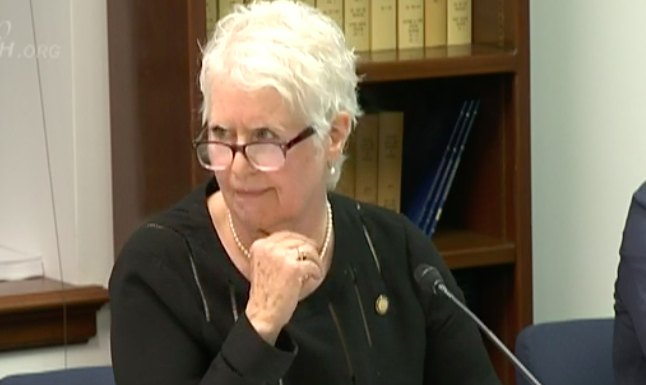
Stutes went so far as to read an anonymous letter into the record, opposing Johnstone. No one on the joint committee objected to her doing so, and she ruled the committee with an iron hand. She made exaggerated expressions during the meeting that Johnstone could not see, but which expressed disapproval or disbelief.
As a committee aide provided material to the attack team on the committee, they asked Johnstone questions they were given to ask. Some of the questions ended up embarrassing the committee members who asked them.
Rep. Sara Hannan wanted to know if Johnstone is a snowbird and how many days he spends in the state. Enough to qualify for a Permanent Fund dividend, Johnstone said. Hannan was trying to imply that having a second home out of state or traveling widely as a retiree should be a disqualifier.
Hannan asked if he took cost of living allowances in his retirement, and she expressed surprise to learn that COLA doesn’t apply to the retirement pensions of retired judges. Stutes’ staff had set her up to look unprepared.
Hannan wanted to know why in 2009 he stayed at the Captain Cook Hotel during the Fish Board meetings. He answered he stayed there because he was advised to stay there by Fish and Game. He was told it would be best if he was on site early and stayed late into the evening to interact with attendees.
[Read: State says per diem was proper]
Hannan wanted to know how much he had donated to the Dunleavy campaign. Johnstone had been an early supporter of the campaign of Charlie Huggins before Huggins dropped from the race, and then Johnstone supported Dunleavy. But he said none of that. To the committee he only said yes, he supported Dunleavy and donated to the political action committee that supported the candidacy of the governor who has since appointed him, and it was $1,000.
Hannan expressed to the committee that she felt that was a problem.
[Read: Top contributors to the Sara Hannan campaign.]
Rep. Geran Tarr implied, delicately, that Johnstone is too old to serve on the Board, and should spend more time “transitioning” and visiting his family. Tarr pondered aloud that he may have too much experience, since he has, in the past, served three terms on the Board of Fisheries. She said maybe it’s time for someone else to serve.
Tarr, who is often heard championing food security with Alaskans, then took up the cause of out-of-state commercial permit holders, rather than those rod-and-reel and dip netters from her own lower-income East Anchorage neighborhoods, who are trying to supplement their food budgets with fish from the rivers.
She said she was troubled that he seemed more concerned with personal use fishing than commercial fishing and that he was not acknowledging climate change as a factor in the changing fishing conditions in Alaska.
Rep. Ivy Spohnholz wanted to know why, when Gov. Bill Walker nominated Roland Maw to the Fish Board in 2015, the board refused to interview him. She said she felt it was not very transparent.
[Read: New indictment on Roland Maw]
Spohnolz didn’t seem to know that Maw had subsequently been indicted on felony charges related to Alaska Permanent Fund dividend fraud and theft, including six felony counts of first-degree unsworn falsification and six felony counts of second-degree theft.
Johnstone politely didn’t bring that up, but said the entire board of seven had decided not to interview Maw, and they didn’t feel that giving a reason was productive.
[Read: Why the Board of Fish never interviewed Roland Maw]
Rep. Chris Tuck wanted to know Johnstone broke hiring rules when hiring a coroner 25 years ago. Johnstone said he was wrong to have done so, and he had been rightfully admonished for not following established procedures.
Rep. Stutes then wanted to know how many times Johnstone had attended the Kenai River Classics, a fundraiser started by Sen. Ted Stevens to support fisheries conservation. Johnstone said hadn’t been for six or seven years.
“Did you in the past?” she continued.
Yes, Johnstone said, but he only attended the dinner, which he paid for himself. He didn’t attend the fishing portion of the event.
Stutes wouldn’t let up: “Did you pay for all your expenses?”
Yes, Johnstone said, he drove to Kenai and back at his own expense.
The accusations kept coming like a firing squad. Stutes and her sisterhood on the committee were going to take him down.
Johnstone is, for United Fishermen of Alaska, their number one target. Both Israel Peyton and Marit Carlson Van Dort breezed through their confirmation interviews with barely a concern from the committee earlier in the evening.
The governor’s nominee for the Fisheries Board then was the subject of hours of testimony from the public. The sports fishing community praised him, while the commercial fishing community damned him. Chairwoman Stutes quickly cut off the testimony of his supporters, while allowing those who oppose him to go on for another 15 seconds past the 90-second limit she had set at the beginning.
At the end of the list of commenters came Roland Maw, but he told the committee that perhaps he’d just not have anything to say at this time.
Chairwoman Stutes then read a four-minute scripted statement about why she opposes Johnstone, reiterating many of the points provided by the United Fishermen of Alaska. She represents commercial fishing interests in Kodiak and Cordova.
The inquisition ended after four hours. Supporters of Johnstone complained that while they got their letters submitted in time, they were not added to the committee packet. But then again, it was never intended to be a fair meeting.
Johnstone’s nomination to the Fish Board will be considered by a joint session of the House and Senate on Wednesday. It’s considered to be close.
Have an opinion on the matter? The Kenai River Sports Fishing Association has a handy tool for sending your thoughts on Johnstone or the other nominees to all Alaska legislators. Try it here.


